
Keeping a cleaning client is often easier than constantly replacing one.
For recurring residential and commercial cleaning businesses, customer retention affects far more than the number of clients on your schedule. It can influence revenue stability, crew planning, marketing costs, and long-term profitability.
But retention should not be treated as a vague measure of whether customers “seem happy.”
You can measure it.
In this guide, we’ll look at how to calculate cleaning business customer retention, why clients leave, and practical ways to keep good customers longer.
What Is Customer Retention in a Cleaning Business?
Customer retention measures how successfully your cleaning business keeps existing customers over a specific period.
For example, imagine you begin the month with 100 recurring customers.
During the month:
- 15 new customers sign up
- 10 existing customers leave
- You finish with 105 customers
Your customer count increased.
But that does not mean you retained every existing customer.
That is why simply comparing your starting and ending customer counts can be misleading.
A business can continue adding new customers while quietly losing existing ones.
Why Customer Retention Matters
Recurring cleaning businesses depend on predictable work.
When customers stay longer, it becomes easier to:
- Forecast revenue
- Build stable cleaning schedules
- Plan staffing requirements
- Reduce the pressure to constantly replace lost customers
- Improve route density
- Build stronger customer relationships
- Generate referrals and reviews
High customer turnover creates the opposite problem.
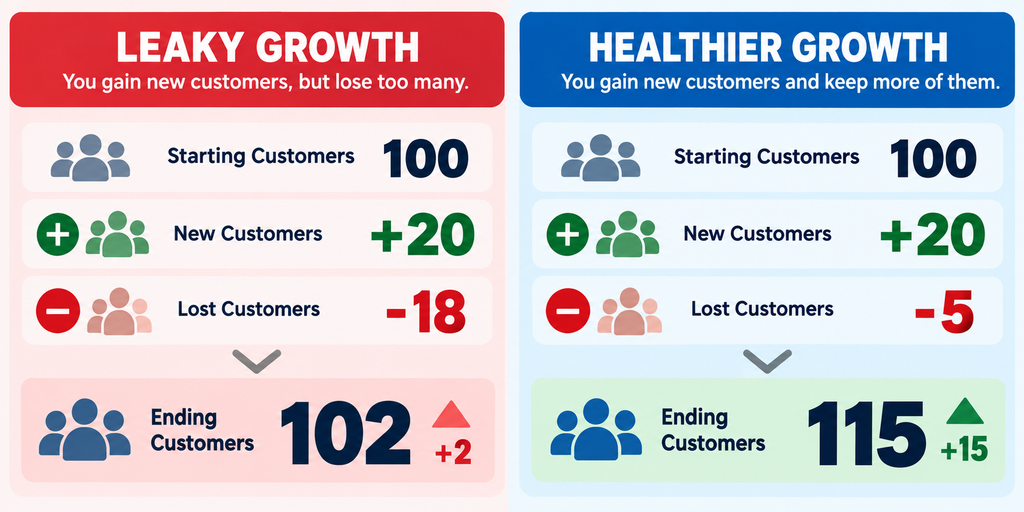
Your marketing may appear successful because new customers keep coming in, while the business struggles to grow because existing customers keep leaving.
This is sometimes called a leaky bucket problem.
FIGURE 1 — CUSTOMER ACQUISITION VS CUSTOMER RETENTION
How to Calculate Customer Retention Rate
A common customer retention formula is:
Customer Retention Rate = ((Customers at End − New Customers) ÷ Customers at Start) × 100
For example:
- Customers at start: 100
- New customers: 20
- Customers at end: 105
Then:
((105 − 20) ÷ 100) × 100 = 85%
Your customer retention rate for that period is 85%.
This calculation separates customers you retained from customers you acquired during the period.
You should always use the same measurement period when comparing retention over time.
For many small cleaning businesses, monthly tracking is a practical starting point.
Customer Retention Rate vs. Customer Churn
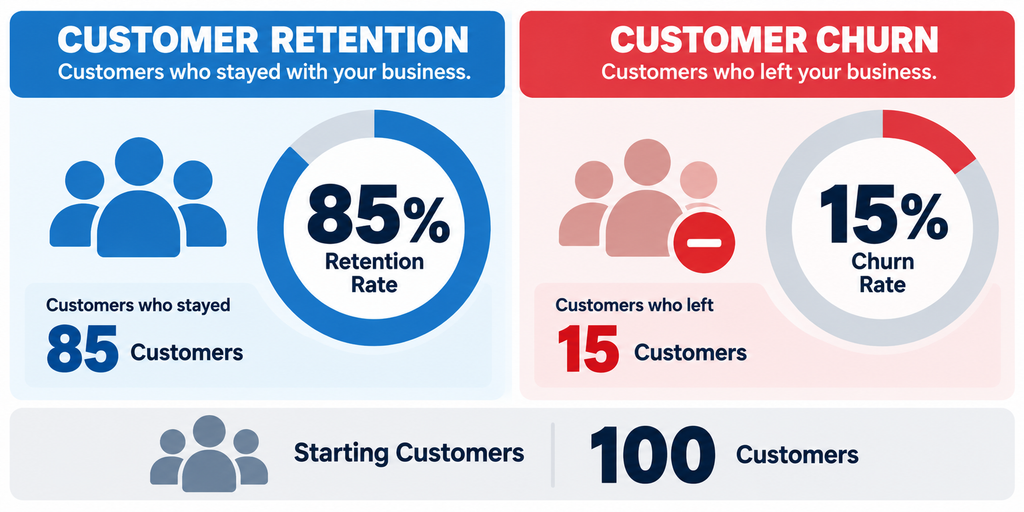
Retention tells you how many existing customers stayed.
Churn tells you how many existing customers left.
If you started the month with 100 recurring customers and 15 of those customers stopped service, your customer churn rate would be:
15 ÷ 100 × 100 = 15%
Retention and churn give you two views of the same underlying problem:
Are customers staying, or are they leaving?
Tracking both can make changes easier to spot.
FIGURE 2 — CUSTOMER RETENTION VS CUSTOMER CHURN
Cleaning Business Customer Retention Calculator
Use the calculator below to estimate your customer retention rate and see how many existing customers you lost during the period.
Customer Retention Rate = ((Customers at End − New Customers Acquired) ÷ Customers at Start) × 100
Why Cleaning Customers Leave
A customer cancellation does not automatically mean your cleaning quality was poor.
Clients leave cleaning companies for many reasons.
Common examples include:
- Inconsistent cleaning quality
- Missed areas or repeated mistakes
- Frequent schedule changes
- Cleaner turnover
- Poor communication
- Unresolved complaints
- Unexpected price changes
- Billing problems
- Difficulty accessing customer support
- Changes in the customer’s budget
- Moving to another property
- No longer needing the service
Some reasons are within your control.
Others are not.
The important part is identifying the difference.
1. Track Why Customers Cancel
Do not record every cancellation simply as:
Canceled.
Record the reason whenever possible.
A simple cancellation log could use categories such as:
| Cancellation Reason | Example |
|---|---|
| Quality | Cleaning did not meet expectations |
| Scheduling | Preferred service time unavailable |
| Communication | Slow or unclear response |
| Price | Customer says service is too expensive |
| Cleaner | Customer requests a different cleaner |
| Billing | Payment or invoice issue |
| Customer Circumstances | Moving, budget change, no longer needs service |
| Unknown | Customer did not provide a reason |
Over time, patterns may appear.
If most cancellations are caused by customers moving, there may be little operational problem to fix.
If many cancellations mention inconsistent cleaning quality, that is different.
You now have a specific operational issue to investigate.
2. Fix Quality Problems Before They Become Cancellations
Cleaning customers may tolerate one small mistake.
Repeated mistakes are more dangerous.
If the same areas are regularly missed, the customer may eventually stop reporting the problem and simply cancel.
A basic quality control process can help you identify recurring problems before they damage the customer relationship.
That can include:
- Cleaning checklists
- Supervisor inspections
- Customer feedback
- Rework tracking
- Complaint tracking
- Clear cleaning standards
If you have not built a quality control system yet, see our Cleaning Business Quality Control Checklist for a practical inspection process.
3. Set Clear Expectations From the Beginning
Retention starts before the first cleaning visit.
Customers should understand:
- What is included in the service
- What is not included
- How often cleaning will occur
- Approximate arrival windows
- How access will work
- How billing works
- How schedule changes are handled
- How special requests should be submitted
Unclear expectations create preventable complaints.
For example, if a customer assumes interior oven cleaning is included but your standard service does not include it, the problem may not be cleaning quality.
The problem is an unclear service scope.
A detailed quote and onboarding process can prevent this.
4. Make Service Quality Consistent
Customers usually do not want one excellent cleaning followed by two average ones.
They want consistency.
Your service should not depend entirely on which cleaner happens to be assigned that day.
Standard operating procedures, training, checklists, and quality inspections help create repeatable results.
The goal is:
Same service scope → same cleaning standard → consistent customer experience
That becomes increasingly important as your team grows.
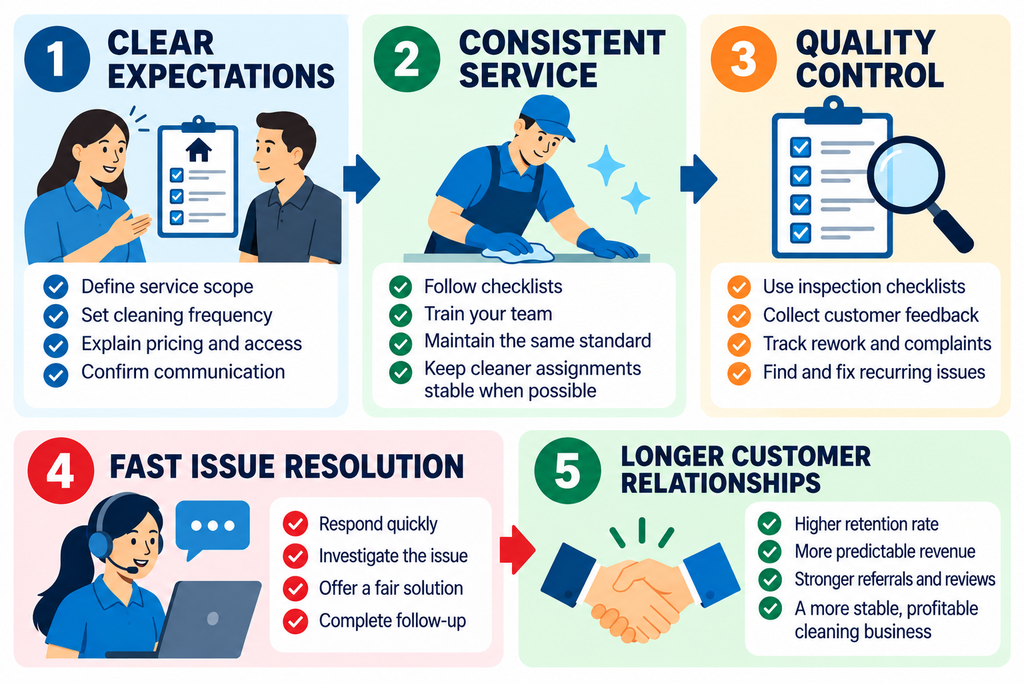
FIGURE 3 — CLEANING CUSTOMER RETENTION SYSTEM
5. Communicate Before the Customer Has to Ask
Poor communication can make even a good cleaning service feel unreliable.
Customers should not need to repeatedly ask:
- When is the cleaner arriving?
- Was my schedule changed?
- Did you receive my request?
- Was my payment processed?
- Who should I contact about a problem?
Create simple communication standards.
For example:
- Confirm appointments
- Notify customers about meaningful delays
- Respond to complaints quickly
- Confirm schedule changes
- Follow up after serious service issues
The goal is not to send customers constant messages.
It is to remove uncertainty.
6. Respond Quickly When Something Goes Wrong
Mistakes will happen.
A cleaner may miss an area.
A team may arrive late.
An item may be damaged.
A customer may misunderstand the service scope.
The first problem does not always cause the cancellation.
The response to the problem often matters just as much.
A simple service recovery process might look like this:
Receive complaint → Confirm the issue → Investigate → Offer a reasonable solution → Correct the problem → Follow up
Do not let complaints disappear into text messages, emails, or individual employee conversations.
Track them.
That makes recurring problems visible.
7. Watch for Repeated Rework and Complaints
A single complaint does not necessarily indicate a major problem.
Patterns do.
Suppose one customer has requested three recleans in two months.
Or several customers assigned to the same crew report similar missed areas.
Those are signals worth investigating.
Track:
- Customer
- Job date
- Complaint type
- Crew or cleaner
- Corrective action
- Reclean required?
- Follow-up completed?
This also connects retention to another important KPI:
Rework and complaint rate.
Our Cleaning Business KPIs: 10 Metrics You Should Track guide explains how retention, rework, labor efficiency, profitability, and other business metrics fit together.
8. Be Careful With Price Increases
Prices sometimes need to increase.
Labor costs rise.
Supplies become more expensive.
Insurance, vehicles, software, and other operating costs can also change.
Keeping an unprofitable customer forever is not a successful retention strategy.
But price increases should be handled deliberately.
Before increasing prices:
- Understand the customer’s current profitability
- Know your true labor cost
- Review the service scope
- Give reasonable notice
- Communicate clearly
- Avoid surprising customers without explanation
If you do not know your true labor cost, use our Cleaning Labor Cost Calculator before making pricing decisions.
Do not confuse customer retention with keeping every customer at any cost.
A customer who consistently generates losses, creates unreasonable demands, or requires excessive unpaid work may not be a customer you should fight to retain.
The goal is to retain good, profitable customer relationships.
9. Reduce Cleaner Turnover Where Possible
For recurring cleaning customers, the cleaner can become part of the customer experience.
Constantly changing cleaners can create:
- Different cleaning habits
- Repeated customer instructions
- Access confusion
- Reduced trust
- Inconsistent results
You may not always be able to assign the same cleaner.
But stable teams, clear customer notes, documented service requirements, and good employee training can reduce the disruption when assignments change.
10. Review Retention by Customer Type
Your overall retention rate may hide useful information.
Consider reviewing retention separately for:
- Residential customers
- Commercial customers
- Weekly customers
- Biweekly customers
- Monthly customers
- Different service areas
- Different crews
- Different acquisition channels
You may discover that one type of customer stays much longer than another.
For example, customers acquired through referrals may behave differently from customers acquired through a discount campaign.
That information can influence both operations and marketing decisions.
Build a Simple Customer Retention Dashboard
You do not need complicated software to start.
A spreadsheet can work.
Track at least:
- Customers at start
- New customers
- Customers lost
- Customers at end
- Retention rate
- Churn rate
- Cancellation reason
- Rework or complaint history
Review the numbers consistently.
The purpose is not simply to produce another percentage.
The purpose is to understand why customers stay and why they leave.
Measure Retention Alongside Profitability
A high retention rate is useful, but it should not be viewed in isolation.
Imagine two cleaning businesses.
Business A retains almost every customer but regularly underprices jobs.
Business B has slightly lower retention but maintains healthy job profitability and sustainable service standards.
Retention alone cannot tell you which business is healthier.
That is why customer retention should be reviewed alongside:
- Profit margin
- Labor cost percentage
- Revenue per labor hour
- Job profitability
- Average job value
- Rework rate
These metrics together provide a much clearer picture of business performance.
Use Scheduling and Customer Records as You Grow
Tracking customers manually becomes harder as your schedule grows.
Customer information may end up spread across:
- Text messages
- Emails
- Spreadsheets
- Paper notes
- Individual employee phones
That makes it harder to maintain consistent service.
A field service management system can help centralize customer information, job details, schedules, invoices, and communication.
Keep Customer and Job Information in One Place
Jobber helps cleaning businesses manage customer information, scheduling, crew assignments, jobs, invoicing, and payments in one system.
Customer Retention Is an Operating Metric
Customer retention is not only a marketing metric.
For a cleaning business, it reflects several parts of the operation at once:
- Cleaning quality
- Employee training
- Scheduling
- Communication
- Pricing
- Complaint handling
- Customer expectations
That makes retention especially useful.
If your retention rate begins falling, do not immediately launch another marketing campaign.
First ask:
Why are existing customers leaving?
Then look for patterns.
A cleaning business that consistently acquires customers but cannot keep them may struggle to build predictable recurring revenue.
A business that understands why customers stay — and systematically fixes the reasons they leave — has a much stronger foundation for sustainable growth.