
Average job value is one of the simplest cleaning business metrics to calculate.
But it can tell you something important:
How much revenue does the average completed job generate?
If your cleaning business completes more jobs every month but revenue barely improves, the problem may not be the number of customers.
Your average job value may be too low.
Increasing average job value does not mean adding unnecessary services or aggressively upselling every customer.
It means making sure your pricing, service packages, add-ons, and minimum charges reflect the value and cost of the work you perform.
In this guide, we’ll look at how to calculate average job value and practical ways to increase it without sacrificing customer trust.
What Is Average Job Value in a Cleaning Business?
Average job value measures the average amount of revenue generated by each completed cleaning job.
The basic formula is:
Average Job Value = Total Job Revenue ÷ Number of Completed Jobs
For example:
- Total job revenue: $20,000
- Completed jobs: 120
Then:
$20,000 ÷ 120 = $166.67
Your average job value is $166.67 per completed job.
This metric can help you understand whether changes in pricing, service mix, or add-on sales are increasing the amount of revenue generated from each job.
Why Average Job Value Matters
There are two basic ways to generate more cleaning revenue:
Complete more jobs
or
Generate more revenue from each job
Many cleaning businesses focus almost entirely on the first option.
That can work.
But more jobs can also require:
- More cleaners
- More travel
- More scheduling
- More supplies
- More customer communication
- More administrative work
Increasing average job value can sometimes improve revenue without requiring the same increase in job volume.
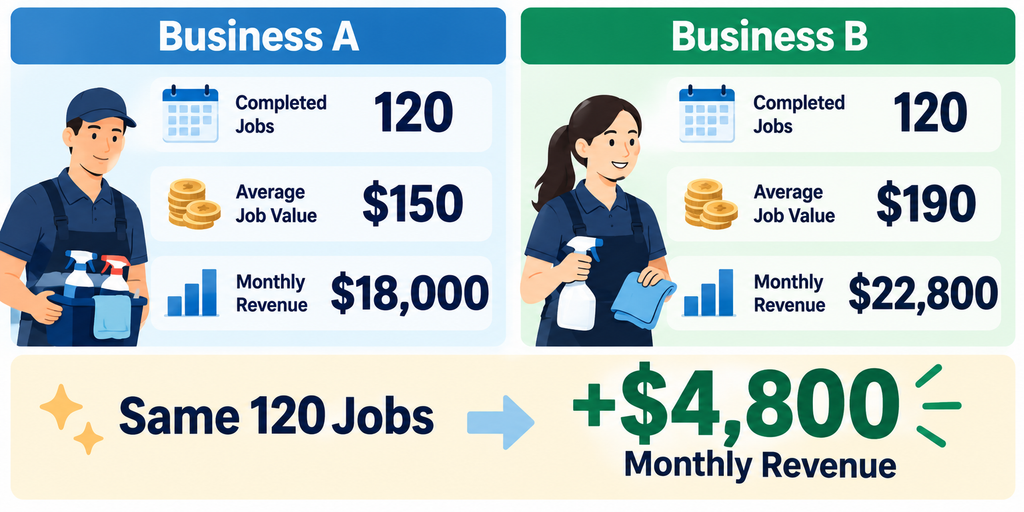
Consider two businesses that each complete 120 jobs per month.
Business A
120 jobs × $150 average job value = $18,000 revenue
Business B
120 jobs × $190 average job value = $22,800 revenue
The number of completed jobs is identical.
The difference is $4,800 in monthly revenue.
That does not automatically mean Business B is more profitable.
Labor and other costs still matter.
But average job value helps explain how much revenue each completed job is producing.
FIGURE 1 — SAME NUMBER OF JOBS, DIFFERENT REVENUE
How to Calculate Average Job Value
The calculation is simple:
Total Job Revenue ÷ Completed Jobs = Average Job Value
Suppose your cleaning business generated $24,000 from 150 completed jobs.
$24,000 ÷ 150 = $160
Your average job value is $160.
The important part is using consistent data.
If you calculate monthly average job value, use:
- Revenue from completed jobs during that month
- Jobs completed during that same month
Do not compare revenue from one period with job volume from another.
Average Job Value Calculator
Use the calculator below to estimate your current average job value and see how much additional revenue the same number of jobs could generate at a higher target average job value.
Average Job Value = Total Job Revenue ÷ Completed Jobs
Do Not Confuse Average Job Value With Profit
A higher average job value does not automatically mean a more profitable job.
Imagine two cleaning jobs.
Job A
Revenue: $150
Labor and direct job costs: $90
Job B
Revenue: $250
Labor and direct job costs: $230
Job B has a higher value.
But Job A may produce more profit.
That is why average job value should be reviewed alongside:
- Job profitability
- Labor cost
- Revenue per labor hour
- Profit margin
If you do not know your true labor cost, use our Cleaning Labor Cost Calculator before making major pricing decisions.
The goal is not simply to make every invoice larger.
The goal is to increase the value of jobs while maintaining healthy margins and delivering services customers actually need.
1. Review Whether Your Current Prices Still Make Sense
The first place to look is your existing pricing.
A price that worked two years ago may not work today.
Your costs may have changed because of:
- Higher wages
- Payroll burden
- Cleaning supplies
- Insurance
- Fuel and vehicle expenses
- Software
- Equipment
- Administrative costs
If prices stay the same while costs rise, you may complete the same amount of work while keeping less of the revenue.
Review pricing regularly.
That does not mean every customer needs an immediate price increase.
Instead, identify:
- Jobs priced below your current standard
- Jobs with consistently high labor hours
- Services that have become more expensive to deliver
- Customers whose service scope has expanded over time
Start with the jobs where the numbers no longer make sense.
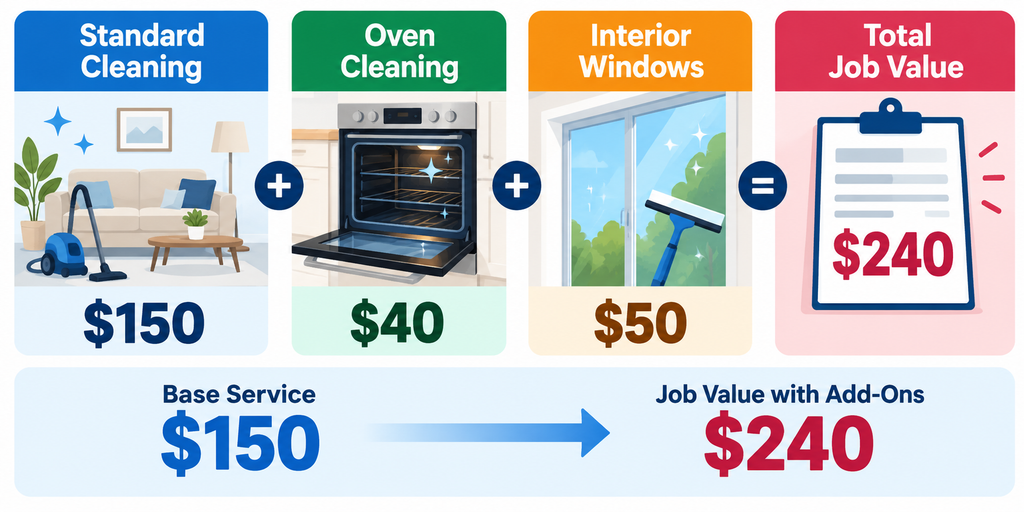
2. Offer Relevant Add-On Services
Add-on services can increase average job value without changing the customer's core cleaning service.
Examples may include:
- Interior oven cleaning
- Interior refrigerator cleaning
- Interior window cleaning
- Inside cabinet cleaning
- Baseboard detailing
- Deep cleaning
- Carpet or upholstery services, if offered
- Additional rooms or areas
- Move-in or move-out extras
The important word is:
Relevant.
Do not offer every possible add-on to every customer.
Offer services that make sense for the property and the customer's needs.
For example, a recurring residential customer may not need an oven cleaning every visit.
But offering it occasionally may be useful.
A move-out customer may need several additional services at once.
Add-ons work best when customers can clearly understand:
What is included, what it costs, and why they might want it.
FIGURE 2 — BASE SERVICE + ADD-ONS
3. Create Clear Service Packages
Another option is to organize services into packages.
Packages can make it easier for customers to understand the difference between service levels.
They can also reduce confusion about what is included.
Avoid creating too many packages.
If customers have to compare seven complicated options, the pricing structure may create more friction instead of making the decision easier.
A small number of clearly differentiated packages is usually easier to understand.
4. Set a Minimum Job Charge
Very small jobs can create hidden costs.
Even a short cleaning job may require:
- Travel time
- Scheduling
- Customer communication
- Loading and unloading supplies
- Payment processing
- Administrative work
Suppose a cleaner spends:
- 25 minutes traveling to the property
- 45 minutes cleaning
- 20 minutes traveling to the next job
FIGURE 3 — CLEANING TIME VS TOTAL TIME COMMITTED
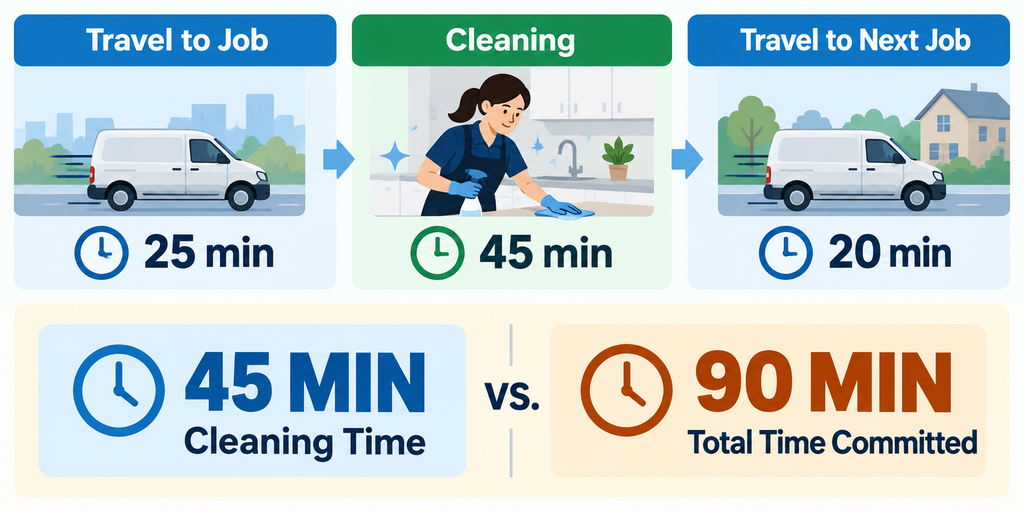
The invoice may represent only 45 minutes of cleaning.
But the business has committed much more time to completing that job.
A minimum job charge can help protect against jobs that are too small to operate efficiently.
Your minimum should reflect your own costs, service area, labor requirements, and pricing model.
5. Review Your Service Scope
Average job value can remain low when the service scope gradually expands but the price does not.
This can happen when customers repeatedly ask for:
- One extra room
- Additional bathrooms
- Interior appliances
- Extra detailing
- More frequent special requests
Each individual request may seem small.
Over time, however, the business may be providing significantly more work for the original price.
Document the agreed service scope.
When the scope changes materially, review whether the price should change too.
This also protects employees from being expected to perform work that was never included in the original job.
6. Upsell Without Being Pushy
Upselling does not need to sound like:
“What else can we sell this customer?”
A better question is:
“Is there another service that would genuinely solve a problem for this customer?”
For example:
A customer books a move-out cleaning.
They mention that the refrigerator and oven also need attention.
Instead of assuming those tasks are included, you can clearly explain the available add-ons and prices.
That is useful selling.
Good upselling should be:
- Relevant
- Transparent
- Optional
- Clearly priced
- Easy to understand
Avoid pressure tactics.
Customer trust is more valuable than a single larger invoice.
7. Use Checklists During Estimates
An estimating checklist can help identify work that may otherwise be missed.
For residential cleaning, that might include:
- Number of bedrooms
- Number of bathrooms
- Property size
- Current condition
- Pets
- Stairs
- Interior windows
- Appliances
- Heavy buildup
- Special surfaces
- Additional requested areas
For commercial cleaning, the checklist may include:
- Square footage
- Restrooms
- Break rooms
- Flooring types
- Cleaning frequency
- Supply requirements
- High-touch areas
- Special equipment
- Security or access requirements
The purpose is not to inflate the quote.
It is to understand the complete scope before setting the price.
8. Review Discounts Carefully
Discounts can help with customer acquisition or promotions.
But permanent or poorly structured discounts can reduce average job value for a long time.
Before offering a discount, ask:
- What behavior is the discount designed to encourage?
- Is it temporary or permanent?
- Does the job remain profitable?
- Could a package or add-on provide more value instead?
- Will the customer expect the discounted price indefinitely?
Track discounted customers separately if discounts are a significant part of your pricing strategy.
You may discover that some campaigns generate plenty of jobs but very little profitable revenue.
9. Compare Recurring and One-Time Jobs Separately
One-time and recurring cleaning jobs often have different economics.
A deep cleaning or move-out job may have a much higher invoice than a routine recurring cleaning visit.
If you combine every job into one average, the result may hide important differences.
Consider tracking average job value separately for:
- Weekly recurring cleaning
- Biweekly recurring cleaning
- Monthly recurring cleaning
- Deep cleaning
- Move-in / move-out cleaning
- Commercial cleaning
- Other major service types
This makes your data much more useful.
You can see which services generate higher revenue per job and then compare that information with profitability and labor requirements.
10. Increase Frequency When It Makes Sense
Average job value is not the only way to increase customer value.
Service frequency matters too.
A customer who pays $180 once may generate less long-term revenue than a customer who pays $140 every two weeks.
That is why average job value should not replace customer retention or recurring revenue metrics.
Look at the bigger picture.
A slightly lower-value recurring job may be extremely valuable if:
- It is profitable
- It fits your route
- The customer stays for a long time
- The service is operationally efficient
Our Cleaning Business Customer Retention guide explains how to measure and improve retention for recurring customers.
Track the Revenue Impact of a Higher Average Job Value
Small changes can become meaningful when repeated across many jobs.
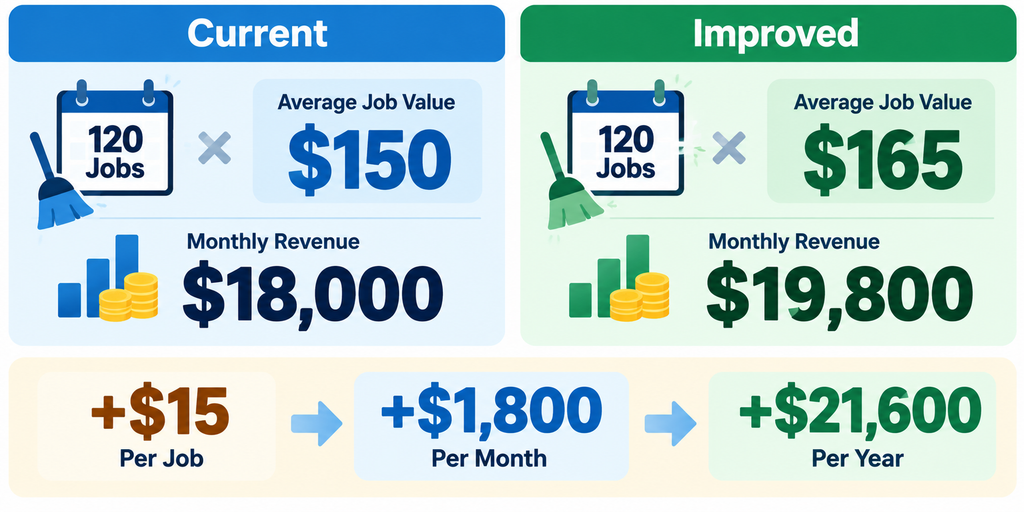
Suppose you currently complete:
120 jobs per month
at an average job value of:
$150
Monthly job revenue:
120 × $150 = $18,000
Now suppose you improve average job value to:
$165
without increasing job volume.
Monthly job revenue becomes:
120 × $165 = $19,800
That is:
+$1,800 per month
or:
+$21,600 over 12 months
before considering changes in costs, job volume, or customer behavior.
FIGURE 4 — SMALL INCREASE, BIGGER REVENUE IMPACT
Do Not Increase Job Value by Adding Unprofitable Work
More revenue is useful only when the additional work makes financial sense.
Suppose you sell a $40 add-on.
If that add-on requires:
- Significant additional labor
- Expensive supplies
- Extra travel
- Specialized equipment
- Rework risk
the additional $40 may not be attractive.
Evaluate add-ons like any other service.
Estimate:
Additional Revenue − Additional Costs = Additional Contribution
An add-on that customers love and your team can deliver efficiently may be valuable.
An add-on that creates scheduling problems and little profit may not be.
Track Average Job Value Over Time
Do not calculate average job value once and forget about it.
Track it consistently.
A simple monthly scorecard might include:
- Total job revenue
- Completed jobs
- Average job value
- Labor cost percentage
- Revenue per labor hour
- Job profitability
- Customer retention rate
- Rework rate
This makes it easier to see whether changes in pricing or service mix are actually improving the business.
Our Cleaning Business KPIs: 10 Metrics You Should Track guide explains how these metrics work together.
Keep Pricing, Customers, and Jobs Connected
As your cleaning business grows, pricing and job information can become scattered across:
- Spreadsheets
- Text messages
- Paper notes
- Estimates
- Invoices
- Employee phones
That makes it harder to compare what customers were quoted with what work was actually completed.
Manage Quotes, Jobs, and Payments in One Place
Jobber helps cleaning businesses manage customer information, quotes, scheduling, jobs, invoicing, and payments in one system.
Increase Value, Not Just Price
Increasing average job value is not simply about charging more.
It can come from:
- Correcting outdated prices
- Offering useful add-ons
- Creating clearer service packages
- Setting appropriate minimum charges
- Pricing expanded service scopes correctly
- Improving the estimating process
- Reducing unnecessary discounts
But average job value should never be viewed alone.
A larger invoice is not automatically a better job.
The strongest cleaning businesses understand both sides:
How much revenue does the job generate?
and
How much does the job cost to deliver?
Track both.
Then focus on the services, customers, and pricing decisions that create sustainable value for the customer and the business.