
A cleaning business can receive plenty of leads and still struggle to grow.
The problem may not be lead volume.
It may be what happens after the estimate is sent.
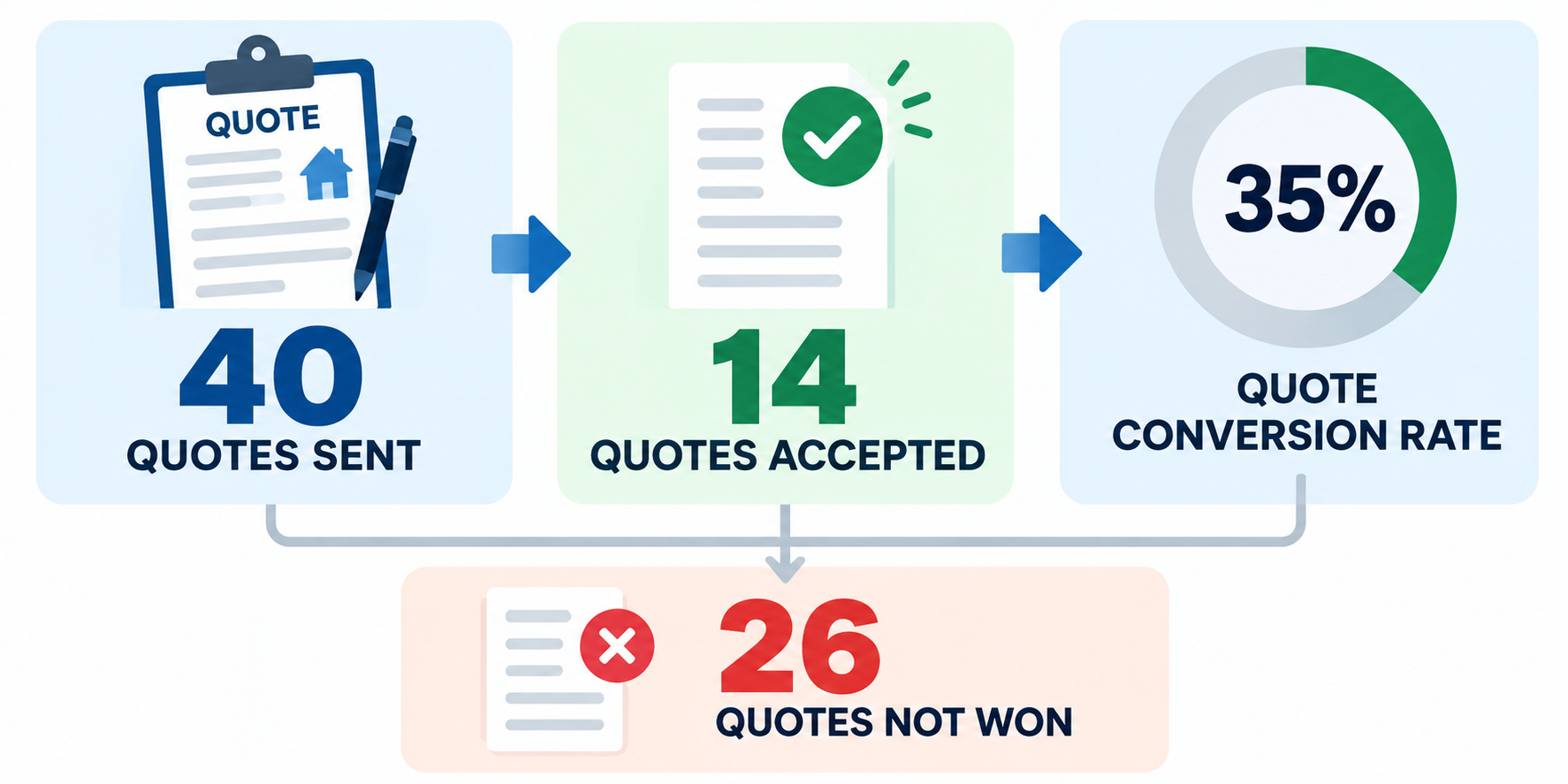
If 40 potential customers receive a quote but only 14 accept it, your cleaning business has a 35% quote conversion rate.
Understanding that number can help you answer important questions:
- Are you attracting the right leads?
- Are customers receiving quotes quickly enough?
- Is your pricing clear?
- Are prospects comparing your business only on price?
- Are you following up with undecided customers?
- Which lead sources actually produce paying customers?
The goal is not to win every quote.
The goal is to convert more qualified, profitable customers without discounting every job just to get a yes.
What Is a Cleaning Business Quote Conversion Rate?
Quote conversion rate measures the percentage of cleaning quotes or estimates that turn into accepted jobs.
The basic formula is:
Quote Conversion Rate = Accepted Quotes ÷ Quotes Sent × 100
For example:
40 quotes sent
14 quotes accepted
Then:
14 ÷ 40 × 100 = 35%
Your quote conversion rate is 35%.
That also means 26 of the 40 quotes did not become booked jobs during the period being measured.
FIGURE 1 — FROM CLEANING QUOTES TO BOOKED JOBS
Why Quote Conversion Rate Matters
Marketing metrics can tell you how many people discover your cleaning business.
Quote conversion rate tells you what happens after those prospects become serious enough to request pricing.
Suppose two cleaning businesses each receive 40 quote opportunities.
| Metric | Business A | Business B |
|---|---|---|
| Quotes Sent | 40 | 40 |
| Quotes Accepted | 10 | 18 |
| Quote Conversion Rate | 25% | 45% |
| Average Job Value | $200 | $200 |
| Revenue Won | $2,000 | $3,600 |
Both businesses created the same number of quotes.
But Business B converted eight additional jobs and generated $1,600 more revenue won from those quotes.
This does not automatically mean a higher conversion rate is always better.
If Business B is winning jobs because its prices are too low, the additional revenue may not produce healthy profit.
Quote conversion should therefore be reviewed alongside:
- Average job value
- Job profitability
- Labor cost
- Customer retention
- Lead source
Our Cleaning Business KPIs: 10 Metrics You Should Track guide explains how these metrics work together.
Cleaning Business Quote Conversion Rate Calculator
Use the calculator below to measure your quote conversion rate and estimate the value of the jobs you won.
Quote Conversion Rate = Quotes Accepted ÷ Quotes Sent × 100
Use the same measurement period for every input.
For example, if you are reviewing September, count quotes sent and accepted from the same defined reporting period.
What Is a Good Quote Conversion Rate for a Cleaning Business?
There is no single conversion rate that every cleaning company should target.
Your rate can vary depending on:
- Residential vs. commercial cleaning
- Recurring vs. one-time service
- Lead source
- Price level
- Service area
- Competition
- How qualified the lead is
- How quickly you respond
- How the estimate is presented
A business receiving highly qualified referrals may convert a much larger percentage of quotes than a business receiving broad paid-ad leads.
That does not necessarily mean one sales process is better than the other.
The lead mix is different.
Use your own historical conversion rate as the starting benchmark.
Track it consistently, then investigate why it moves up or down.
Do not chase an arbitrary conversion percentage by lowering prices until every prospect says yes.
A high conversion rate on poorly priced jobs can create a busy but unprofitable cleaning business.
Look at the Entire Quote Process
A lost quote does not always mean:
“The price was too high.”
There are several places where a potential customer can be lost.
FIGURE 2 — CLEANING QUOTE CONVERSION PROCESS
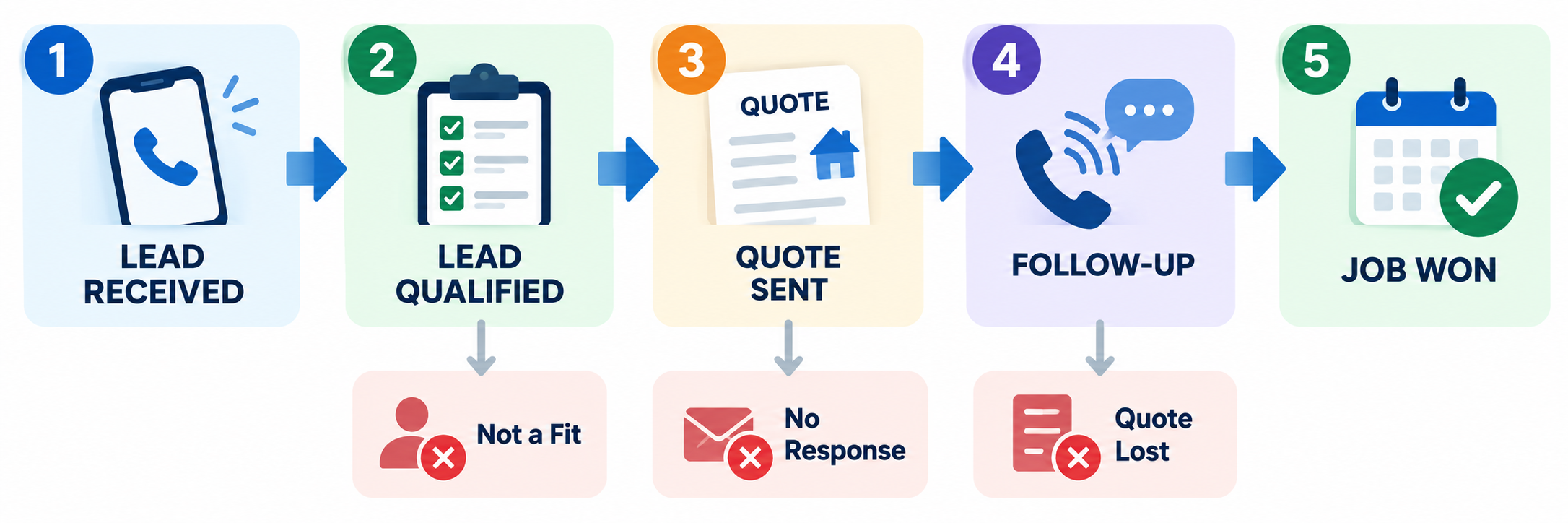
If conversion is weak, identify where prospects are dropping out before changing your pricing.
1. Respond to New Leads Quickly
A customer requesting a cleaning quote may contact several businesses.
If one company responds quickly and another waits several days, the slower company may never get a serious opportunity to compete.
Create a simple process for new inquiries:
- Capture the customer’s contact information.
- Confirm what service they need.
- Gather the information required to estimate the job.
- Explain what happens next.
- Send the estimate as soon as practical.
Fast does not mean careless.
An inaccurate quote sent immediately can create bigger problems later.
The goal is a process that is both responsive and consistent.
2. Qualify Leads Before Spending Too Much Time Quoting
Not every inquiry is a good fit.
Before preparing a detailed estimate, confirm basic information such as:
- Service location
- Property type
- Cleaning frequency
- Approximate size
- Requested service
- Desired start date
- Special requirements
- Whether the property is within your service area
For commercial cleaning, you may also need:
- Facility type
- Square footage
- Number of restrooms
- Cleaning schedule
- Security requirements
- Supply expectations
- Contract requirements
Qualification prevents your team from spending too much time preparing estimates for jobs you cannot or do not want to perform.
3. Make Your Cleaning Quote Easy to Understand
A quote should answer the customer’s most important questions without forcing them to decode the document.
A strong cleaning quote should clearly communicate:
| Quote Element | What the Customer Should Understand |
|---|---|
| Service | What cleaning service they are buying |
| Scope | What is included in the job |
| Price | What they will pay |
| Frequency | How often service will occur |
| Add-Ons | Which optional services cost extra |
| Exclusions | What is not included |
| Next Step | How to approve or book the service |
Avoid vague descriptions such as:
“General cleaning — $200.”
The customer may not know whether that includes:
- Interior appliances
- Baseboards
- Interior windows
- Heavy buildup
- Extra rooms
- Specialty surfaces
Clear scope protects both the customer and the cleaning business.
4. Do Not Compete on Price Alone
When a prospect says your quote is expensive, lowering the price immediately can be tempting.
But price is only one part of the decision.
Customers may also care about:
- Reliability
- Insurance
- Communication
- Consistent quality
- Easy scheduling
- Professional employees
- Clear service scope
- Reviews and reputation
- Payment convenience
- Whether problems are handled quickly
If your quote looks identical to every competitor’s except for the price, customers have little reason to compare anything else.
Make the value of your service clear.
That does not mean writing a long sales pitch.
It means helping the customer understand what they receive for the price.
5. Follow Up on Open Quotes
Some quotes are not rejected.
They are simply forgotten.
The customer may:
- Get busy
- Miss the email
- Be waiting for another estimate
- Need approval from someone else
- Plan to decide later
A simple follow-up process can recover opportunities that would otherwise disappear.
For example:
Quote sent
→ Confirm the customer received it
→ Follow up if there is no response
→ Record the final outcome
Avoid repeatedly contacting someone who has clearly declined.
Follow-up should be useful, not aggressive.
6. Track Why Cleaning Quotes Are Lost
If you record only won or lost, you know the outcome but not the reason.
Create a small set of consistent lost-quote categories.
| Lost Quote Reason | What It May Tell You |
|---|---|
| Price | Prospect chose a cheaper option or budget was too low |
| No Response | Follow-up or lead quality may need review |
| Competitor | Another provider was selected |
| Timing | Customer delayed or canceled the project |
| Service Mismatch | Requested work did not fit your services |
| Outside Service Area | Geography was not a fit |
| Schedule | Required time or date was unavailable |
| Unknown | Reason could not be confirmed |
Do not create 30 different categories.
A short standardized list makes patterns easier to identify.
After enough quotes, you may discover that what felt like a pricing problem is actually a response-time problem, scheduling problem, or lead-quality problem.
7. Compare Quote Conversion Rate by Lead Source
An overall conversion rate can hide major differences between marketing channels.
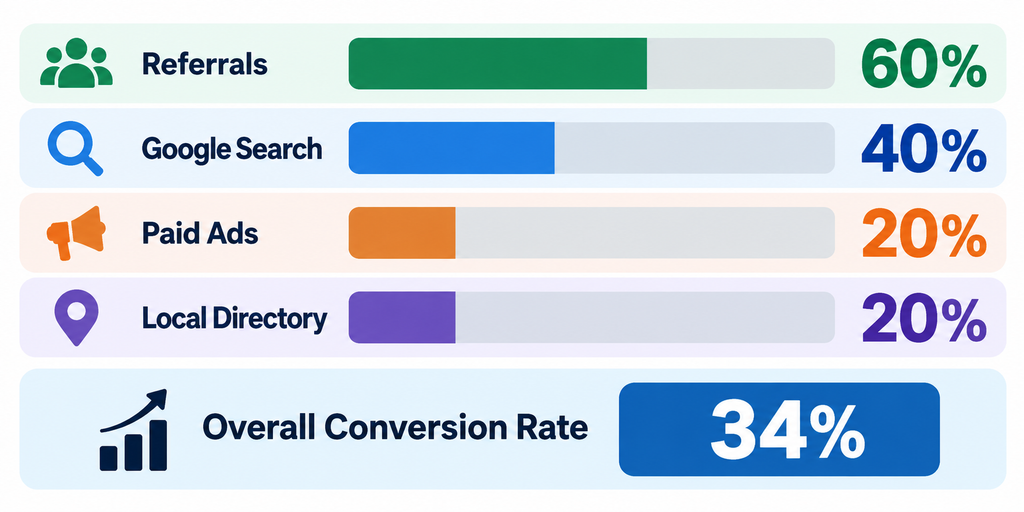
Suppose your results look like this:
| Lead Source | Quotes Sent | Accepted | Conversion Rate | Revenue Won |
|---|---|---|---|---|
| Referrals | 20 | 12 | 60% | $2,400 |
| Google Search | 30 | 12 | 40% | $2,400 |
| Paid Ads | 30 | 6 | 20% | $1,200 |
| Local Directory | 20 | 4 | 20% | $800 |
Overall:
100 quotes → 34 accepted → 34% conversion
But the overall 34% hides an important fact:
Referral leads converted three times as often as Paid Ads or Local Directory leads in this example.
That does not automatically mean you should stop paid advertising.
You also need to consider:
- Cost per lead
- Customer acquisition cost
- Average job value
- Customer retention
- Lifetime value
- Profitability
But conversion by source gives you another piece of the picture.
FIGURE 3 — QUOTE CONVERSION RATE BY LEAD SOURCE
8. Compare Similar Types of Quotes
Do not assume every quote should convert at the same rate.
A $150 recurring residential cleaning quote is different from a $5,000 commercial cleaning proposal.
Consider separating conversion data by:
- Residential vs. commercial
- Recurring vs. one-time
- Standard vs. deep cleaning
- Move-in / move-out cleaning
- Lead source
- New vs. returning customer
- Major service type
This gives you a more useful comparison.
For example, you might discover:
Recurring residential quotes convert well
while:
Move-out cleaning quotes convert poorly
That tells you where to investigate.
9. Review Your Pricing When Conversion Changes
Quote conversion can sometimes reveal pricing problems.
But interpret the signal carefully.
If Conversion Suddenly Drops
Possible causes include:
- Prices increased
- Lead quality changed
- A new competitor entered the market
- Response times became slower
- Scheduling availability decreased
- Your quote process changed
If Conversion Is Extremely High
That sounds positive.
But it may also be worth checking whether:
- Prices are too low
- Difficult jobs are being accepted too easily
- Estimates are missing part of the service scope
- Labor requirements are being underestimated
Winning more jobs is useful only when the jobs are worth winning.
Do not optimize conversion rate at the expense of profitability.
10. Measure the Revenue Impact of Better Conversion
Small improvements in conversion can create meaningful revenue when quote volume is consistent.
Suppose your cleaning business sends:
40 quotes per month
with an average job value of:
$200
At a 35% conversion rate:
14 jobs × $200 = $2,800 revenue won
If conversion improves to 45%:
18 jobs × $200 = $3,600 revenue won
Difference:
+$800 per month
without increasing the number of quotes sent.
FIGURE 4 — SAME QUOTES, HIGHER CONVERSION
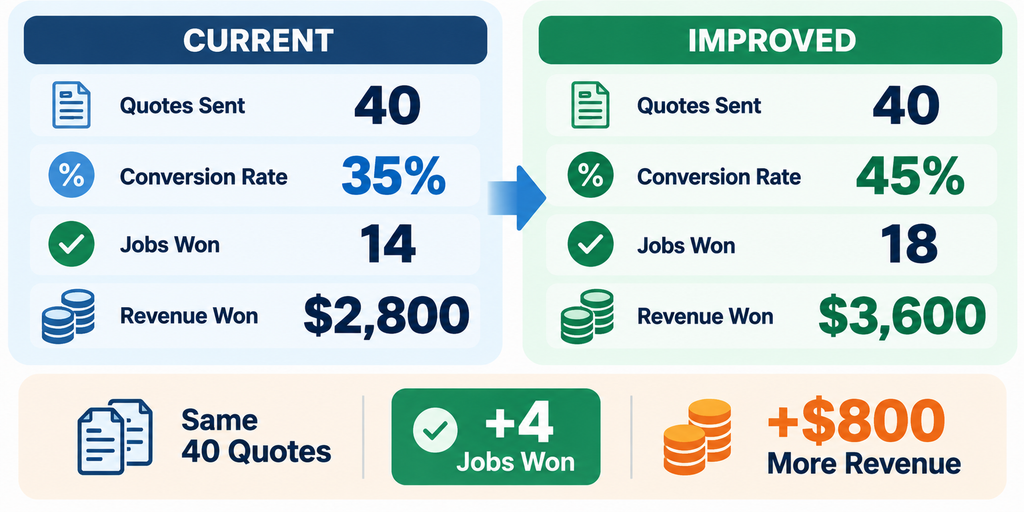
This is why conversion improvement can sometimes be as valuable as generating more leads.
But again, the additional jobs must be profitable and operationally manageable.
Quote Conversion Rate vs. Customer Acquisition Cost
Conversion rate also affects how efficiently marketing dollars turn into customers.
Imagine spending $1,000 to generate enough leads for 20 quotes.
If 4 become customers:
Customer Acquisition Cost = $1,000 ÷ 4 = $250
If 8 become customers from the same marketing spend:
Customer Acquisition Cost = $1,000 ÷ 8 = $125
The marketing spend did not change.
The number of acquired customers did.
This is why lead generation and sales conversion should not be analyzed separately.
If you are spending more money to generate leads, first make sure your existing quote process is not leaking good opportunities.
Track Quote Conversion Over Time
Do not judge your sales process from five estimates.
Small samples can move dramatically.
Instead, track conversion consistently.
A monthly quote scorecard can include:
| Metric | What to Track |
|---|---|
| Leads Received | Total new inquiries |
| Qualified Leads | Leads that fit your basic criteria |
| Quotes Sent | Estimates delivered |
| Quotes Accepted | Estimates approved |
| Quote Conversion Rate | Accepted ÷ Sent |
| Average Job Value | Revenue value per completed job |
| Revenue Won | Estimated value of accepted quotes |
| Top Lost Reason | Most common reason quotes were lost |
| Best Lead Source | Source producing strong qualified conversions |
Over time, trends become more useful than a single month’s percentage.
If quote conversion falls for three consecutive months, investigate.
If it improves after changing your follow-up process, compare the data before and after the change.
Keep Leads, Quotes, and Jobs Connected
As your cleaning business grows, quote tracking becomes harder when customer information is spread across:
- Text messages
- Spreadsheets
- Paper notes
- Calendars
- Invoices
A lead can request a quote, receive an estimate, follow up later, approve the work, and become a recurring customer.
Keeping those steps connected makes it easier to understand what happened.
Manage Quotes and Customers in One Place
Jobber helps cleaning businesses manage customer information, quotes, scheduling, jobs, invoicing, and payments in one system.
Do Not Try to Win Every Cleaning Quote
A 100% quote conversion rate should not be the goal.
Some prospects:
- Are outside your service area
- Want services you do not provide
- Have unrealistic budgets
- Need schedules you cannot support
- May create operational problems
- Are simply not a good fit
The objective is not:
Win every quote.
It is:
Win more of the right jobs at prices that make sense for your business.
Track quote conversion rate.
Compare it by lead source and service type.
Record why quotes are lost.
Improve response times and follow-up.
Make your estimates easier to understand.
Then review conversion alongside average job value, labor cost, customer retention, and profitability.
That gives you a much clearer picture than simply counting how many estimates you send.