
Customer acquisition cost tells you how much your cleaning business spends to acquire a new customer.
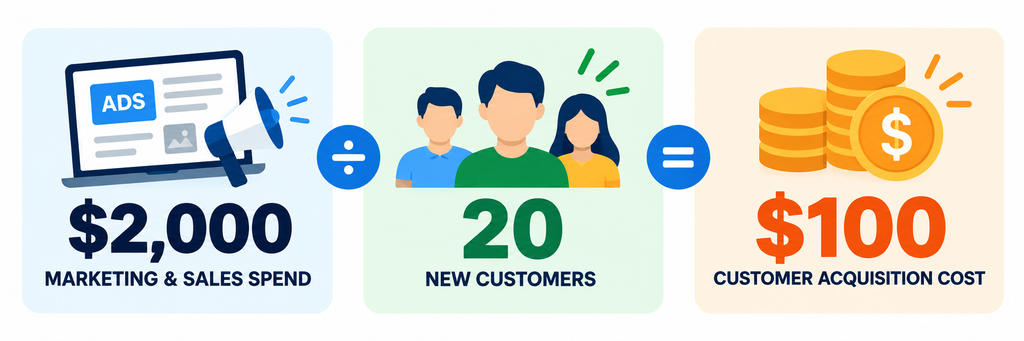
If you spend $2,000 on marketing and acquire 20 new customers, your customer acquisition cost is:
$2,000 ÷ 20 = $100 per new customer
The formula is simple.
But using CAC correctly is more complicated.
A $100 customer acquisition cost could be excellent if the customer stays for a year and generates thousands of dollars in profitable revenue.
The same $100 CAC could be terrible if the customer books one small, low-margin job and never returns.
That is why cleaning businesses should not ask only:
“How much does it cost to acquire a customer?”
They should also ask:
“What kind of customer did that spending acquire?”
This guide explains how to calculate customer acquisition cost, compare CAC across marketing channels, and use it alongside conversion, customer value, retention, and profitability.
What Is Customer Acquisition Cost for a Cleaning Business?
Customer acquisition cost, commonly called CAC, measures how much you spend to acquire a new customer.
The basic formula is:
Customer Acquisition Cost = Customer Acquisition Spending ÷ New Customers Acquired
$2,000 in acquisition spending that generates 20 new customers produces a $100 CAC.
FIGURE 1 — HOW CUSTOMER ACQUISITION COST WORKS
Why Customer Acquisition Cost Matters
Revenue tells you how much money customers generate.
CAC helps tell you how much you spent to acquire them.
Suppose two cleaning businesses each acquire 20 new customers.
| Metric | Business A | Business B |
|---|---|---|
| Acquisition Spending | $2,000 | $4,000 |
| New Customers | 20 | 20 |
| Customer Acquisition Cost | $100 | $200 |
| Average First Job Value | $200 | $200 |
| First-Job Revenue | $4,000 | $4,000 |
Both businesses acquired the same number of customers and generated the same first-job revenue.
But Business B spent twice as much to acquire them.
That difference matters.
However, this table still does not tell us which business has the better customers.
If Business B acquired recurring customers who stay longer, its higher CAC may be justified.
CAC needs context.
Cleaning Business Customer Acquisition Cost Calculator
Use the calculator below to estimate how much you are spending to acquire each new customer and compare that cost with the revenue generated by the customer’s first job.
Use data from the same reporting period.
If you are measuring September CAC, use September acquisition spending and customers acquired from the activity being measured.
What Should Be Included in Customer Acquisition Spending?
This is where CAC calculations can become inconsistent.
Some businesses count only advertising spend.
Others include broader sales and marketing costs.
For a small cleaning business, the practical approach is to decide what you are measuring and use the same method consistently.
| Cost | Usually Include? | Example |
|---|---|---|
| Paid Advertising | Yes | Google Ads, Meta Ads |
| Lead Fees | Yes | Paid lead platforms |
| Direct Mail | Yes | Flyers, postcards |
| Referral Incentives | Yes | Customer referral rewards |
| Marketing Agency Fees | If applicable | Campaign management |
| Sales Software | If directly related | CRM or sales tools |
| Sales Labor | For fuller CAC | Time spent selling |
| General Cleaning Labor | No | Cost of delivering jobs |
| Cleaning Supplies | No | Service delivery expense |
A simple marketing CAC may include only direct acquisition spending.
A more complete CAC can include sales-related costs too.
The important thing is not to switch definitions every month.
Choose a CAC definition that fits your business, document it, and use it consistently.
Otherwise, a CAC of $80 this month and $120 next month may reflect a change in accounting rather than a real change in marketing performance.
CAC Is Not the Same as Cost per Lead
These two metrics answer different questions.
Cost per Lead (CPL) measures how much it costs to generate an inquiry.
Customer Acquisition Cost (CAC) measures how much it costs to acquire an actual customer.
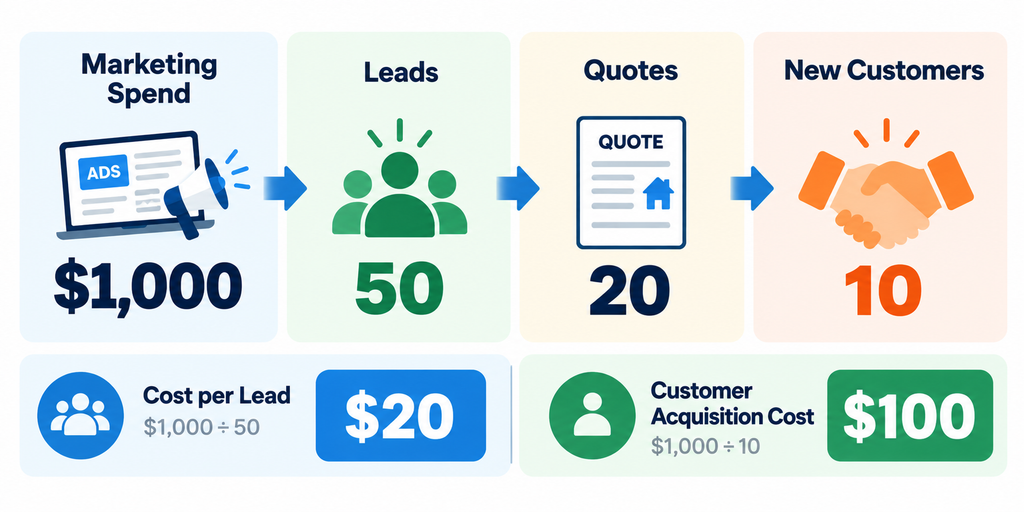
Suppose you spend:
$1,000 on marketing
and generate:
50 leads
Then:
$1,000 ÷ 50 = $20 cost per lead
If only 10 of those leads become customers:
$1,000 ÷ 10 = $100 CAC
| Metric | Formula | What It Measures |
|---|---|---|
| Cost per Lead | Marketing Spend ÷ Leads | Cost to generate an inquiry |
| Customer Acquisition Cost | Acquisition Spend ÷ New Customers | Cost to acquire a customer |
| Quote Conversion Rate | Accepted Quotes ÷ Quotes Sent × 100 | How effectively quotes become jobs |
These metrics are connected.
If your cost per lead stays the same but your quote conversion improves, CAC may fall because more of those opportunities become customers.
Our Cleaning Business Quote Conversion Rate guide explains how to measure and improve that part of the process.
FIGURE 2 — FROM MARKETING SPEND TO NEW CUSTOMER
What Is a Good Customer Acquisition Cost for a Cleaning Business?
There is no universal CAC number that every cleaning company should target.
A reasonable acquisition cost depends on factors such as:
- Service type
- Average job value
- Gross margin
- Customer retention
- Cleaning frequency
- Customer lifetime value
- Lead quality
- Marketing channel
- Residential vs. commercial service
- One-time vs. recurring work
A $150 CAC might be unacceptable for a $120 one-time cleaning.
The same $150 CAC could potentially make sense for a profitable recurring customer who stays for years.
Do not judge CAC without considering what the acquired customer is worth.
A low CAC is not automatically good.
A high CAC is not automatically bad.
The economics of the customer matter more than the acquisition cost by itself.
1. Compare CAC With Average Job Value
Average job value gives you a simple first comparison.
Suppose:
CAC = $100
and:
Average first job value = $200
The first job generates revenue equal to twice the acquisition cost.
But that does not mean you made $100 profit.
You still have costs such as:
- Cleaning labor
- Payroll burden
- Supplies
- Travel
- Insurance
- Payment processing
- Overhead
CAC is another cost that must eventually be recovered by the customer’s profitable revenue.
Our How to Increase Average Job Value guide explains how to measure and improve revenue per completed job.
2. Compare CAC With Customer Retention
- Retention can completely change how you interpret acquisition cost.
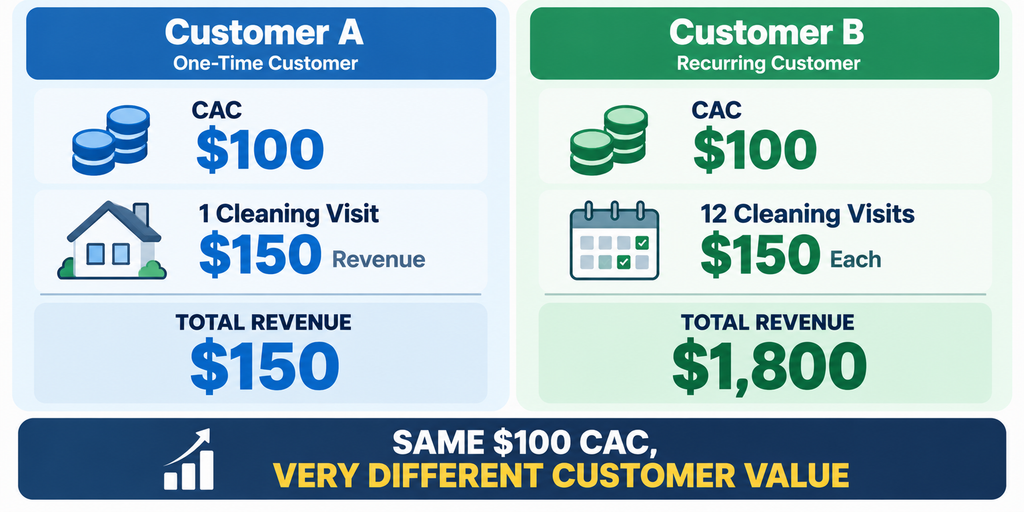
- Two customers can have the same CAC but produce very different long-term value.
- Recurring customers give the business more opportunities to recover acquisition costs and generate profit.
FIGURE 3 — SAME CAC, DIFFERENT CUSTOMER VALUE
Our Cleaning Business Customer Retention guide explains how to calculate retention and churn for recurring customers.
3. Calculate CAC by Marketing Channel
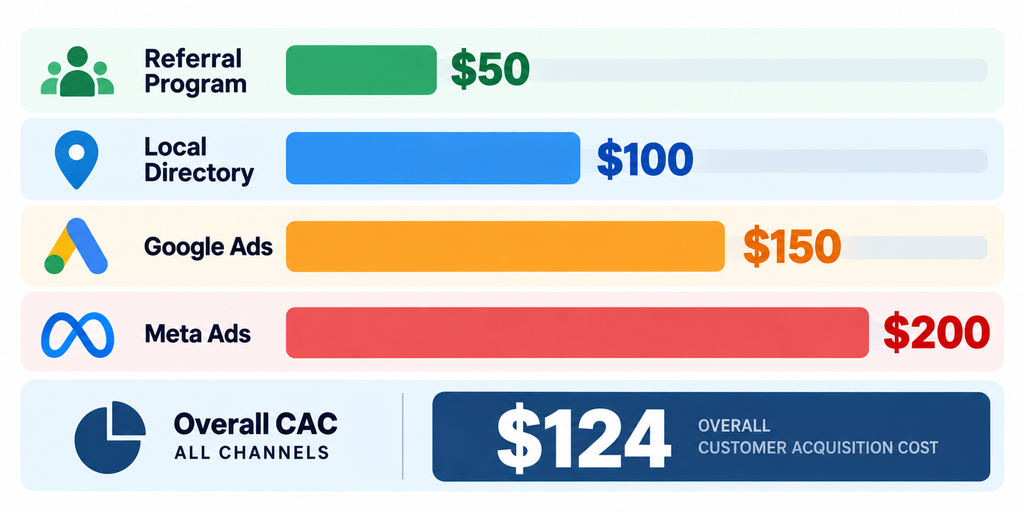
An overall CAC can hide major differences between lead sources.
Suppose your business spends $3,100 across four channels and acquires 25 customers, producing an overall CAC of $124.
FIGURE 4 — CUSTOMER ACQUISITION COST BY CHANNEL
Do not immediately move all of your marketing budget to the lowest-CAC channel.
There is more to evaluate.
4. Compare Lead Quality, Not Just Acquisition Cost
Suppose referrals have a $50 CAC while paid search has a $150 CAC.
It is tempting to conclude:
“Referrals are three times better.”
Maybe.
But ask additional questions:
- How many customers can each channel realistically generate?
- What services do those customers buy?
- What is their average job value?
- How often do they book?
- How long do they stay?
- How profitable are their jobs?
- Do they fit your service area?
- How often do they cancel?
- How much management time does the channel require?
A low-cost channel that generates only two customers per month may be valuable but impossible to scale.
A more expensive channel may still deserve investment if it consistently produces profitable customers at higher volume.
5. Track CAC by Service Type
Different cleaning services can support different acquisition costs.
For example:
- Recurring residential cleaning
- Deep cleaning
- Move-in / move-out cleaning
- Commercial cleaning
- Specialty cleaning
may all have different:
- Job values
- Margins
- Sales cycles
- Retention
- Repeat frequency
Combining every customer into one CAC number can hide those differences.
A $200 CAC for a one-time $250 service is very different from a $200 CAC for a profitable recurring account.
Track separately when the service economics are meaningfully different.
6. Improve Quote Conversion Before Buying More Leads
One way to reduce CAC is to generate cheaper leads.
Another is to convert more of the leads you already have.
Suppose you spend:
$1,000
and ultimately acquire:
4 customers
CAC:
$250
If the same $1,000 produces 8 customers because your qualification, quoting, and follow-up improve:
CAC becomes:
$125
You did not reduce marketing spend.
You improved the percentage of opportunities that became customers.
That is why CAC and quote conversion rate should be reviewed together.
7. Improve Lead Targeting
Poorly targeted marketing can produce many inquiries without producing many customers.
For example, you may receive leads that are:
- Outside your service area
- Looking for services you do not provide
- Below your minimum job size
- Searching for extremely low prices
- Requesting unavailable schedules
- Commercial when you serve residential only
Those leads still consume marketing budget and staff time.
Clear targeting can help reduce waste.
Your advertising and website should make important information easy to understand, such as:
- Service area
- Core services
- Customer type
- Basic service positioning
- How to request a quote
The goal is not necessarily to maximize the number of leads.
It is to attract more qualified leads.
8. Track Where Customers Actually Came From
CAC by channel is useless if attribution is unreliable.
Ask new customers how they found your business and record the answer consistently.
Useful source categories might include:
- Google Search
- Google Ads
- Facebook / Instagram
- Referral
- Local directory
- Direct mail
- Repeat customer
- Other
Avoid having multiple labels for the same channel.
For example:
Google Search
Organic Google
Website / Google
may all end up describing similar customer journeys.
Standardized source categories make reporting easier.
9. Be Careful With “Free” Customer Acquisition
Referrals and organic search may appear to have no acquisition cost.
But “free” is not always truly free.
Referral programs may include:
- Discounts
- Credits
- Gift cards
- Administrative time
Organic marketing may require:
- Website development
- SEO work
- Content creation
- Photography
- Software
- Staff time
You do not need to assign every minute of work to CAC.
But be consistent about what your calculation includes.
Otherwise, paid channels may look artificially expensive compared with channels whose costs are simply being ignored.
10. Do Not Cut Marketing Based on CAC Alone
Imagine two marketing channels:
Channel A
CAC: $60
Average customer revenue: $180
Channel B
CAC: $180
Average customer revenue: $2,000
If you looked only at CAC, Channel A would appear better.
But customer value tells a different story.
The higher-CAC channel may be producing customers who book larger jobs, stay longer, or generate recurring revenue.
This is why CAC should eventually be compared with customer lifetime value and profitability.
The cheapest customer is not always the most valuable customer.
Optimize for profitable customer acquisition, not simply the lowest possible CAC.
How to Reduce Customer Acquisition Cost
There are several ways to improve CAC without simply cutting marketing spending.
Improve Conversion
Turn more qualified leads and quotes into customers.
Improve Targeting
Reduce spending on people who are unlikely to buy your services.
Strengthen Referrals
Make it easy for satisfied customers to recommend your business.
Improve Local Search Visibility
Help potential customers find your business when they are actively searching for cleaning services.
Improve Your Quote Process
Respond quickly, explain the scope clearly, and follow up consistently.
Track Channel Performance
Move budget away from channels that repeatedly produce poor-quality customers.
Improve Customer Retention
Retention does not reduce the original acquisition cost, but it can increase the value generated from each acquired customer.
Build a Simple Customer Acquisition Scorecard
Do not track CAC in isolation.
A practical monthly acquisition scorecard can include:
| Metric | What It Tells You |
|---|---|
| Marketing Spend | How much you invested in acquisition |
| Leads | How many inquiries were generated |
| Cost per Lead | Cost to generate each inquiry |
| Quotes Sent | How many prospects reached the quoting stage |
| Quote Conversion Rate | How effectively quotes became jobs |
| New Customers | How many customers were acquired |
| CAC | Cost to acquire each customer |
| Average Job Value | Initial revenue generated per job |
| Customer Retention | Whether customers continue buying |
| Revenue by Source | Revenue associated with each channel |
The purpose is not to create a complicated dashboard.
It is to connect:
Marketing → Leads → Quotes → Customers → Revenue
so you can see where acquisition performance is improving or breaking down.
Keep Customer Sources, Quotes, and Jobs Connected
As your cleaning business grows, marketing attribution becomes harder when information is scattered across:
- Ad platforms
- Text messages
- Spreadsheets
- Quotes
- Calendars
- Invoices
A prospect may discover your business through one channel, request a quote later, and become a recurring customer.
Keeping customer information connected makes it easier to understand which marketing activity actually produces business.
Manage Customers, Quotes, and Jobs in One Place
Jobber helps cleaning businesses manage customer information, quotes, scheduling, jobs, invoicing, and payments in one system.
CAC Is a Starting Point, Not the Final Answer
Customer acquisition cost answers an important question:
How much are we spending to acquire each new customer?
But it does not tell you everything.
A useful acquisition analysis also considers:
- Lead quality
- Quote conversion
- Average job value
- Labor cost
- Customer retention
- Customer lifetime value
- Profitability
Start by calculating CAC consistently.
Then compare it by marketing channel and service type.
Identify where acquisition spending is producing strong customers and where money is being wasted.
The objective is not simply to acquire customers as cheaply as possible.
It is to build a repeatable system for acquiring profitable customers at a cost your cleaning business can sustain.