
A cleaning business can complete every scheduled job, send invoices on time, and still struggle to collect the money it has earned.
For residential customers, payment may arrive immediately after service. Commercial cleaning contracts, however, often involve invoicing cycles, payment terms, multiple approval steps, and occasional disputes.
When unpaid invoices accumulate, the business may need to cover payroll, supplies, and other expenses before customer payments arrive.
Accounts receivable management helps you see what customers owe, when payment is expected, and which invoices need attention.
This guide explains how to build a practical receivables process, measure overdue balances, and reduce collection delays without damaging customer relationships.
What Are Accounts Receivable in a Cleaning Business?
Accounts receivable (AR) is money customers owe your cleaning business for services already billed but not yet paid.
For example, a commercial customer may receive a $2,000 invoice after a month of cleaning services, with payment due 30 days later.
Until payment arrives, that $2,000 remains an outstanding receivable.
Accounts Receivable = Total Unpaid Customer Invoice Balances
The amount should reflect the remaining unpaid balance, including any partial payments or approved credits.
Accounts receivable is not the same as available cash. Your business may have $20,000 in unpaid invoices but only $4,000 in its bank account.
For a broader explanation of why that distinction matters, read our Cleaning Business Cash Flow Management Guide.
FIGURE 1 — FROM COMPLETED CLEANING JOB TO COLLECTED CASH
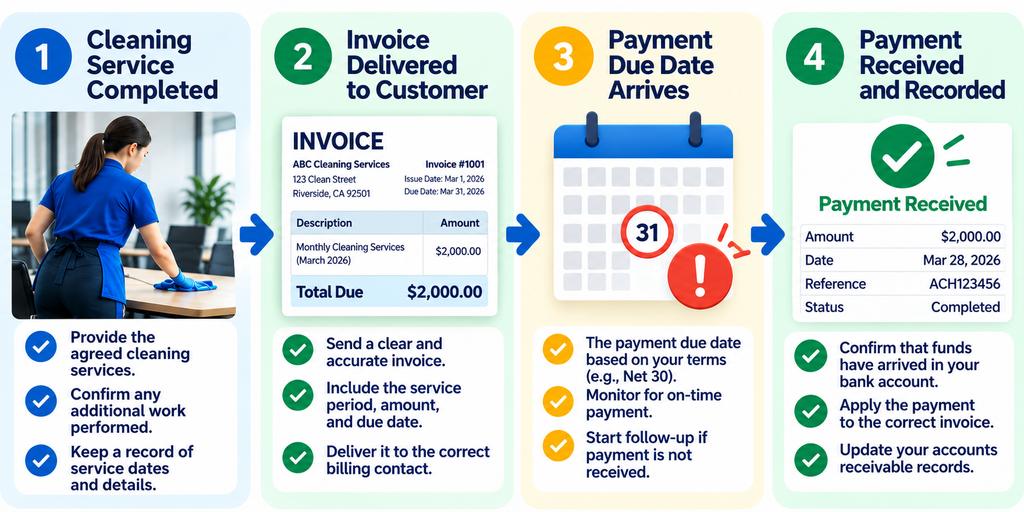
The collection process has four important stages: service completion, invoice delivery, payment due date, and confirmed receipt of funds.
Tracking each stage makes it easier to identify whether a payment problem started with invoicing, customer approval, or collection.
Why Accounts Receivable Management Matters
An overdue invoice creates more than an administrative inconvenience.
It can reduce the cash available for wages, force the business to delay planned purchases, and consume management time that could otherwise support customers and operations.
Consider two cleaning companies with the same monthly invoiced revenue.
| Metric | Company A | Company B |
|---|---|---|
| Monthly Invoiced Revenue | $30,000 | $30,000 |
| Unpaid Invoice Balance | $4,000 | $18,000 |
| Overdue Receivables | $1,000 | $9,000 |
| Collection Priority | Routine follow-up | Immediate review |
Both businesses invoice the same amount, but Company B has substantially more money tied up in unpaid customer balances.
This does not automatically mean Company B is less profitable. It does mean management should investigate payment timing, overdue invoices, and customer concentration.
Revenue growth is less useful when the business cannot reliably collect what customers owe.
Cleaning Business Accounts Receivable Aging Calculator
An accounts receivable aging report groups unpaid invoices according to how long they have been outstanding.
For practical collection management, it is often useful to measure the number of days past the contractual due date.
Use the calculator below to enter unpaid invoices, their due dates, and any remaining balances.
Enter each unpaid invoice’s remaining balance and payment due date. The calculator groups invoices by days past due and updates automatically.
| Invoice / Customer | Due Date | Unpaid Balance | Days Overdue | Aging Category | Remove |
|---|
Aging is based on the due date, not the invoice date. An invoice is overdue starting the day after its due date. You can add up to 20 invoices.
This is a planning tool, not an accounting or legal determination. Enter remaining unpaid balances after payments and approved credits. Aging categories are based on the report date you select. A disputed invoice remains outstanding until resolved or adjusted.
Build an Accounts Receivable Aging Report
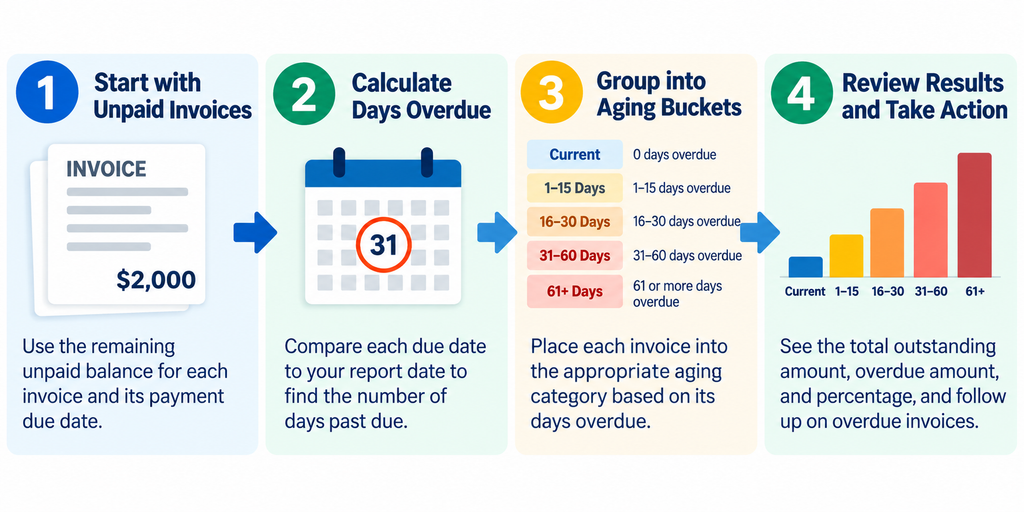
A useful aging report answers two questions: how much money remains unpaid, and how long has each invoice been overdue?
For this guide, aging is measured from the payment due date, rather than the invoice issue date.
| Aging Bucket | Meaning | Recommended Review |
|---|---|---|
| Current | Due date has not passed | Confirm invoice delivery |
| 1–15 Days Overdue | Recently past due | Send a courteous reminder |
| 16–30 Days Overdue | Payment delay continues | Confirm payment status |
| 31–60 Days Overdue | Extended delay | Escalate internally |
| 61+ Days Overdue | Significant collection risk | Review formal options |
These are suggested management categories, not universal legal deadlines.
Aging reports may also use invoice-date buckets. The important point is to define the method consistently so that staff do not confuse a 30-day-old invoice with an invoice that is 30 days overdue.
FIGURE 2 — HOW ACCOUNTS RECEIVABLE AGING WORKS
Example: Reading an Aging Report
Suppose a cleaning business has $20,000 in outstanding customer invoices.
| Category | Outstanding Balance |
|---|---|
| Current | $9,000 |
| 1–15 Days Overdue | $5,000 |
| 16–30 Days Overdue | $3,000 |
| 31–60 Days Overdue | $2,000 |
| 61+ Days Overdue | $1,000 |
| Total Accounts Receivable | $20,000 |
The overdue portion is $11,000.
Overdue AR Percentage = Overdue Receivables ÷ Total Accounts Receivable × 100
In this example:
$11,000 ÷ $20,000 × 100 = 55%
This is not the same as saying 55% of all sales are late. The denominator includes only invoices that remain unpaid at the reporting date.
A single snapshot is useful, but comparing the percentage over time is more informative.
1. Establish Clear Payment Terms Before Cleaning Begins
Collection problems often begin before the first invoice is issued.
If the contract does not clearly explain when invoices will be sent, who approves them, and when payment is due, the cleaning business may encounter avoidable delays.
A commercial cleaning agreement should address the payment process in practical terms.
| Payment Term | Question to Resolve |
|---|---|
| Billing Frequency | Weekly, monthly, or after each service? |
| Payment Due Date | When must payment arrive? |
| Invoice Recipient | Who receives the invoice? |
| Approval Process | Is a purchase order or service confirmation required? |
| Accepted Payment Methods | How can the customer pay? |
| Disputed Charges | How are billing questions resolved? |
Do not assume that the employee who arranged the cleaning contract is also responsible for approving invoices.
For larger customers, confirm the accounts payable contact and any required vendor registration before the first billing cycle.
The goal is to remove administrative barriers before they delay payment.
2. Send Accurate Invoices Promptly
Even reliable customers may pay late when an invoice is incomplete or sent to the wrong person.
A cleaning invoice should clearly identify the service period, work performed, agreed price, payment due date, and payment instructions.
For recurring commercial contracts, consistency matters. Sending invoices on different dates each month can make payment timing less predictable.
A simple invoicing workflow is:
- Confirm completed services and any approved additional work.
- Prepare the invoice using the agreed billing terms.
- Check the customer name, reference number, and amount.
- Send it to the correct billing contact.
- Record the invoice number and due date in the AR tracker.
Keep evidence of invoice delivery and any customer approval requirements.
When a customer disputes an amount, separate the disputed portion from the undisputed balance and resolve the issue according to the contract.
3. Create a Consistent Payment Follow-Up Process
A collection process should be predictable rather than improvised whenever cash becomes tight.
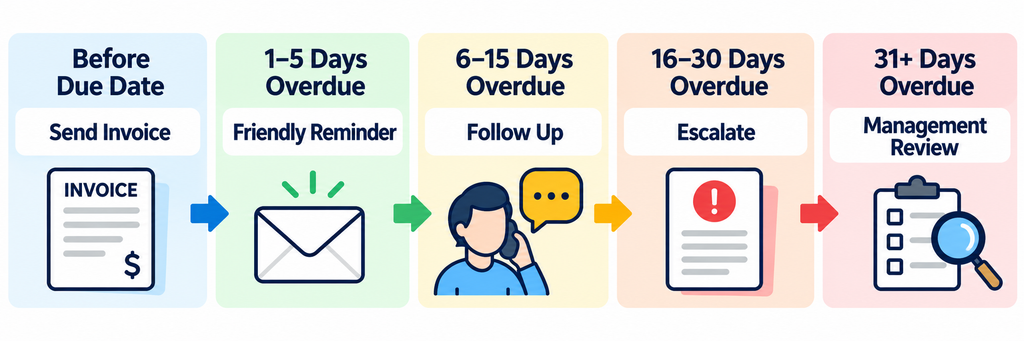
For example, a cleaning company might confirm invoice receipt before the due date, send a polite reminder shortly after the due date, and escalate unresolved invoices according to a documented schedule.
Suggested Follow-Up Schedule
| Timing | Action | Objective |
|---|---|---|
| Before Due Date | Confirm receipt when appropriate | Prevent processing problems |
| 1–5 Days Overdue | Send friendly reminder | Identify oversight |
| 6–15 Days Overdue | Contact billing representative | Confirm payment date |
| 16–30 Days Overdue | Escalate to account manager | Resolve persistent delay |
| 31+ Days Overdue | Management review | Decide next steps |
This schedule is an operational example, not a legal requirement.
Actual follow-up timing should reflect the contract, customer relationship, dispute status, and applicable law.
FIGURE 3 — A PRACTICAL INVOICE FOLLOW-UP TIMELINE
Example: First Payment Reminder
A professional reminder should identify the invoice without immediately suggesting bad faith.
Subject: Payment Follow-Up — Invoice [Invoice Number]
Hello [Customer Name],
I hope you are doing well.
I’m following up on invoice [Invoice Number] for [Amount], which was due on [Due Date].
Could you please confirm its payment status or let us know if any additional information is needed?
Thank you for your help.
Best regards,
[Your Name]
[Cleaning Business Name]
Keep the message factual and make it easy for the customer to respond.
Avoid sending aggressive or misleading threats. Collection requirements can differ depending on whether the debt is consumer or commercial, who is collecting it, and which laws apply.
The Consumer Financial Protection Bureau’s explanation of debt collection laws distinguishes consumer debt protections under the federal FDCPA from business debts, which are generally outside that law’s scope.
That distinction does not mean every collection practice is permitted for commercial debts. Applicable state laws, contracts, and other legal requirements still matter.
4. Track Partial Payments and Invoice Disputes Correctly
Not every unpaid invoice is simply late.
A customer may have paid part of the balance, requested a correction, or disputed additional services.
Your tracker should preserve the original invoice amount while separately recording payments, credits, and the remaining balance.
Remaining Balance = Original Invoice Amount − Payments Received − Approved Credits
For example, if a customer owes $1,500, pays $500, and receives an approved $100 credit, the remaining receivable is $900.
The $900—not $1,500—belongs in the outstanding AR total.
A practical tracker should also include a status field such as:
| Invoice Status | Meaning |
|---|---|
| Open | Unpaid and not yet due |
| Overdue | Past due with balance remaining |
| Partially Paid | Some payment received |
| Disputed | Customer questions part or all of invoice |
| Payment Scheduled | Customer has communicated a payment date |
| Paid | Balance is zero |
A promised payment date should be recorded, but it is not the same as confirmed receipt.
Keep disputed invoices visible rather than removing them from the report. Otherwise, management may underestimate the amount of money still unresolved.
5. Prioritize Collections by Risk, Not Just Invoice Age
The oldest invoice is not always the most urgent.
A relatively new overdue balance from a major customer may create more financial pressure than a much older invoice for a small amount.
When prioritizing follow-up, consider the unpaid amount, number of days overdue, customer payment history, concentration risk, and whether a dispute is blocking payment.
FIGURE 4 — WHICH UNPAID INVOICES NEED ATTENTION FIRST?
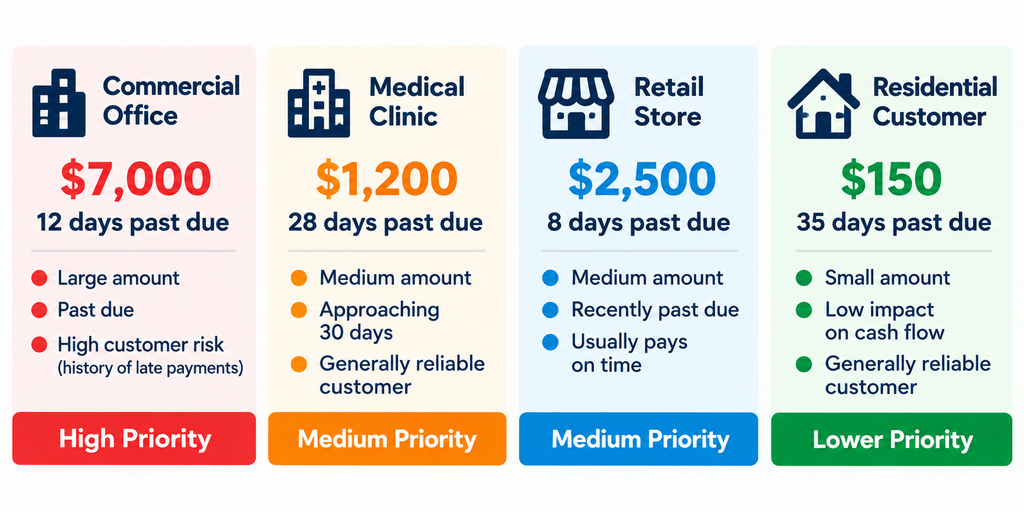
For example, a $7,000 invoice that is 12 days overdue may deserve immediate management attention if the business needs that payment for an upcoming payroll.
A $150 invoice that is 35 days overdue still needs follow-up, but it may not present the same near-term cash risk.
Prioritization should help staff allocate attention—not justify ignoring smaller customers or applying inconsistent terms.
6. Measure Collection Performance With Useful KPIs
Total outstanding receivables is important, but it does not fully describe collection performance.
Three additional indicators can help management identify changes.
Overdue AR Percentage
Overdue AR % = Overdue AR ÷ Total AR × 100
This measures the share of currently outstanding balances that are past due.
Days Sales Outstanding (DSO)
DSO = Average Accounts Receivable ÷ Net Credit Sales × Days in Period
For example, if average AR is $15,000 and net credit sales during a 30-day period are $30,000:
DSO = $15,000 ÷ $30,000 × 30 = 15 days
DSO estimates how long sales remain in receivables on average. It should use consistent accounting periods and credit-sales definitions.
It is not a direct measure of the number of days each invoice is overdue.
Collection Effectiveness
You can also monitor the percentage of invoices paid by their contractual due dates.
On-Time Payment Rate = Invoices Paid On Time ÷ Invoices Paid × 100
This is a count-based measure. It gives each invoice equal weight regardless of amount.
For a value-weighted perspective, calculate the proportion of invoice dollars collected by the due date.
Use these indicators together rather than treating one number as a complete diagnosis.
7. Connect Accounts Receivable to Your Cash Flow Forecast
An invoice aging report identifies what customers owe. A cash flow forecast estimates when money may actually arrive.
These are related but different management tools.
Suppose your cleaning business has $12,000 in outstanding invoices, including $5,000 overdue.
You should not automatically include the full $12,000 as cash expected next week.
Instead, review customer payment history, confirmed payment dates, disputes, and realistic collection expectations.
| Receivable Situation | Cash Flow Forecast Treatment |
|---|---|
| Payment Confirmed for Next Week | Include in next week’s expected receipts |
| Reliable Customer With Established Pattern | Forecast using realistic timing |
| Overdue With No Confirmed Date | Treat as uncertain |
| Invoice Under Dispute | Adjust for likely timing and resolution |
| Already Paid | Include in starting cash if funds are available |
For the full forecasting process, use the Cleaning Business Cash Flow Forecast Calculator.
A receivable becomes usable cash only when the payment is actually available to the business.
8. Reduce the Risk of Uncollectible Invoices
Some receivables may ultimately become uncollectible.
Prevention starts with clear contracts, accurate invoices, customer communication, and documented follow-up.
For customers with repeated payment problems, management may need to reconsider future credit terms, billing frequency, or whether to continue providing services under the existing arrangement.
Any decision to pause or terminate services must follow the contract and applicable law.
When an Invoice May Become a Bad Debt
An unpaid invoice does not automatically become a tax-deductible bad debt merely because it is overdue.
The IRS Tax Guide for Small Business explains that business bad-debt deductions depend on factors including whether the amount was previously included in taxable income and whether the debt has become partly or entirely worthless.
For example, under the cash method of accounting, a business generally cannot deduct unpaid service revenue as a bad debt if that revenue was never included in income.
Do not assume an unpaid invoice can simply be written off for tax purposes.
Consult a qualified tax professional before recording a deduction or changing accounting treatment.
Build a Simple Weekly Accounts Receivable Dashboard
You do not need an expensive reporting system to begin.
A spreadsheet or properly configured invoicing system can provide the basic information needed for a weekly review.
| Dashboard Metric | Management Purpose |
|---|---|
| Total Outstanding AR | Shows money still owed |
| Overdue AR | Identifies balances past due |
| Overdue AR Percentage | Tracks late-payment exposure |
| Largest Overdue Customer | Highlights concentration |
| Disputed Invoice Balance | Shows unresolved billing issues |
| Payments Expected This Week | Supports short-term cash planning |
| Follow-Ups Due | Keeps collection work organized |
FIGURE 5 — ACCOUNTS RECEIVABLE HEALTH DASHBOARD
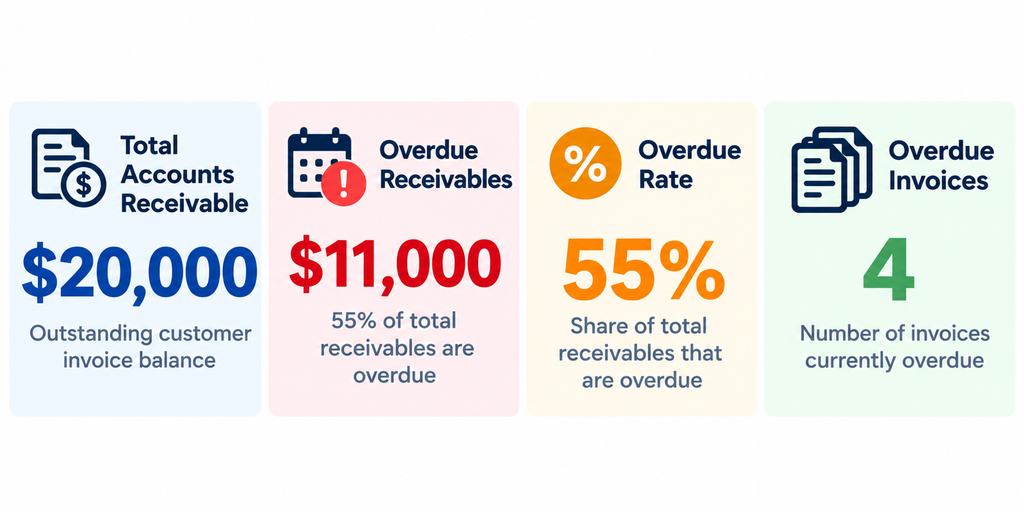
Review the dashboard on a consistent day each week.
During the review, confirm that payments have been applied to the correct invoices, check whether promised payment dates were met, and assign an owner to every significant overdue balance.
A dashboard is useful only when it leads to timely action.
A Practical Accounts Receivable Management Checklist
Use this interactive checklist to identify gaps in your accounts receivable process. Check off each item as you review your current practices and track your progress.
Review your accounts receivable process. Check each item when it is in place. Your progress is saved in this browser.
Check items to track your progress.
If several items remain unchecked, focus first on the gaps that could delay collections or create billing disputes. Revisit this checklist regularly as your cleaning business grows and your invoicing process evolves.
Collect What You Earn Before Chasing More Revenue
Growing a cleaning business requires more than winning new customers and completing additional jobs.
It also requires a reliable process for collecting the money those jobs generate.
Start with clear payment terms, accurate invoices, and a weekly accounts receivable aging report. Then use a consistent follow-up process to identify overdue balances before they create serious cash pressure.
As the business grows, monitor both the total amount owed and the reliability of collection.
A cleaning business is financially stronger when completed work becomes collected cash predictably—not merely when invoiced revenue increases.