
Running a cleaning business is not just about bringing in more revenue. What matters is how much money is left after paying for labor, supplies, vehicles, insurance, software, marketing, and other operating costs.
This free Cleaning Business Profit Margin Calculator helps you estimate your monthly net profit and net profit margin using the actual numbers from your business.
Enter your monthly revenue and expenses below to see:
- Total monthly costs
- Net profit
- Net profit margin
- Labor cost as a percentage of revenue
- Where your operating expenses are going
The calculator is designed for residential and commercial cleaning businesses and uses a simple net-profit calculation rather than assuming that one profit margin is “good” for every company.
Cleaning Business Profit Margin Calculator
Estimates are based on the monthly revenue and expenses you enter. This calculator is for planning purposes and does not provide accounting, tax, or financial advice.
How to Use the Cleaning Business Profit Margin Calculator
Using the calculator takes less than a minute. Enter your average monthly revenue, then add the monthly costs required to run your cleaning business.
Include labor, cleaning supplies and chemicals, vehicle and travel costs, insurance, software, marketing, and any other overhead expenses you regularly pay.
The calculator will automatically estimate your total monthly costs, net profit, net profit margin, and labor cost as a percentage of revenue.
For the most useful result, use actual figures from a recent month rather than rough estimates. If your revenue or expenses vary significantly throughout the year, calculate several representative months instead of relying on a single period.
How Cleaning Business Profit Margin Is Calculated
Net profit is the money left after subtracting your operating costs from revenue.
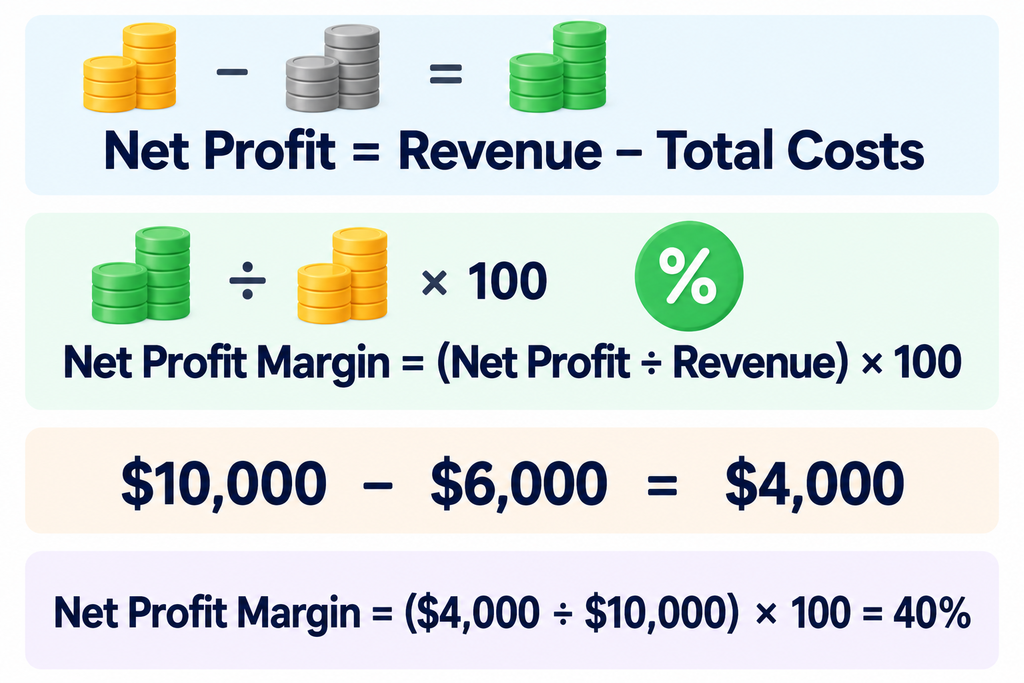
Net profit margin shows that profit as a percentage of revenue.
For example, suppose a cleaning business generates $10,000 in monthly revenue and has $6,000 in total monthly costs.
That means $0.40 of every $1 in revenue remains after the costs included in the calculation.
What Costs Should You Include?
A useful profit-margin calculation depends on including the real costs of running your cleaning business. Leaving out expenses can make the business look more profitable than it actually is.
Here are the main cost categories used in the OpsButler calculator.
Labor
Include wages paid to cleaners and other employees for the period you are calculating. If applicable, also account for employer-paid payroll costs and other labor expenses that are not already included elsewhere.
Supplies & Chemicals
Include cleaning chemicals, disposable supplies, gloves, trash bags, paper products, and other consumable items used to complete cleaning jobs.
Vehicle & Travel
Include the business costs associated with getting your team and equipment to jobs, such as fuel, vehicle expenses, parking, and other job-related travel costs.
Insurance
Include business insurance costs attributable to the period, such as general liability, commercial auto, and other insurance carried by your cleaning company.
Software
Include recurring software expenses for scheduling, customer management, invoicing, payroll, accounting, communication, and other tools used to operate the business.
Marketing
Include advertising, lead-generation services, website expenses, local marketing, and other recurring costs used to attract customers.
Other Overhead
Use this category for operating costs that do not fit neatly into the categories above, such as office expenses, professional services, licenses, phone service, equipment costs, and other recurring business expenses.
Avoid entering the same expense in more than one category.
Gross Profit vs. Net Profit: What’s the Difference?
Gross profit and net profit measure different things, so it is important not to confuse them when evaluating your cleaning business.
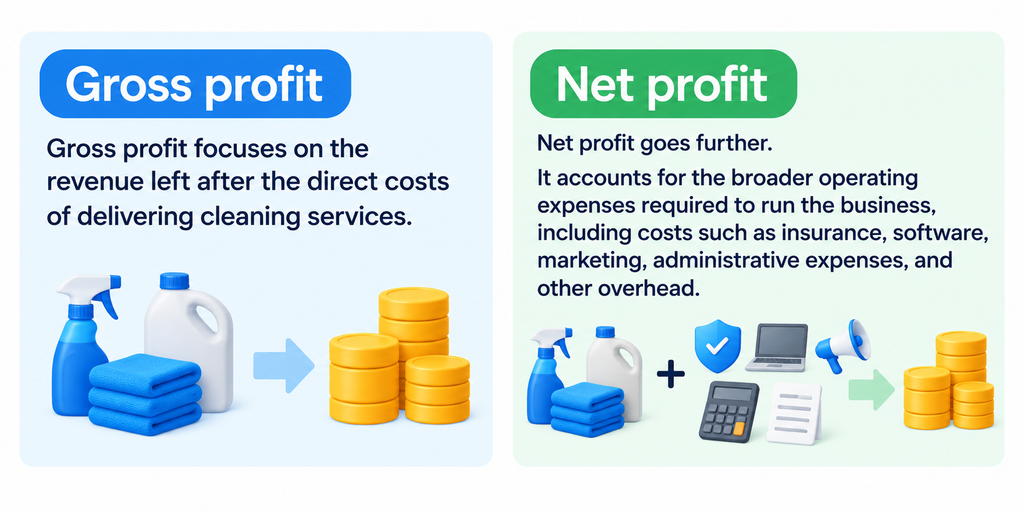
Gross profit focuses on the revenue left after the direct costs of delivering cleaning services. Depending on how a business keeps its books, those direct costs may include cleaner labor, cleaning supplies, and other costs directly tied to completing jobs.
Net profit goes further. It accounts for the broader operating expenses required to run the business, including costs such as insurance, software, marketing, administrative expenses, and other overhead.
For example, a cleaning company can have a strong gross profit on individual jobs but still produce a much lower net profit after overhead is included.
The OpsButler calculator on this page focuses on net profit based on the expense categories you enter. This gives you a broader view of how much money remains after the operating costs included in your calculation.
What Your Profit Margin Can Tell You
Your profit margin is most useful as a business-management metric rather than a score.
Instead of asking whether one percentage is universally “good” or “bad,” track how your own margin changes over time and investigate what is driving those changes.
A falling margin may mean that labor costs, supplies, travel, marketing, or other expenses are increasing faster than revenue. It can also indicate that some jobs are priced too low for the cost of delivering them.
A rising margin may indicate better pricing, improved scheduling, higher team productivity, lower operating costs, or a more profitable mix of customers and services.
Compare similar periods whenever possible. Seasonal changes, one-time expenses, equipment purchases, and unusual jobs can make a single month less representative of the business overall.
Why Cleaning Businesses Lose Profit Even When Revenue Grows
Higher revenue does not automatically mean higher profit. A cleaning business can add customers and complete more jobs while its profit margin stays flat or even falls.
Here are some common reasons.
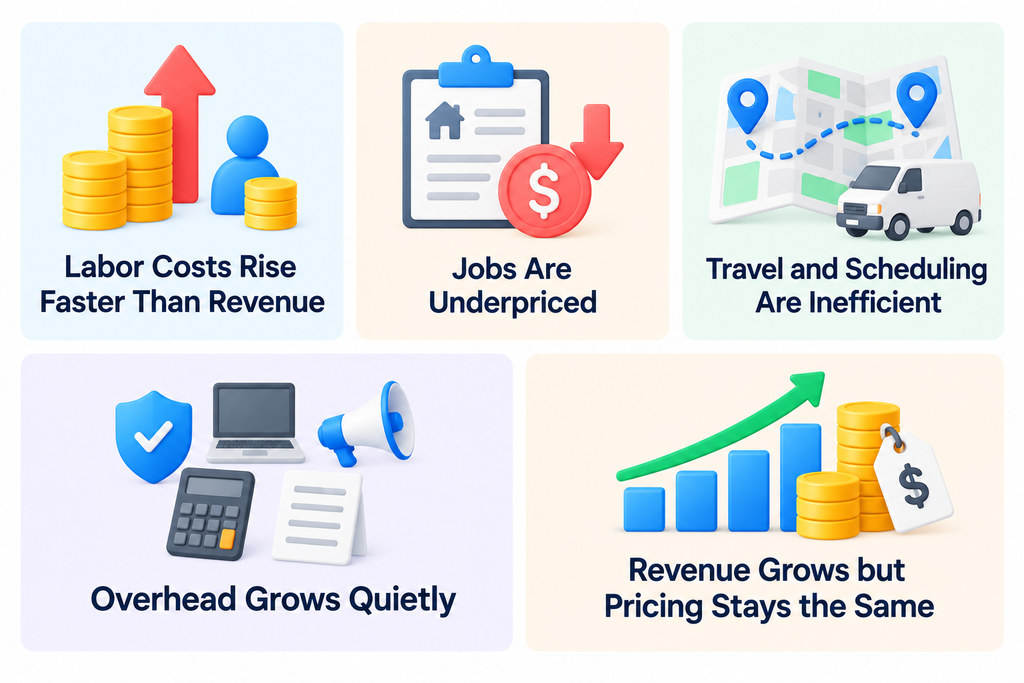
Labor Costs Rise Faster Than Revenue
Labor is often one of the largest costs in a cleaning business. If jobs regularly take longer than expected, overtime increases, or staffing costs rise without corresponding price adjustments, additional revenue may produce little additional profit.
Jobs Are Underpriced
A job can generate revenue and still contribute too little profit if the price does not reflect the time, labor, supplies, travel, and overhead required to complete it.
Tracking actual job costs can help identify services or customers that may need to be repriced.
Travel and Scheduling Are Inefficient
Long travel times, gaps between appointments, inefficient routes, and last-minute schedule changes can increase paid time and vehicle costs without increasing billable revenue.
Better scheduling can therefore improve profitability even when the number of jobs stays the same.
Overhead Grows Quietly
Software subscriptions, insurance, advertising, administrative expenses, equipment, and other overhead costs can accumulate gradually.
Review recurring expenses periodically instead of focusing only on labor and cleaning supplies.
Revenue Grows but Pricing Stays the Same
Costs can change over time. If wages, supplies, insurance, fuel, and other expenses increase while customer prices remain unchanged, profit margin can shrink even as total revenue increases.
Regularly reviewing both pricing and actual operating costs helps show whether growth is translating into more profit.
How to Use Profit Margin When Setting Your Cleaning Prices
Knowing your profit margin is useful only if you use the information to make better business decisions.
If your margin is lower than you expected, raising every customer’s price immediately is not necessarily the answer. First identify which costs, jobs, or operating problems are reducing profit.
Start by comparing the revenue from a job with the costs required to complete it. Consider cleaner labor, supplies, travel time, and other costs directly associated with providing the service.
Then remember that each job also needs to contribute toward the broader costs of running the business, including insurance, software, marketing, administration, and other overhead.
A price that covers labor and supplies but contributes too little toward overhead and profit can keep your team busy without making the business financially stronger.
Review Actual Job Time
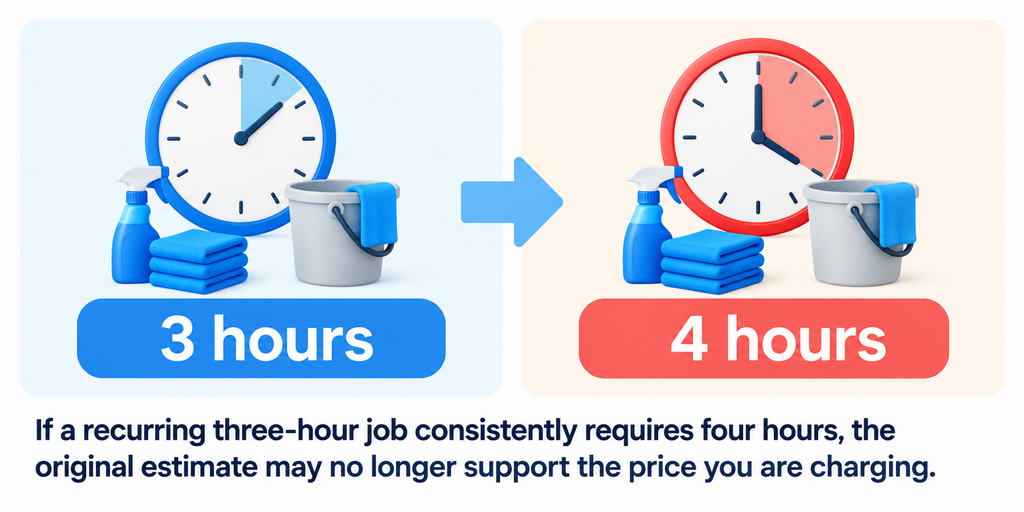
Compare the time you expected a cleaning job to take with the time it actually takes.
Watch Labor as a Percentage of Revenue
The calculator above shows labor cost as a percentage of revenue because changes in labor can have a significant effect on profitability.
Track this percentage over time. If labor consumes a growing share of revenue, investigate whether the cause is pricing, productivity, overtime, scheduling, staffing, or a combination of factors.
Review Prices When Costs Change
Customer prices do not automatically adjust when wages, supplies, fuel, insurance, software, or other business expenses increase.
Periodically recalculate your costs and profit margin so that pricing decisions are based on current operating conditions rather than assumptions made months or years earlier.
Do Not Judge Every Job by Revenue Alone
Two customers paying the same amount can produce very different profits.
One property may require more cleaners, longer travel, additional supplies, difficult access, or significantly more time. Looking beyond revenue helps you identify which jobs are actually contributing to the profitability of the business.
Cleaning Business Profit Margin Example
Here is a simple example of how the calculator works for a cleaning business generating $20,000 in monthly revenue.
| Monthly Item | Amount |
|---|---|
| Revenue | $20,000 |
| Labor | $8,000 |
| Supplies & Chemicals | $1,000 |
| Vehicle & Travel | $800 |
| Insurance | $400 |
| Software | $200 |
| Marketing | $1,000 |
| Other Overhead | $600 |
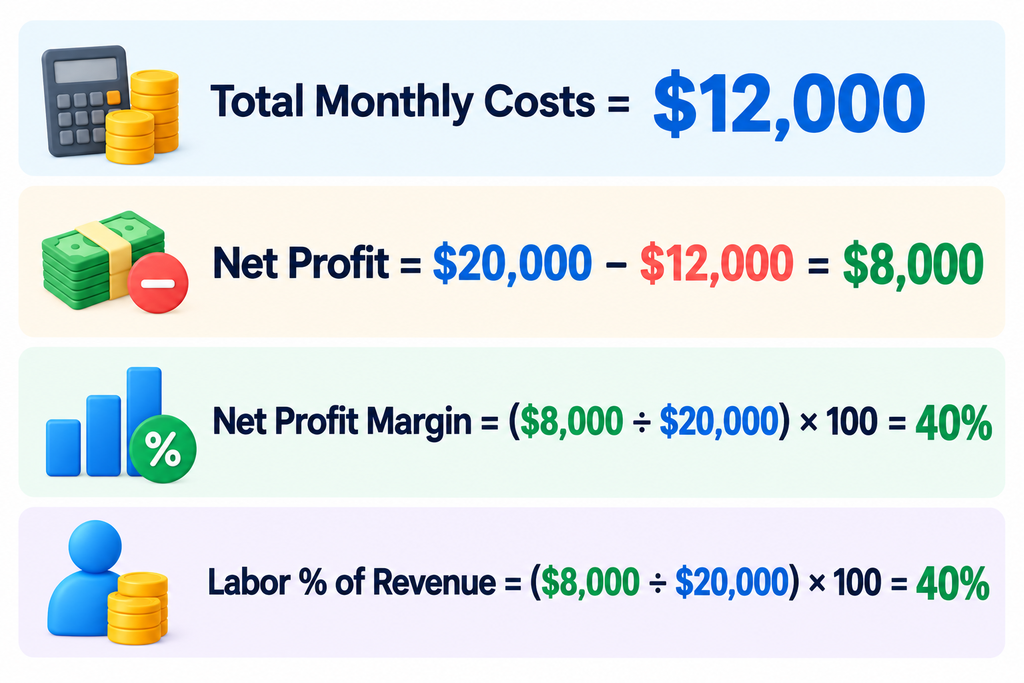
In this example, the business keeps $0.40 of every $1 in revenue after the operating costs included in the calculation.
The example does not mean that a 40% net profit margin should be expected or targeted by every cleaning company. Actual results depend on pricing, staffing, service mix, location, overhead, owner compensation, accounting treatment, and other factors.
The purpose of the calculation is to create a consistent way to measure your own business and compare its performance over time.
Frequently Asked Questions
How do you calculate profit margin for a cleaning business?
Subtract the operating costs included in your calculation from revenue to estimate net profit. Then divide net profit by revenue and multiply by 100 to calculate net profit margin.
Net Profit Margin = (Net Profit ÷ Revenue) × 100
What expenses should a cleaning business include when calculating profit?
Include the costs required to operate the business during the period you are measuring. These may include labor, cleaning supplies and chemicals, vehicle and travel costs, insurance, software, marketing, administrative expenses, and other overhead.
The exact categories depend on how your business operates and keeps its financial records.
What is a good profit margin for a cleaning business?
There is no single profit margin that is appropriate for every cleaning business.
Margins can vary based on labor structure, pricing, location, service type, customer mix, overhead, owner compensation, and accounting methods. Instead of relying on one universal target, calculate your margin consistently and compare it with your own previous periods and business goals.
Why can revenue increase while profit margin falls?
Revenue can grow while profit margin falls if expenses increase faster than sales. Higher labor costs, inefficient scheduling, additional travel, rising supply costs, increased overhead, or underpriced jobs can all reduce the percentage of revenue that remains as profit.
How often should I calculate my cleaning business profit margin?
Monthly tracking provides a useful view for many cleaning businesses because it can reveal changes in revenue and expenses relatively quickly.
It can also be useful to compare several months, quarters, and year-over-year periods so that seasonal changes or unusual one-time expenses do not distort your conclusions.
Final Take
Revenue tells you how much money your cleaning business brings in. Profit margin helps show how much of that revenue remains after the costs included in your calculation.
Use the calculator above with real business numbers, track the result consistently, and investigate why the margin changes over time.
The goal is not simply to chase a particular percentage. It is to understand the relationship between your pricing, labor, operating costs, and profit well enough to make better decisions as the business grows.
Build a More Profitable Cleaning Business
Profitability is also affected by how efficiently you schedule jobs and manage day-to-day operations.
If scheduling and travel time are eating into your margins, see our comparison of the Best Scheduling Software for Cleaning Businesses.
If you are evaluating software for the broader operation of your company, start with our guide to the Best Cleaning Business Software.