
Knowing how much to charge for house cleaning is one of the most important decisions you’ll make as a cleaning business owner.
Charge too little, and a full schedule can still leave you with very little profit. Charge too much without understanding your market or costs, and it can become harder to win new customers.
The goal isn’t simply to copy what another cleaning company charges.
It’s to understand what the job actually costs you, how long it takes, and how much profit you want the job to produce.
Use the calculator below to estimate a starting price, then use the rest of this guide to understand the numbers behind it.
House Cleaning Price Calculator
Use this calculator to estimate a house cleaning price based on the labor and operating costs required for a specific job.
Enter the number of cleaners, estimated cleaning time, labor cost, supplies, travel, allocated overhead, and the profit margin you want to model.
The calculator will estimate:
- Labor Cost
- Total Job Cost
- Suggested Price
- Estimated Profit
- Effective Team Hourly Rate
House Cleaning Price Calculator
Estimate a cleaning price based on your job costs and desired profit margin.
Estimates are based on the job information you enter. This calculator is for planning purposes and does not provide accounting, tax, or financial advice.
- Number of Cleaners
- Hours per Cleaner
- Hourly Labor Cost
- Supplies & Chemicals
- Travel Cost
- Allocated Overhead
- Desired Profit Margin
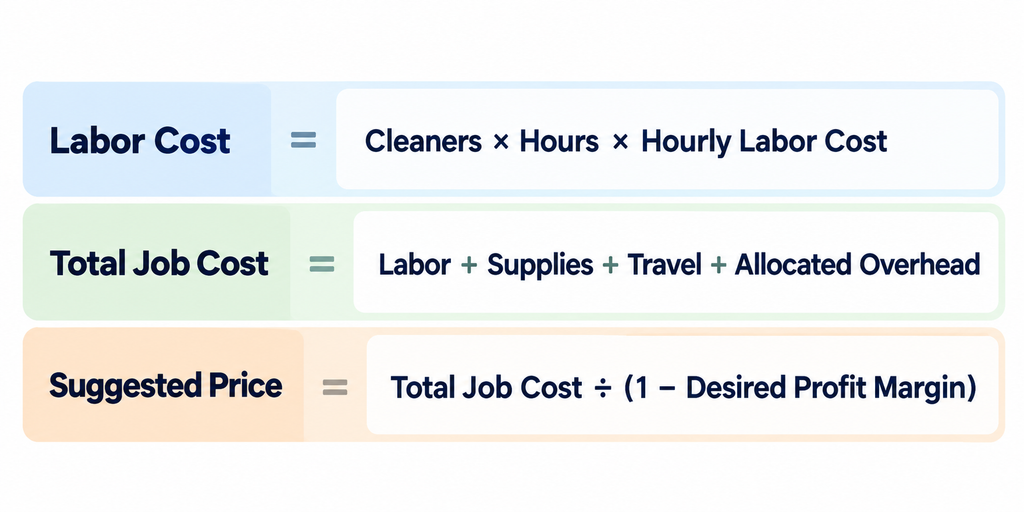
The calculator provides an estimate based on the information you enter. It is intended for planning purposes and does not provide accounting, tax, or financial advice.
How to Use the House Cleaning Price Calculator
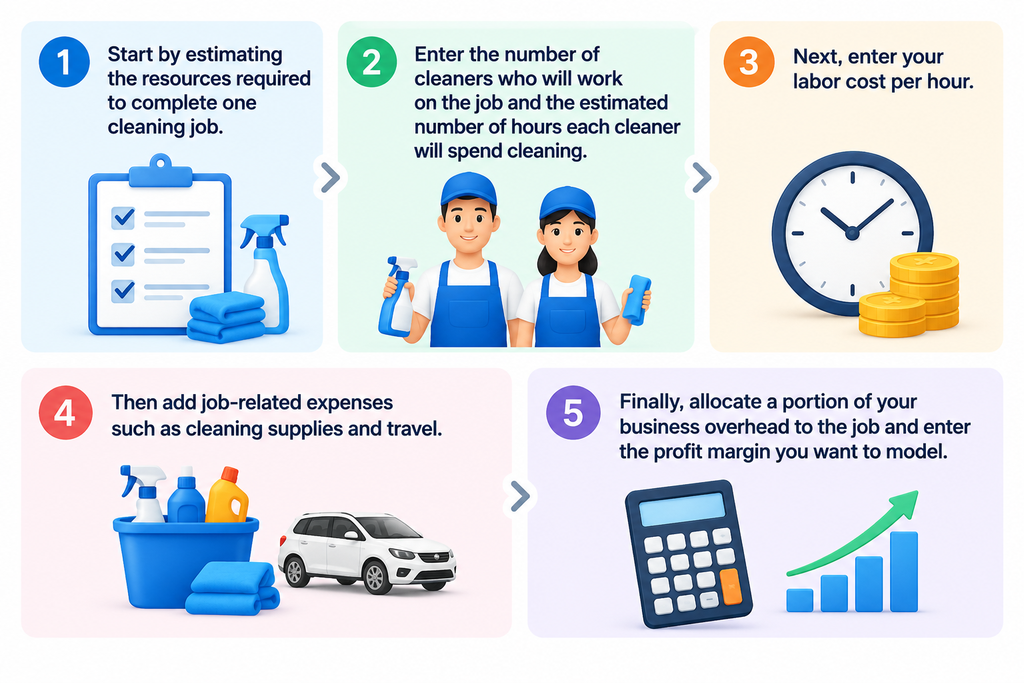
The calculator will estimate a price designed to cover those costs while leaving the selected margin.
Remember that the result is a pricing estimate, not a required market price. Local competition, home condition, service level, frequency, and customer expectations can all affect the final quote.
How Much Should You Charge for House Cleaning?
There is no single house cleaning rate that works for every business.
Residential cleaning businesses commonly use four pricing structures:
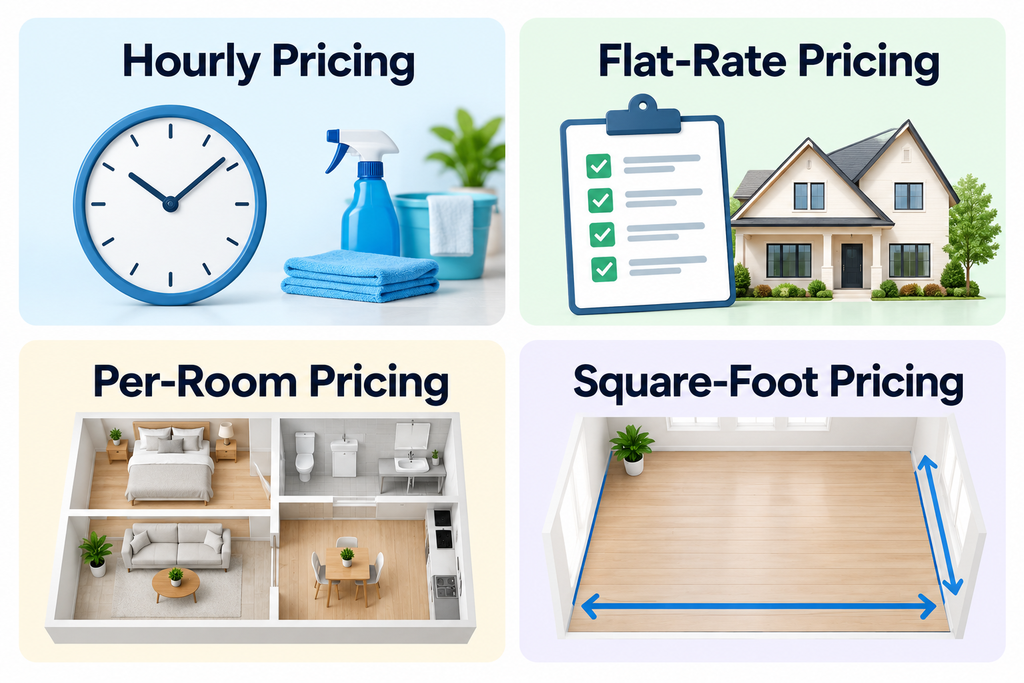
The right method depends on how predictable the job is and how accurately you can estimate the work required.
Your actual price should account for your own labor and operating costs rather than relying only on industry averages.
Hourly House Cleaning Pricing
Hourly pricing means charging customers according to the amount of time spent cleaning.
It can work particularly well when the scope of work is difficult to predict.
Examples may include:
- First-time cleans
- Heavily soiled properties
- Move-out cleaning
- Unusual or customized jobs
- Jobs where the condition is unknown
Hourly pricing reduces some of the risk of underestimating how long a difficult job will take.
However, customers may have less certainty about the final bill.
Housecall Pro notes that hourly pricing can be useful for unpredictable work, while flat-rate pricing can work better for routine and repeatable cleaning services.
Flat-Rate House Cleaning Pricing
Flat-rate pricing gives the customer one price for the entire cleaning job.
For example:
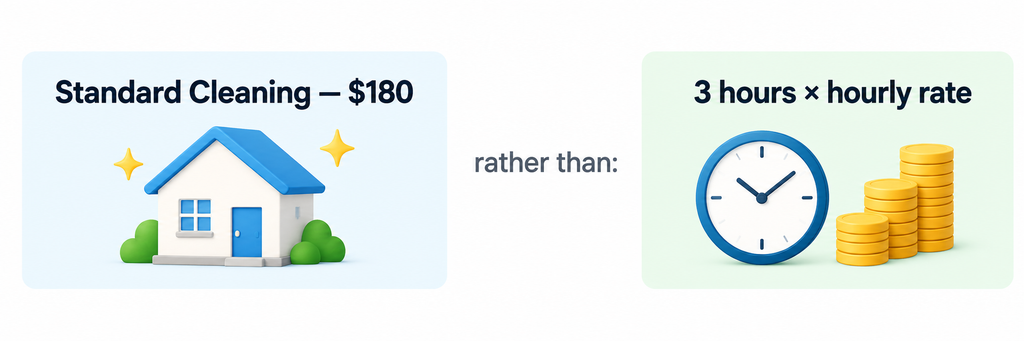
Flat-rate pricing can make quotes easier for customers to understand and can work especially well once you have enough historical data to estimate job times accurately.
It is often useful for:
- Recurring cleaning
- Standard cleaning packages
- Properties you have cleaned before
- Jobs with a predictable scope
But flat-rate pricing creates another risk.
If you estimate a three-hour job and it regularly takes five hours, your effective hourly revenue falls quickly.
That is why tracking actual job time remains important even when customers never see an hourly price.
Pricing by Square Foot
Some cleaning businesses use square footage as part of their estimating process.
A larger property generally requires more time and labor, so square footage can provide a useful starting point.
But square footage alone does not tell you how difficult a property will be to clean.
Two 2,000-square-foot homes can require very different amounts of work depending on:
- Number of bathrooms
- Number of occupants
- Pets
- Clutter
- Cleaning frequency
- Property condition
- Requested services
For that reason, square footage works best as one pricing input rather than the only pricing input.
Pricing by Room
Another approach is to base pricing partly on the number and type of rooms.
Bathrooms and kitchens typically require different amounts of work than bedrooms or lightly used living areas.
A business might therefore start with a base price and adjust it according to:
- Bedrooms
- Bathrooms
- Kitchens
- Additional living spaces
- Extra services
This can make online estimates easier, but you still need to understand the labor required behind each price.
What Costs Should Your Cleaning Price Cover?
A cleaning quote needs to cover more than wages.
Common business costs can include labor, supplies, insurance, advertising, vehicle expenses, software, and other overhead.
For pricing purposes, consider the following costs.
Labor
Labor is often one of the most important costs in a service business.
Include the actual cost of the people performing the cleaning.
If two cleaners each spend three hours on a job, that represents:
2 cleaners × 3 hours = 6 labor hours
Do not confuse six labor hours with three hours on the customer’s clock.
Supplies and Chemicals
Include cleaning products and consumable supplies used to complete jobs.
Even relatively small supply costs reduce profit when they are ignored across hundreds of jobs.
Vehicle and Travel
Travel between jobs consumes both time and money.
Depending on how you operate, costs can include fuel, maintenance, parking, tolls, and other business vehicle expenses.
Business vehicle use and personal commuting can receive different accounting or tax treatment, so that distinction should be handled separately from this pricing estimate.
Insurance
General liability insurance, workers’ compensation where applicable, vehicle insurance, and other business coverage can contribute to overhead.
Software
Scheduling, CRM, payment processing, accounting, communication, and other software subscriptions should eventually be paid for by the revenue your jobs generate.
Marketing
Website expenses, advertising, lead generation, printed materials, and other customer acquisition costs also affect overall profitability.
Other Overhead
Other overhead may include:
- Office expenses
- Phone service
- Professional fees
- Licenses
- Equipment
- Administrative labor
Not every expense belongs entirely to one job.
Instead, businesses can allocate a reasonable portion of monthly overhead across the jobs they expect to complete.
Cleaning Price Example
Suppose a standard house cleaning requires:
| Item | Amount |
|---|---|
| Cleaners | 2 |
| Hours per Cleaner | 2.5 |
| Labor Cost per Hour | $20 |
| Supplies | $15 |
| Travel | $10 |
| Allocated Overhead | $25 |
| Desired Profit Margin | 30% |
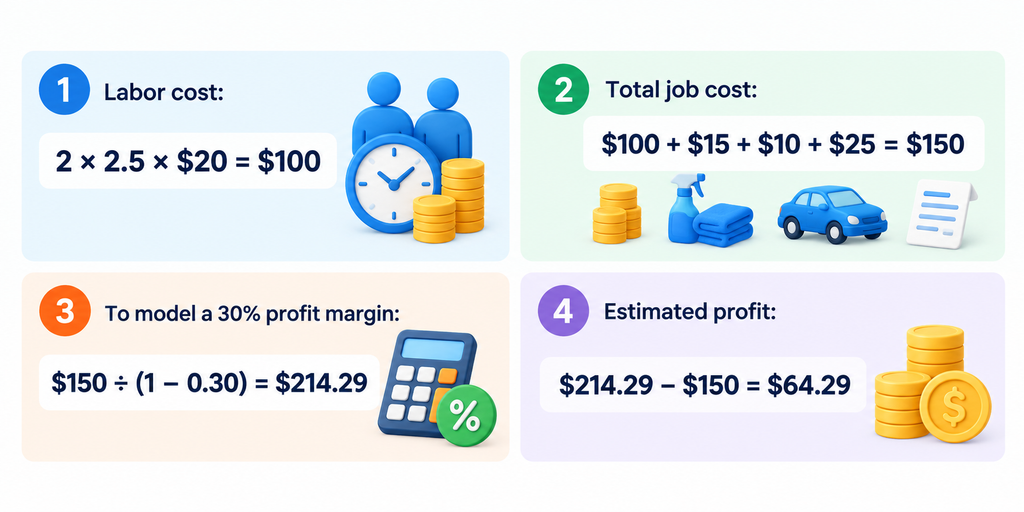
This does not mean every cleaning company should charge $214.29.
It demonstrates how a business can work backward from its own costs and a modeled profit margin before comparing the result with its local market.
Markup vs. Profit Margin
Markup and profit margin are not the same thing.
This matters when setting cleaning prices.
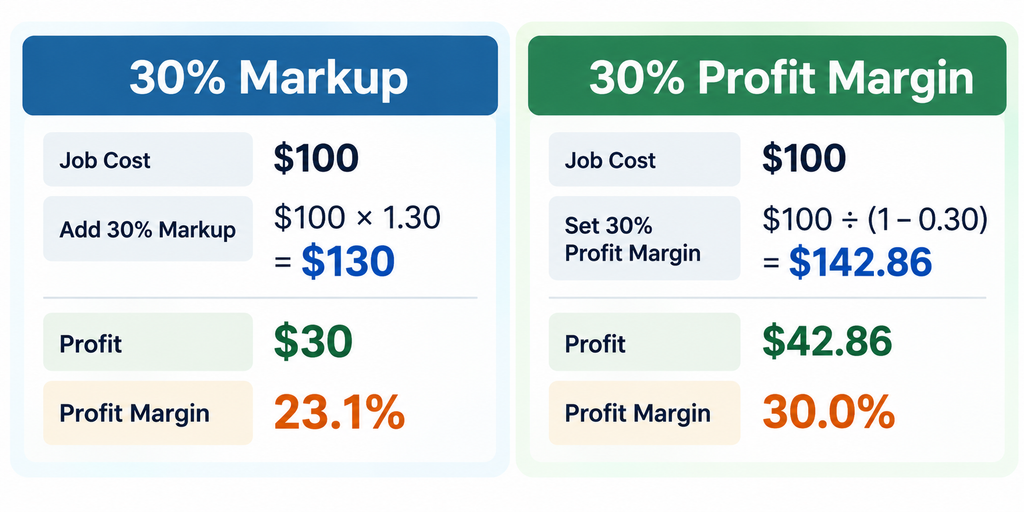
That distinction is one reason pricing purely by adding a percentage to your costs can produce a different margin than expected.
Why Cheap Cleaning Jobs Can Be Expensive for Your Business
A job does not have to lose money on paper to be a poor use of your schedule.
Imagine two jobs both generate $200 in revenue.
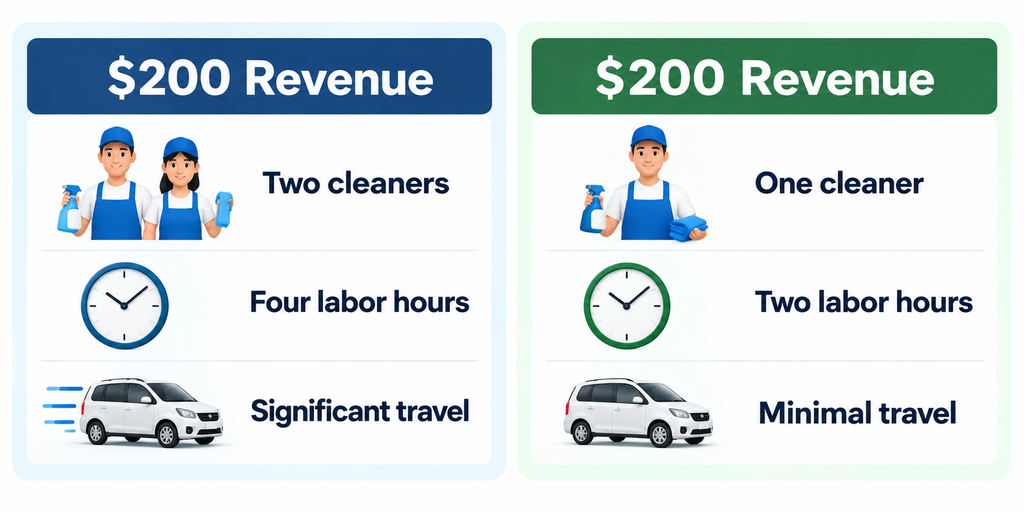
The revenue is identical, but the economics are completely different.
This is why revenue alone is not enough to judge whether a cleaning job is attractive.
Track the labor, direct costs, overhead, and time required to generate that revenue.
How Often Should You Review Your Cleaning Prices?
Pricing should not be a one-time decision.
Review your pricing when meaningful costs change, including:
- Labor rates
- Supply prices
- Insurance
- Fuel and travel
- Software
- Marketing costs
You should also compare your estimated job times with the time jobs actually take.
If a service consistently requires more labor than expected, the problem may be the price, the scope of work, operational efficiency—or a combination of all three.
Don’t Copy Competitor Prices Blindly
Knowing what other cleaning companies charge can help you understand your local market.
But competitors may have completely different:
- Labor costs
- Overhead
- Service packages
- Customer segments
- Team productivity
- Profit goals
A competitor’s price tells you something about the market.
It does not tell you whether that price would be profitable for your business.
Use market pricing as a reference, then compare it with your own economics.
Frequently Asked Questions
How do I calculate a house cleaning price?
Estimate the labor required, add supplies, travel, and an appropriate share of overhead, then determine the price required to support the profit margin you want to model.
Should I charge hourly or a flat rate for house cleaning?
Hourly pricing can be useful when the amount of work is unpredictable. Flat-rate pricing can work well when you can reliably estimate the scope and time required for a repeatable service.
Should cleaning supplies be included in my price?
Your pricing should account for supplies that your business pays for. Whether you display those costs separately to customers or include them in a flat price is a business decision.
How do I calculate a price for multiple cleaners?
Calculate total labor hours across the team.
For example, two cleaners working for three hours each equals six labor hours.
Multiply those hours by your labor cost, then add the other costs associated with the job.
What profit margin should a cleaning business target?
There is no universal profit margin that is appropriate for every cleaning company.
Business size, labor model, location, services, overhead, and growth strategy can all affect the result.
Use the calculator to model different margins rather than treating one percentage as a universal benchmark.
Final Take
Knowing how much to charge for house cleaning starts with knowing your own numbers.
Market rates matter, but your price also needs to reflect the labor, supplies, travel, overhead, and other costs required to deliver the service.
Once you understand those costs, you can compare different pricing structures and model how changes in price affect profitability.
Know What You Actually Keep
Pricing a cleaning job is only half of the equation.
Once revenue starts coming in, track how much remains after all of your business expenses.
Use the Cleaning Business Profit Margin Calculator to estimate your overall monthly costs, net profit, profit margin, and labor percentage.
Cleaning Business Profit Margin Calculator
And as your schedule grows, compare tools that can help manage recurring jobs and teams.