
Getting new clients is one of the biggest challenges when starting or growing a cleaning business.
You can offer excellent service and competitive pricing, but the business still needs a reliable way to turn local homeowners and businesses into paying customers.
The good news is that you do not need to start with a large advertising budget.
Referrals, Google Business Profile, local partnerships, reviews, and direct outreach can all help you build an initial customer base before investing heavily in paid advertising.
This guide covers 12 practical ways to get clients for a cleaning business, how to choose the right acquisition channels, and a simple 30-day plan for getting your first customers.
How to Get Clients for a Cleaning Business: The Quick Answer
If you are starting from zero, focus on these five things first:
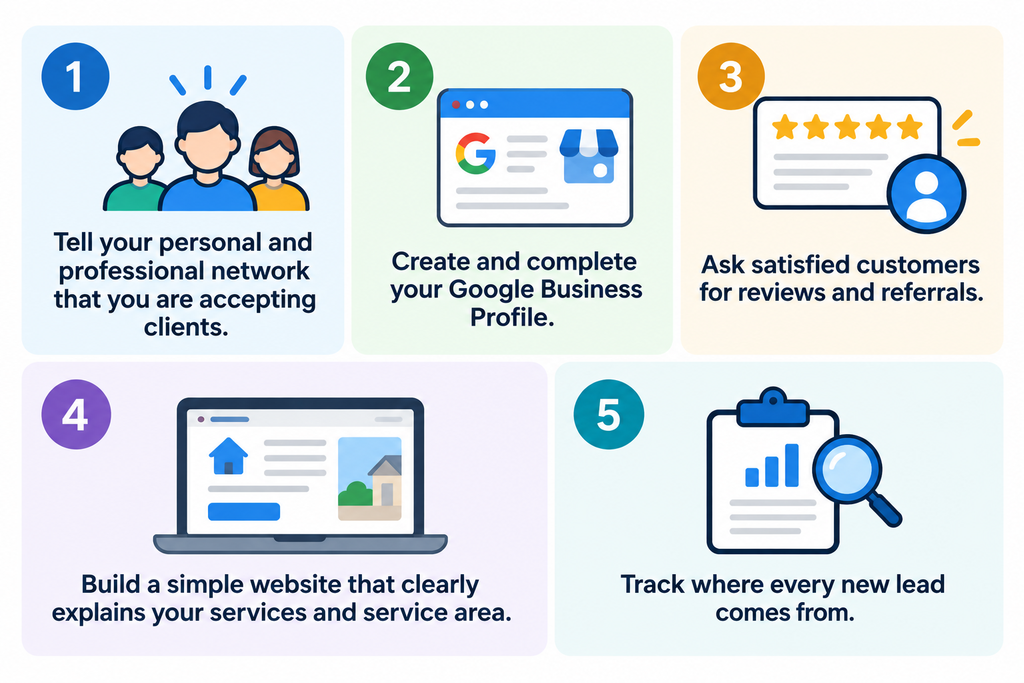
You do not need to use every marketing channel at once.
Trying Google Ads, Facebook, flyers, SEO, Nextdoor, referrals, and several other channels simultaneously can make it difficult to understand what is actually working.
Start with a few low-cost channels, get your first customers, collect reviews, and expand from there.
Before You Look for Clients: Decide Who You Want to Serve
Before spending money on marketing, decide what type of cleaning customer you want to attract.
A homeowner looking for biweekly house cleaning behaves differently from an office manager looking for a commercial cleaning company.
Your target customer affects your pricing, marketing channels, sales process, and the way you communicate your offer.
Residential Cleaning Clients
Residential clients can include:
- Homeowners
- Renters
- Busy professionals
- Families
- Landlords
- Short-term rental hosts
Common services include recurring cleaning, standard house cleaning, deep cleaning, move-in and move-out cleaning, and vacation rental turnover cleaning.
For residential cleaning, local search visibility, customer reviews, referrals, neighborhood communities, and a simple way to request a quote can all be useful.
Before promoting your services, make sure you know what you are going to charge.
If you have not worked out your pricing yet, see our How Much to Charge for House Cleaning: Pricing Guide & Calculator (2026) and use the House Cleaning Price Calculator to estimate a starting price.
Commercial Cleaning Clients
Commercial cleaning usually requires a different approach.
Potential clients can include:
- Offices
- Retail stores
- Property managers
- Medical and professional offices
- Gyms
- Schools and childcare facilities
- Apartment buildings
- Other local businesses
Instead of waiting for these businesses to find you, commercial cleaning can involve more proactive prospecting, networking, partnerships, walkthroughs, and customized quotes.
Know which market you are targeting before deciding where to spend your marketing time and budget.
12 Ways to Get Clients for Your Cleaning Business
There is no single marketing channel that works for every cleaning company.
The goal is to build a combination of channels that consistently produces qualified leads.
1. Start With Your Personal Network
Your first client does not need to come from an advertisement.
Tell people you already know that you are accepting cleaning jobs.
That could include:
- Friends
- Family
- Neighbors
- Former coworkers
- Local business owners
- Realtors
- Landlords
- Property managers
- People you know through local community groups
Be specific.
Instead of simply saying:
“I started a cleaning business.”
Try something closer to:
“I’m taking on new residential cleaning clients in [your service area]. I offer recurring and deep cleaning, and I’m currently filling my first few regular spots.”
People cannot refer you if they do not clearly understand what you sell.
Your personal network may not be a scalable acquisition channel forever, but it can help you land early jobs without paying for leads.
2. Set Up and Optimize Your Google Business Profile
For a local cleaning company, Google Business Profile can be an important online presence.
Cleaning companies that travel to customers may operate as service-area businesses, depending on how the business serves customers.
Complete your profile accurately, including:
- Business name
- Phone number
- Website
- Service area
- Business hours
- Services
- Business description
- Photos
Keep this information current as your business changes.
When someone finds your company through Google, they should quickly understand what you do, where you work, and how to contact you.
3. Ask Happy Customers for Reviews
Cleaning is a trust-based service.
Customers may be giving you access to their home, office, property, or possessions.
Reviews can give potential customers more information about other customers’ experiences before they contact you.
After a successful job, make it easy for the customer to leave a review.
For example:
“Thanks again for choosing us. If you were happy with the cleaning, we’d really appreciate a quick review. It helps local customers find our business.”
Do not make the process unnecessarily complicated.
4. Build a Simple Referral Program
Satisfied customers already know what your service is like.
That makes referrals a natural way to generate additional cleaning jobs.
A referral program could offer:
- A discount on a future cleaning
- A service add-on
- A fixed account credit
- A reward after a referred customer completes their first paid cleaning
Whatever you choose, keep the rules simple and clear.
And remember to actually ask.
A satisfied customer may never think about referring someone unless you give them a reason or reminder.
5. Use Nextdoor and Local Facebook Groups
Cleaning is a local service, so neighborhood communities can be useful places to build awareness.
Look for communities focused on:
- Your city
- Specific neighborhoods
- Local recommendations
- Homeowners
- Families
- Rentals and property management
- Small businesses
Avoid treating community groups as free advertising boards.
Follow the group’s rules, participate appropriately, and respond when someone genuinely asks for cleaning recommendations.
The objective is not to post everywhere.
It is to be visible where potential customers already spend time.
6. Build a Website That Turns Visitors Into Leads
A cleaning business website does not need dozens of pages.
At minimum, a potential customer should quickly understand:
- What you clean
- Where you work
- What services you offer
- Why they should consider your company
- How to request a quote or book
Create dedicated pages for important services when appropriate.
Examples include:
- Recurring house cleaning
- Deep cleaning
- Move-out cleaning
- Commercial cleaning
Give visitors a clear next step.
Examples:
Get a Free Quote
Request an Estimate
Book a Cleaning
Do not make visitors search for the next action.
7. Use Local SEO to Get Found on Google
Local SEO can help your website appear when people search online for cleaning services in your area.
Start by creating genuinely useful pages around the services customers are looking for.
For example:
- House cleaning in [city]
- Deep cleaning in [city]
- Move-out cleaning in [city]
- Office cleaning in [city]
Avoid creating dozens of nearly identical pages that only change the city name.
Each page should provide useful information about the service you actually provide in that location.
SEO generally takes longer than direct outreach or paid advertising, but local organic visibility can become a long-term source of leads.
8. Partner With Realtors, Property Managers, and Local Businesses
One business relationship can sometimes generate multiple cleaning opportunities.
Potential referral partners include:
- Realtors
- Property managers
- Apartment managers
- Vacation rental hosts
- Moving companies
- Home organizers
- Contractors
- Interior designers
- Local offices
Approach the relationship from the partner’s perspective.
A realtor may need dependable cleaning before listings, open houses, or move-ins.
A property manager may need someone who can handle turnovers reliably.
Make it easy for partners to understand when and why they should contact you.
9. Use Door Hangers and Flyers Strategically
Offline marketing can still make sense when your business serves a defined geographic area.
But distributing flyers randomly across an entire city can waste time and money.
Focus on neighborhoods you actually want to serve.
This can be particularly useful when you already have customers nearby.
If you clean one house in a neighborhood, attracting additional nearby customers may help reduce travel between jobs.
A simple flyer should communicate:
- What service you provide
- Where you provide it
- Your key offer or differentiator
- How to contact you
- What the customer should do next
Keep it simple enough to understand quickly.
10. Try Google Local Services Ads
Paid local advertising can help you reach people who are actively looking for services.
Google Local Services Ads are available for eligible service categories and locations.
Requirements, availability, screening, and other features can change, so check Google’s current requirements before relying on this channel.
Do not judge advertising only by the number of leads it generates.
Track how many leads turn into paying customers and how much revenue and profit those customers eventually produce.
11. Test Google Ads or Social Media Ads
Paid advertising can generate leads more quickly than waiting for SEO, but it can also consume money quickly if you do not understand your numbers.
Start small.
Test one channel and one offer before expanding.
Track:
- Advertising spend
- Leads generated
- Quotes sent
- New customers won
- Revenue generated
- Recurring customers
For example, spending $500 to acquire customers is not automatically good or bad.
The important question is what those customers are worth to the business.
A recurring customer who stays for a year has a very different value from someone who books one discounted cleaning and never returns.
12. Reach Out Directly for Commercial Cleaning Contracts
If you want commercial cleaning clients, do not rely entirely on inbound marketing.
Build a targeted list of businesses that fit the type of customer you want.
Examples include:
- Offices
- Property management companies
- Gyms
- Retail businesses
- Professional practices
- Apartment communities
Research each prospect before contacting them.
Explain what you offer and why it may be relevant to that specific business.
The first objective does not always need to be closing a contract.
It may simply be getting a conversation, walkthrough, or opportunity to provide a quote.
Which Client Acquisition Method Should You Start With?
Not every method makes sense at the same stage of your business.
Use this comparison as a starting point.
| Method | Typical Cost | Speed | Best For | Scalability |
|---|---|---|---|---|
| Personal network | Free | Fast | First clients | Low |
| Google Business Profile | Free | Medium | Local leads | High |
| Customer reviews | Free | Medium | Building trust | High |
| Referrals | Low | Fast | Recurring clients | Medium |
| Local online groups | Free–Low | Fast | Residential cleaning | Medium |
| Website | Low–Medium | Medium | Residential & commercial | High |
| Local SEO | Low–Medium | Slow | Long-term lead generation | High |
| Partnerships | Low | Medium | Residential & commercial | Medium |
| Flyers / door hangers | Low–Medium | Medium | Target neighborhoods | Medium |
| Local Services Ads | Paid | Fast | Local service leads | High |
| Google / social ads | Paid | Fast | Paid lead generation | High |
| Direct outreach | Low | Medium | Commercial cleaning | High |
These ratings are relative rather than guarantees.
Actual results depend on your location, competition, pricing, reputation, offer, and how effectively you follow up with leads.
How to Get Your First 5 Cleaning Clients: A 30-Day Plan
Knowing a dozen marketing tactics is not particularly useful if you do not know what to do first.
Here is a simple four-week action plan.
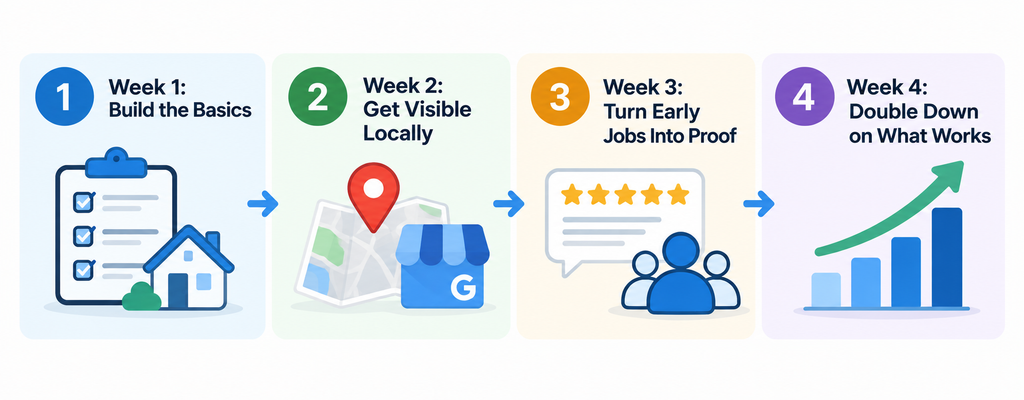
Week 1: Build the Basics
Start by getting the business ready to accept customers.
- Define your primary service.
- Define your ideal customer.
- Define your service area.
- Set your starting prices.
- Create your Google Business Profile.
- Create a simple way for customers to request a quote.
Do not start buying ads before the basics are ready.
If you are still unsure what to charge, use our House Cleaning Price Calculator before promoting your service.
Week 2: Get Visible Locally
Start putting the business in front of potential customers.
- Tell your network you are accepting clients.
- Join relevant local communities.
- Complete your online business profiles.
- Contact potential local partners.
- Make sure your website clearly explains your services.
At this stage, the objective is not scale.
It is to create conversations with potential customers.
Week 3: Turn Early Jobs Into Proof
Once you have completed successful jobs:
- Ask customers for reviews.
- Ask for referrals.
- Take appropriate before-and-after photos with permission.
- Record how each customer found you.
- Identify which services customers request most often.
Your first customers can help make the next customers easier to acquire.
Week 4: Double Down on What Works
Review what happened during the first three weeks.
Ask:
- Which channel generated the most inquiries?
- Which generated paying customers?
- Which customers are likely to book again?
- Which services were easiest to sell?
- Which jobs produced acceptable margins?
Then put more effort into the channels producing useful results.
If you have enough data and budget, this can also be a reasonable point to test one paid acquisition channel.
Not five at once.
Start with one.
How Much Should You Spend to Get a Cleaning Client?
There is no universal amount every cleaning business should spend to acquire a customer.
An acceptable customer acquisition cost depends on factors such as:
- Average job value
- Profit margin
- Frequency of service
- Customer retention
- Advertising costs
- Additional services purchased
This is why revenue alone can be misleading.
Imagine two customers.
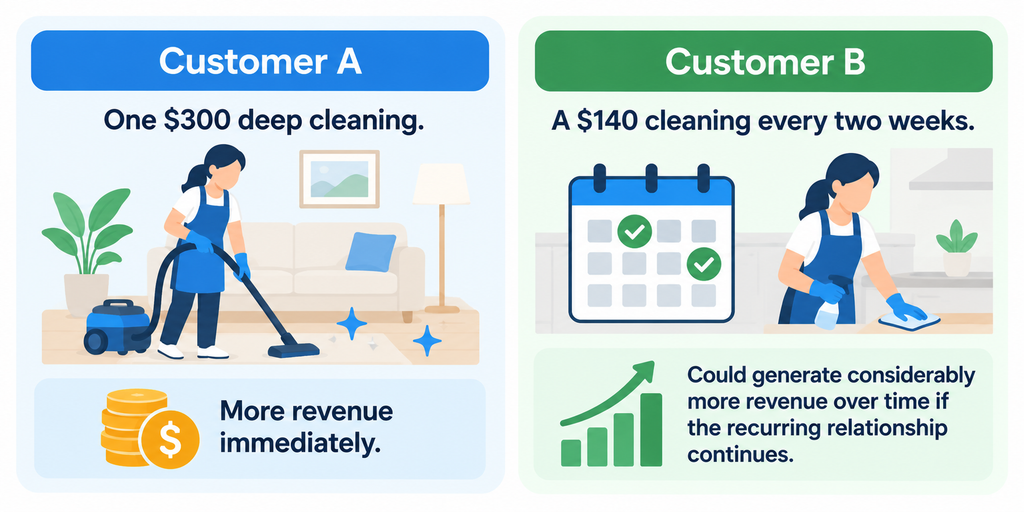
Before scaling paid acquisition, understand how much of your revenue you actually keep.
Use our Cleaning Business Profit Margin Calculator to estimate how labor, supplies, travel, insurance, software, marketing, and other operating costs affect your profit.
What to Do When Leads Start Coming In
Getting a lead is only the first half of customer acquisition.
You still need to turn that lead into a booked job.
A simple process might look like this:
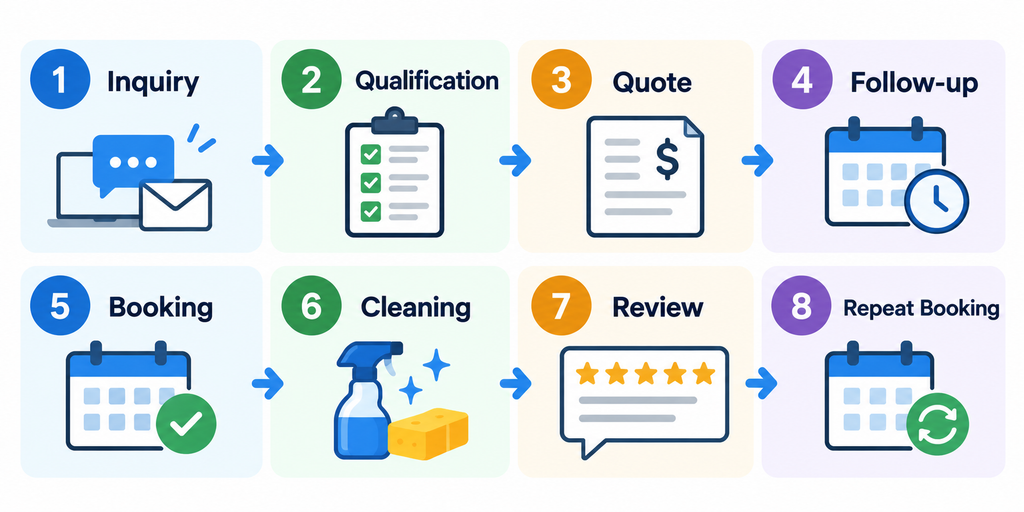
As volume increases, managing this through text messages, paper notes, and separate spreadsheets can become difficult.
Cleaning business software can help manage customer information, quotes, scheduling, invoicing, and other day-to-day work.
If you are reaching that stage, see our Best Cleaning Business Software: 7 Tools Compared.
If scheduling is the specific problem you need to solve, see our Best Scheduling Software for Cleaning Businesses: 7 Tools Compared (2026).
Software should solve an operational problem rather than simply add another subscription.
Common Mistakes That Make Getting Cleaning Clients Harder
Trying Every Marketing Channel at Once
More marketing channels do not automatically produce more customers.
Using too many at the same time also makes it harder to understand where your best customers are coming from.
Start with a few channels, track the results, and expand deliberately.
Competing Only on Price
Being the cheapest cleaner in town is not the only way to attract customers.
Customers may also care about:
- Reliability
- Trust
- Communication
- Convenience
- Quality
- Consistency
- Easy booking
- Recurring availability
Know your costs before discounting your service.
A full schedule does not help much if the jobs are not profitable.
Responding Slowly to Leads
Someone requesting a cleaning quote may contact several businesses.
Create a consistent process for responding to inquiries.
Even if you cannot provide an immediate price, acknowledge the inquiry and explain what happens next.
Making It Hard to Request a Quote
Do not force potential customers to search for your phone number or contact form.
Every important service page should make the next action clear.
Failing to Track Lead Sources
Ask new customers:
“How did you hear about us?”
Record the answer.
Over time, this simple habit can help you understand which channels are actually producing customers.
Focusing on Revenue Instead of Profitable Clients
More jobs do not automatically create a stronger business.
Track the cost of delivering the service as well as the cost of acquiring the customer.
A channel that generates many low-margin, one-time jobs may produce very different economics from a channel that generates recurring customers.
Frequently Asked Questions
How Do I Get My First Client for a Cleaning Business?
Start with people who already know you, establish your local online presence, participate appropriately in local communities, and contact potential referral partners.
The initial goal is to get real customers, provide a strong service, and begin building reviews and referrals.
How Can I Get Cleaning Clients Without Spending Money?
Your personal network, referrals, Google Business Profile, relevant local communities, partnerships, and direct outreach can all be used without a large advertising budget.
They still require time and consistent effort.
Where Can I Advertise My Cleaning Business?
Potential channels include Google, social media platforms, neighborhood communities, local directories, printed materials, and local partnerships.
The appropriate mix depends on whether you target residential or commercial customers, your location, and your budget.
How Do I Get More Recurring Cleaning Clients?
Make recurring service easy to understand and book.
Provide consistent service, communicate clearly, follow up after initial jobs, and give satisfied customers an easy way to schedule future cleaning.
How Do I Get Commercial Cleaning Clients?
Define the type of commercial customer you want, build a targeted prospect list, develop local business relationships, and use direct outreach to create opportunities for conversations, walkthroughs, and quotes.
Are Google Local Services Ads Worth It for Cleaning Businesses?
They can provide another source of leads for eligible businesses, but the economics depend on your market, lead costs, conversion rate, pricing, and customer value.
Track the results rather than assuming paid leads will automatically be profitable.
Final Take
Getting clients for a cleaning business is not about finding one secret marketing tactic.
It is about building a repeatable acquisition process.
Start with low-cost channels, get visible locally, win your first customers, collect reviews and referrals, track where customers come from, and expand the channels that produce useful results.
As your customer base grows, the challenge gradually shifts from finding work to managing that work efficiently and profitably.
Turn New Clients Into Profitable Growth
Getting more customers is only useful if the work is priced profitably.
Before increasing your marketing spend, use our Cleaning Business Profit Margin Calculator to understand how labor, supplies, travel, marketing, and other operating costs affect what you actually keep.
And if you are still deciding what to charge residential customers, use our House Cleaning Price Calculator to estimate a starting price based on your job costs and desired margin.