
Hiring cleaners can become one of the biggest challenges as a cleaning business grows.
When you are doing most of the cleaning yourself, your capacity is limited by the number of jobs you can personally complete.
Hiring reliable cleaners can help you serve more customers, build recurring routes, and grow beyond an owner-operated business.
But hiring quickly without a clear process can create new problems, including inconsistent cleaning quality, scheduling issues, customer complaints, and employee turnover.
This guide explains how to build a practical hiring process for your cleaning business—from defining the role and finding candidates to interviewing, onboarding, training, and retaining cleaners.
The Basic Cleaning Business Hiring Process
A simple hiring process looks like this:
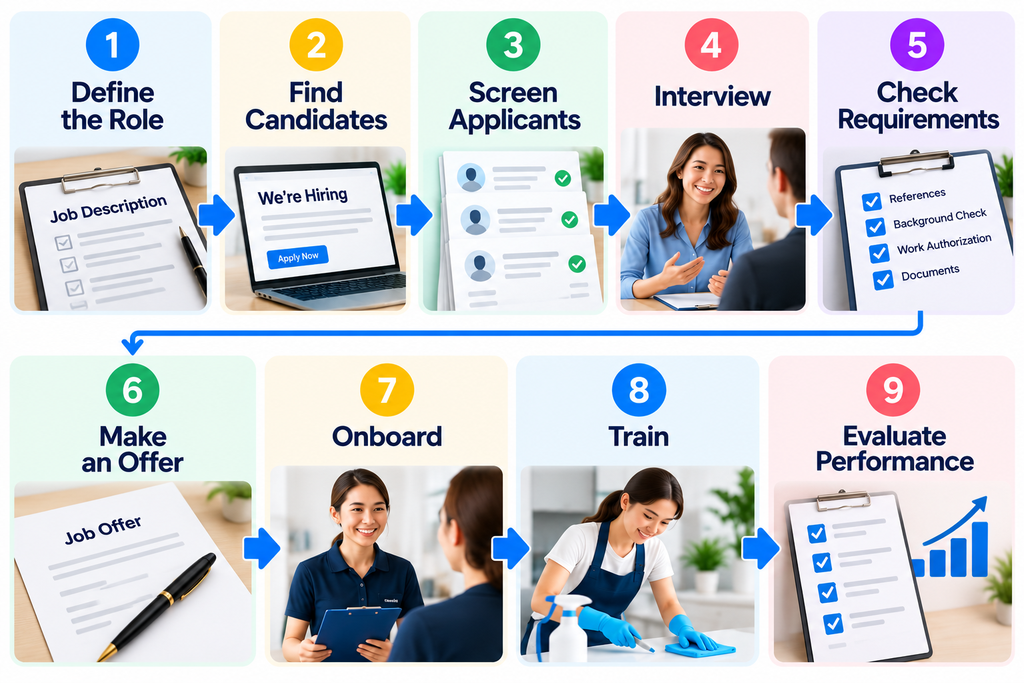
The goal is not simply to fill an open position as quickly as possible.
You want a repeatable process that helps you identify people who can perform the work reliably and represent your business professionally in customers’ homes or workplaces.
1. Know When It Is Time to Hire
Hiring too early can create payroll pressure.
Hiring too late can leave you turning away customers, overloading your existing team, or working too many hours yourself.
Look for signs that your current capacity is becoming a constraint.
It may be time to hire when:
- You regularly turn away cleaning jobs
- Your schedule is consistently full
- You are working more hours than you can sustain
- Existing cleaners are overloaded
- You cannot accept new recurring customers
- Customers have limited scheduling options
- You spend most of your time cleaning instead of running the business
Do not base the decision only on one unusually busy week.
Look at whether customer demand is consistently high enough to support additional labor.
Your pricing also needs to leave enough room to cover labor and other operating costs.
Use our cleaning business profit margin calculator to understand how labor costs affect your margins.
2. Define the Cleaning Role Before You Recruit
Do not start recruiting with a vague idea that you simply “need another cleaner.”
Define what the person will actually do.
A clear role helps candidates understand the job and gives you a consistent standard for evaluating applicants.
Define:
- Type of cleaning work
- Typical working hours
- Expected availability
- Service area
- Whether transportation is required
- Physical requirements of the role
- Customer communication responsibilities
- Supplies or equipment responsibilities
- Training requirements
- Compensation structure
The role may also differ depending on whether you provide residential cleaning, commercial cleaning, move-out cleaning, deep cleaning, or several types of service.
The clearer the role is before recruiting begins, the easier it becomes to evaluate whether a candidate is actually a good fit.
3. Decide What You Need From a Cleaner
Cleaning experience can be useful, but experience alone does not guarantee that someone will work well in your business.
Think about the characteristics required for the role.
Depending on your business, you may look for:
- Reliability
- Attention to detail
- Ability to follow a checklist
- Professional communication
- Time management
- Ability to work independently
- Ability to work as part of a crew
- Willingness to learn your cleaning process
- Consistent availability
- Ability to travel between jobs when required
Separate what is essential from what can be taught.
For example, you may be able to teach your cleaning process, but reliability and consistent attendance may be much harder to train.
4. Write a Clear Cleaner Job Description
A job posting should help candidates decide whether the position is right for them before they apply.
Avoid descriptions that are so vague that candidates do not understand the actual work.
A cleaner job description can include:
Job title
Brief description of the cleaning business
Main responsibilities
Typical work schedule
Service area
Required qualifications
Preferred experience
Physical requirements
Transportation requirements, if applicable
Compensation information
How to apply
Be realistic about the work.
If the position involves driving between customer locations, working independently, carrying supplies, or cleaning several properties in one day, candidates should understand that before the interview.
5. Find Cleaner Candidates
Do not depend on only one recruiting source.
Different channels may produce different types of candidates.
Possible recruiting channels include:
- Online job boards
- Your business website
- Employee referrals
- Local community groups
- Social media
- Local workforce organizations
- Personal referrals
- Previous applicants
Track where strong applicants come from.
Over time, you may discover that one recruiting channel produces many applications but few successful hires, while another produces fewer but more reliable candidates.
That information can help you decide where to spend your recruiting time and budget.
6. Screen Applicants Before the Interview
You do not need to schedule a full interview with every applicant.
A simple screening step can help identify obvious mismatches before you invest more time.
Initial screening questions might cover:
- Availability
- Previous cleaning or service experience
- Ability to work in your service area
- Transportation, when relevant to the role
- Desired working hours
- Expected start date
- Ability to meet the basic requirements of the position
Keep your screening process consistent.
Using the same basic criteria for candidates can make it easier to compare applicants and reduce decisions based only on first impressions.
7. Ask Practical Interview Questions
An interview should help you understand how the candidate is likely to behave on the job.
Ask questions related to real situations cleaners may encounter.
Example cleaner interview questions:
“What would you do if you were running late for a cleaning appointment?”
“How would you handle a customer who says an area was not cleaned properly?”
“What would you do if you noticed damage inside a customer’s property?”
“How do you make sure you do not miss tasks when cleaning?”
“How would you handle a last-minute schedule change?”
“Do you prefer working independently or with a team?”
“What does good customer service mean to you?”
Listen for specific examples rather than only the answer you think the candidate should give.
You are trying to understand how the person communicates, solves problems, follows processes, and handles responsibility.
8. Verify the Requirements for the Role
Before hiring someone, determine which checks, documents, and employment requirements apply to your business and location.
These requirements can vary by jurisdiction and by the way workers are classified.
Depending on the role and local rules, the process may involve items such as:
- Identity and work authorization documentation
- Employment paperwork
- References
- Driving requirements
- Insurance-related requirements
- Background checks, when appropriate and legally permitted
- Payroll and tax documentation
- Required workplace policies or notices
Do not assume that calling someone an independent contractor automatically makes that worker a contractor.
Worker-classification rules depend on applicable law and the actual working relationship.
Check the requirements that apply where your business operates, and use qualified legal or accounting advice when necessary.
9. Make a Clear Job Offer
Once you choose a candidate, make sure the basic terms of the role are clear.
Do not leave important expectations until after the person starts.
Clarify:
- Position
- Compensation
- Expected schedule
- Start date
- Work location or service area
- Main responsibilities
- Training expectations
- Who the employee reports to
- Any conditions that apply to the offer
Follow the employment and documentation requirements that apply in your jurisdiction.
10. Build a Simple Cleaner Onboarding Process
Hiring does not end when the candidate accepts the job.
A new cleaner needs to understand how your business operates.
Without a consistent onboarding process, each employee may learn a different version of the job.
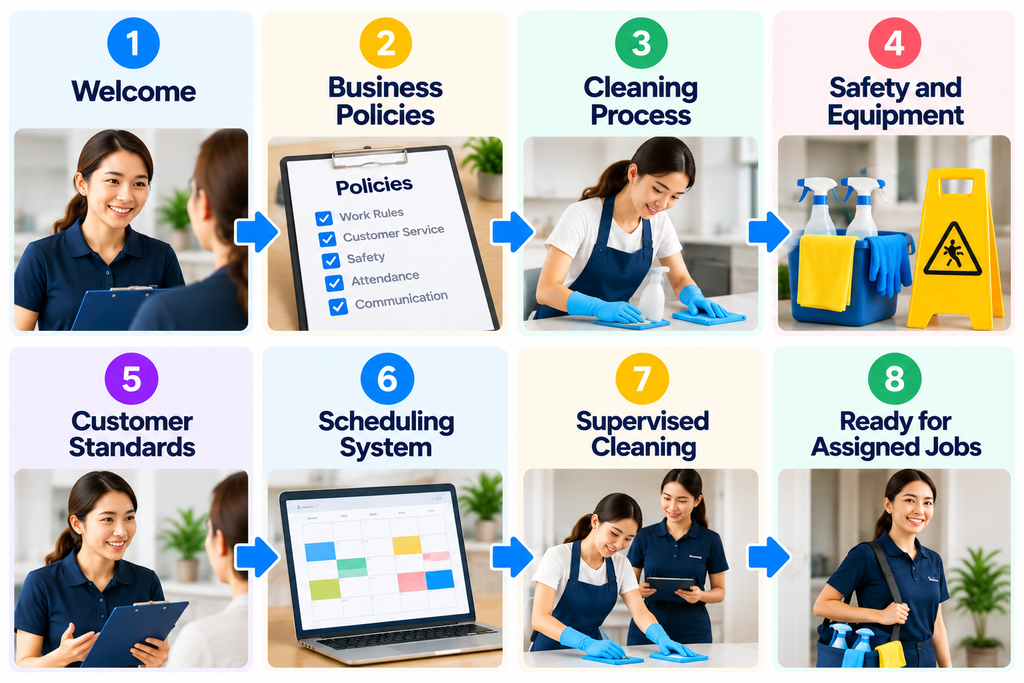
Your onboarding process should prepare the cleaner for both the technical work and the customer experience.
Onboarding may cover:
- Company expectations
- Cleaning procedures
- Cleaning supplies and equipment
- Safety procedures
- Customer communication
- Property access
- Scheduling
- Time tracking
- Reporting problems or damage
- Quality standards
Use our professional house cleaning checklist as a starting point for standardizing the cleaning work itself.
11. Train Cleaners With a Repeatable Process
Telling a new employee to “clean it well” is not a training system.
Define how you want common cleaning jobs performed.
A basic training process can combine explanation, demonstration, supervised work, and feedback.
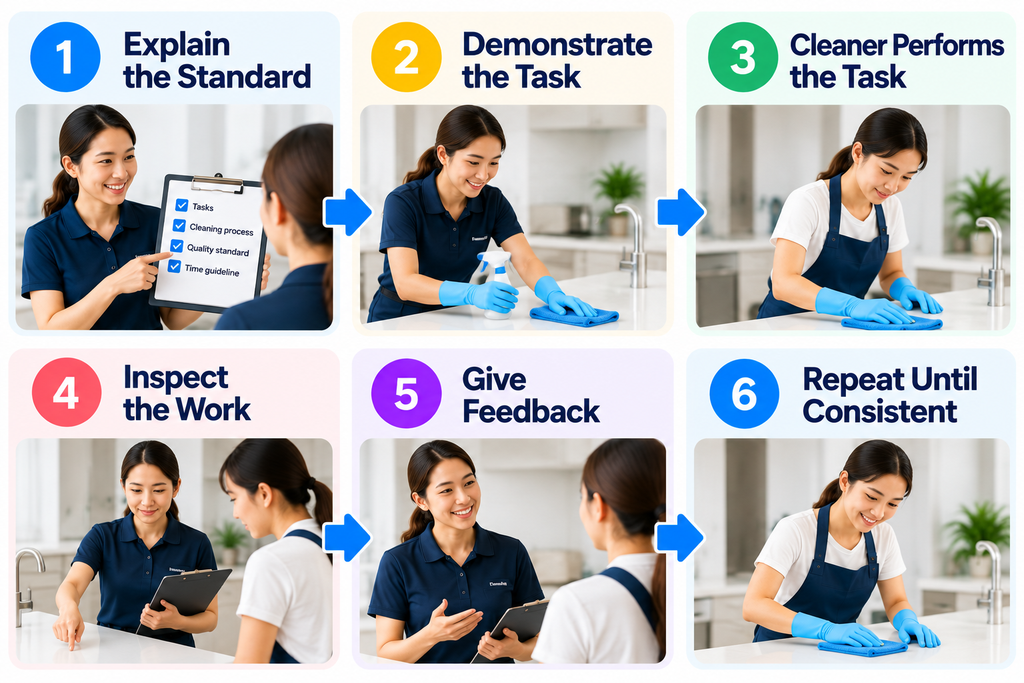
This gives both the cleaner and manager a clearer definition of what acceptable work looks like.
Training should also cover what to do when something goes wrong.
A cleaner should know how to report damage, customer complaints, missing supplies, access problems, or schedule delays rather than trying to solve every situation alone.
12. Use Checklists to Standardize Cleaning Quality
Customers should not receive completely different service depending on which cleaner arrives.
Checklists can help establish a consistent baseline.
A checklist can define the tasks expected for each service while still allowing customer-specific instructions.
For example, you may have different checklists for:
- Standard cleaning
- Deep cleaning
- Move-in or move-out cleaning
- Recurring cleaning
- Commercial cleaning
- Customer-specific requests
A checklist does not replace training or supervision.
It gives the cleaner a repeatable reference and gives the business a clearer standard for evaluating completed work.
13. Schedule New Cleaners Carefully
Do not overload a new cleaner immediately.
Give them enough time to learn your process and understand how long different jobs actually take.
When possible, begin with manageable assignments before increasing workload.
As your team grows, scheduling becomes more complicated because you need to balance customer appointments with cleaner availability, location, travel time, and job duration.
Our cleaning business scheduling guide explains how to organize jobs and crews.
You can also compare the best scheduling software for cleaning businesses if manual scheduling is becoming difficult.
14. Evaluate Performance During the First Few Weeks
Do not wait several months before telling a new cleaner that something is wrong.
Provide feedback early.
Look at both cleaning quality and reliability.
Early performance indicators may include:
- Attendance
- Punctuality
- Cleaning quality
- Completion of required tasks
- Customer feedback
- Communication
- Ability to follow instructions
- Ability to complete jobs within reasonable time
- Care with customer property
- Teamwork
Specific feedback is more useful than saying someone needs to “do better.”
Explain what happened, what standard you expect, and what should change on the next job.
15. Retain Reliable Cleaners
Constantly replacing cleaners creates recruiting and training costs and can disrupt customer relationships.
Once you have reliable employees, pay attention to the reasons they stay or leave.
Compensation matters, but retention can also be affected by scheduling, communication, workload, management, and whether expectations are clear.
Consider:
- Competitive compensation
- Predictable scheduling where possible
- Clear expectations
- Reasonable workloads
- Useful training
- Regular feedback
- Respectful communication
- Recognition for strong performance
- Opportunities for additional responsibility as the business grows
You may not be able to prevent every employee from leaving.
The goal is to build a workplace where reliable cleaners have clear reasons to stay.
Track Your Hiring Process
Just as you track marketing and customer acquisition, you can track basic recruiting results.
You do not need a complicated HR dashboard.
Useful hiring metrics may include:
- Applicants received
- Applicants interviewed
- Offers made
- Offers accepted
- New hires
- Recruiting source
- Employees who complete initial training
- Employees retained after the first few months
Over time, this can help you identify where the hiring process is breaking down.
For example, many applicants but very few qualified interviews may indicate a problem with your recruiting source or job description.
Many hires but poor retention may point to onboarding, workload, compensation, management, or job-expectation issues.
When Team Management Software Starts to Help
A small cleaning business may initially manage employee information and schedules manually.
That becomes harder as the team grows.
Software may become useful when you need to manage:
- Multiple cleaner schedules
- Job assignments
- Customer information
- Team availability
- Time tracking
- Job notes
- Schedule changes
- Communication between the office and field team
If you are reaching that point, compare our best cleaning business software and cleaning business scheduling software guides.
Final Take
Hiring cleaners is not simply about finding someone who can clean.
You need people who can follow your process, show up reliably, communicate professionally, and deliver consistent work for customers.
Start by defining the role clearly. Build a repeatable screening and interview process, verify the requirements that apply to the position, and make expectations clear before the employee starts.
Then invest in onboarding and training.
Use checklists, supervised cleaning, early feedback, and consistent quality standards so new cleaners understand exactly what good work looks like.
As your team grows, connect hiring with scheduling and customer demand rather than adding employees without a plan.
If your schedule is already filling with recurring customers, read our guide to getting more recurring cleaning clients.
Then use our cleaning business scheduling guide to organize those customers and your growing team.