
Running a cleaning business becomes more complicated as soon as you are no longer the only person doing the work.
New cleaners need to know how jobs should be completed. Supervisors need standards for inspecting work. Office staff need procedures for scheduling, customer communication, complaints, payments, and unexpected problems.
If all of that information lives only in the owner’s head, the business becomes difficult to scale.
A cleaning business operations manual gives your team one place to find the systems, standards, and procedures that keep the company running consistently.
In this guide, you will learn what to include in a cleaning business operations manual, how to organize it, and how to build one without creating an unnecessarily complicated document.
You can also use the free cleaning business operations manual template in this guide to start building your own.
What Is a Cleaning Business Operations Manual?
A cleaning business operations manual is a central document that explains how your cleaning company operates.
It can include policies, workflows, service standards, responsibilities, safety procedures, customer service processes, and links to detailed standard operating procedures (SOPs).
Think of it as the master guide for running the business.
It should answer questions such as:
- How should a new customer be onboarded?
- Who is responsible for scheduling cleaners?
- What happens when an employee calls out?
- How should a cleaning job be performed?
- How is quality inspected?
- What happens when a customer complains?
- How are incidents documented?
- How should employees communicate with customers?
- Where can employees find detailed cleaning procedures?
The goal is not to document every possible situation.
The goal is to make your most important operations repeatable and understandable.
Operations Manual vs. SOP vs. Employee Handbook
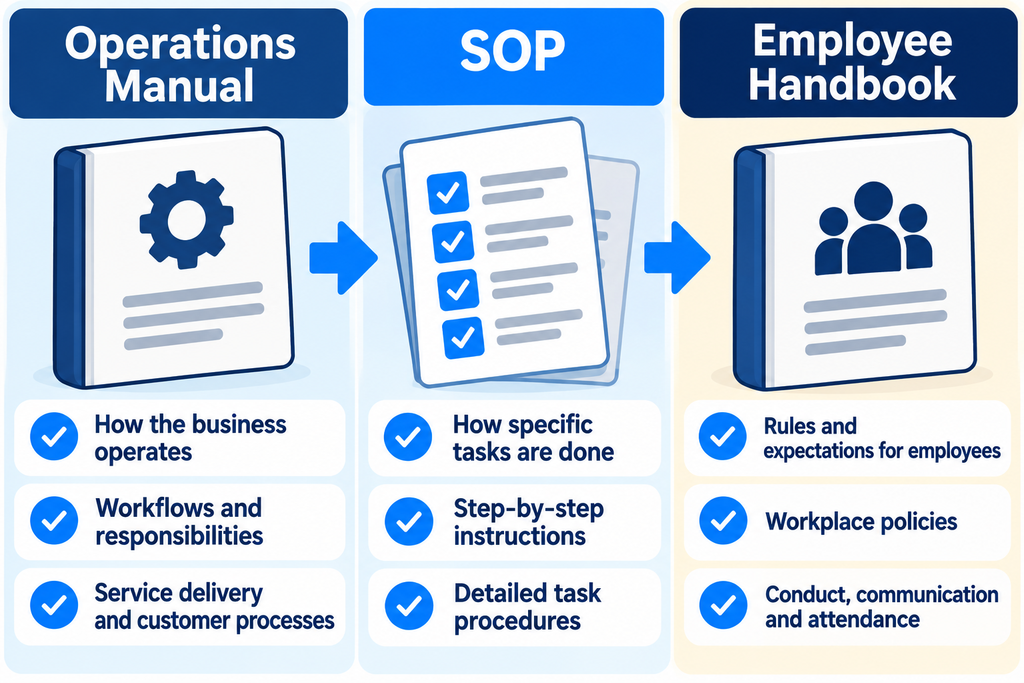
These documents are related, but they serve different purposes.
| Document | Main Purpose | Typical Content |
|---|---|---|
| Operations Manual | Explains how the business operates | Workflows, responsibilities, service delivery, quality control, customer processes |
| SOP | Explains how to perform a specific process | Step-by-step instructions for completing a task |
| Employee Handbook | Explains workplace policies and expectations | Attendance, conduct, communication, employment policies |
For example:
Your operations manual might say that every completed cleaning job must go through a quality inspection.
The related SOP explains exactly how the inspection is performed.
Your employee handbook explains the broader rules and expectations employees are required to follow.
These documents should work together rather than repeat the same information.
If you have not created your SOP system yet, see our guide to creating standard operating procedures for a cleaning business.
FIGURE 1 — OPERATIONS MANUAL VS SOP VS EMPLOYEE HANDBOOK
What Should a Cleaning Business Operations Manual Include?
There is no single required structure for an operations manual.
A small residential cleaning company may only need a relatively simple manual, while a larger commercial cleaning business may need more detailed documentation.
For most cleaning businesses, the following sections provide a practical starting point.
1. Company Overview
Start with a short explanation of the business.
This section helps new employees understand what the company does and the standards it expects.
Include:
- Company name
- Services offered
- Types of customers served
- Service area
- Business hours
- Mission or service philosophy
- Basic organizational structure
- Important contact information
Keep this section short.
The purpose is orientation—not company history.
2. Roles and Responsibilities
Define who is responsible for what.
This becomes increasingly important as the business grows.
Possible roles include:
- Owner
- Operations manager
- Office administrator
- Cleaning supervisor
- Team leader
- Cleaner
- Quality inspector
For each role, identify its main responsibilities and decision-making authority.
Example: Cleaning Supervisor
Responsible for:
- Assigning work when required
- Confirming crews understand job requirements
- Monitoring cleaning quality
- Conducting inspections
- Reporting recurring problems
- Supporting cleaner training
- Escalating customer issues when necessary
Clear responsibilities reduce situations where everyone assumes someone else will handle a problem.
3. Customer Onboarding
Document what happens after a prospect becomes a customer.
A basic customer onboarding process might include:
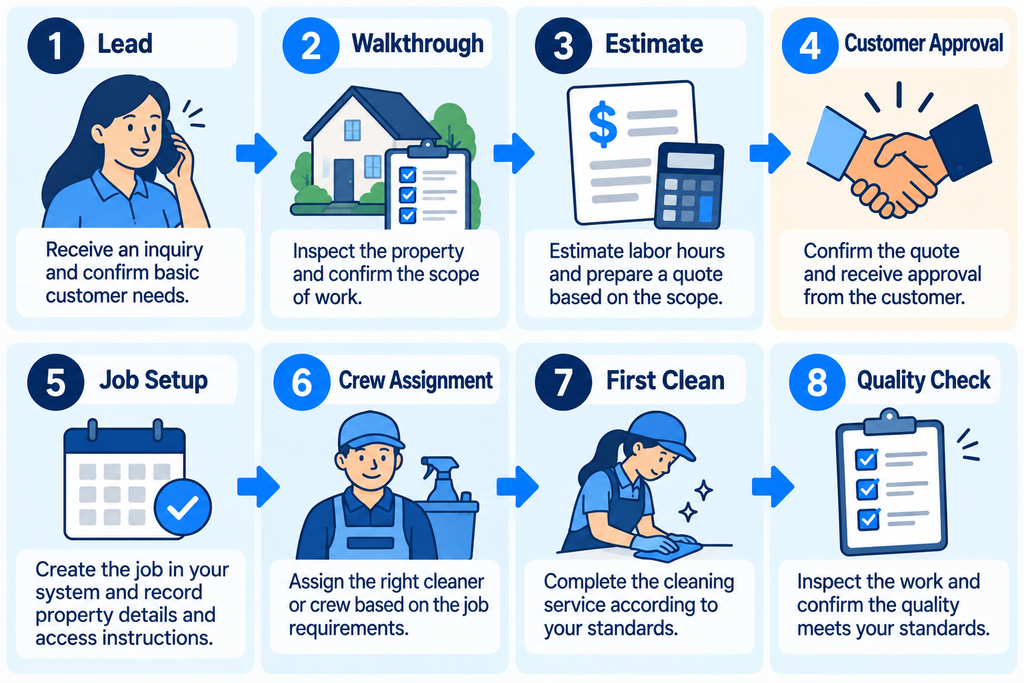
- Confirm the service scope.
- Confirm pricing.
- Record property details.
- Document access instructions.
- Record customer preferences.
- Schedule the first service.
- Assign the appropriate cleaner or crew.
- Send service confirmation.
For larger or commercial properties, you may also need to document security procedures, alarm information, restricted areas, and site-specific requirements.
4. Job Estimating and Pricing
Your manual should explain how the company approaches estimates.
This does not mean every employee needs access to confidential pricing information.
Instead, document the process.
Walkthrough → Identify Scope → Estimate Labor Hours → Estimate Job Cost → Apply Pricing Method → Prepare Quote → Customer Approval
Your estimating process should be consistent enough that similar jobs do not receive completely different estimates without a clear reason.
For property inspections, use the Cleaning Business Walkthrough Checklist to document the scope before preparing an estimate.
For pricing decisions, your manual can also reference your cleaning pricing procedures and calculators instead of duplicating them here.
FIGURE 2 — CLEANING CUSTOMER ONBOARDING & JOB SETUP WORKFLOW
5. Scheduling and Crew Assignment
Scheduling procedures should explain how jobs are assigned and what happens when the schedule changes.
Document:
- Who manages the schedule
- How cleaners receive assignments
- How travel time is considered
- How recurring customers are scheduled
- How schedule changes are communicated
- What happens when a cleaner is absent
- How emergency coverage is handled
- Who can approve overtime or additional labor
A simple rule can prevent a lot of confusion:
Every job should have a confirmed customer, location, service scope, scheduled time, and assigned cleaner or crew before the workday begins.
Put Your Cleaning Operations Into One System
Jobber helps cleaning businesses manage scheduling, crew assignments, customer information, jobs, invoicing, and payments in one place.
If your company uses scheduling software, document which system employees should use rather than relying on texts, paper notes, and multiple calendars.
6. Cleaning Procedures and SOPs
The operations manual should not contain dozens of pages explaining how to clean every surface.
That is what SOPs are for.
Instead, create a central section that links employees to the correct procedures.
Example SOP Library
- Residential cleaning SOP
- Commercial cleaning SOP
- Kitchen cleaning SOP
- Bathroom cleaning SOP
- Floor cleaning SOP
- Deep cleaning SOP
- Move-out cleaning SOP
- Equipment setup and storage SOP
- Chemical handling SOP
- End-of-job inspection SOP
This keeps the operations manual manageable while allowing individual procedures to be updated separately.
Your SOP library can grow as the business grows.
7. Equipment and Supply Management
Document how cleaning supplies and equipment are managed.
Include procedures for:
- Supply storage
- Inventory checks
- Reordering
- Equipment checkout
- Equipment cleaning
- Equipment maintenance
- Damaged equipment
- Lost equipment
- Chemical labeling
- Safety Data Sheets (SDS)
You should also define who is authorized to purchase supplies and when approval is required.
Without a simple inventory process, small supply problems can quickly become missed jobs or unnecessary emergency purchases.
8. Safety Procedures
Safety procedures deserve their own section.
Cleaning employees may work with chemicals, wet floors, electrical equipment, ladders, heavy objects, sharp items, and unfamiliar customer environments.
Your manual should explain the company’s general safety expectations and point employees toward more detailed safety procedures where necessary.
Possible topics include:
- Personal protective equipment
- Chemical handling
- Chemical labeling
- Safety Data Sheets
- Slip and fall prevention
- Electrical equipment
- Lifting
- Sharps or hazardous objects
- Incident reporting
- Emergency procedures
Do not invent safety rules solely for the manual.
Your procedures should reflect the products, equipment, work environments, and legal requirements that actually apply to your business.
9. Quality Control
Quality control should be a repeatable process—not something that happens only after a customer complains.
Document:
- Who performs inspections
- When inspections occur
- What is inspected
- How results are recorded
- What counts as a failed item
- How corrections are handled
- When retraining is required
- How recurring problems are tracked
Cleaning Completed → Inspection → Pass / Issue Found → Correction → Verification → Record Result
Use the Cleaning Business Quality Control Checklist to create a repeatable inspection process and calculate an inspection score.
This allows quality standards to become part of normal operations instead of relying only on the owner noticing problems.
10. Customer Communication
Employees should know when they can communicate directly with a customer and when an issue should be escalated.
Document procedures for:
- Arrival notifications
- Schedule changes
- Customer requests
- Access problems
- Complaints
- Damage reports
- Missed areas
- Re-clean requests
- Billing questions
- Service cancellations
Avoid giving every employee unlimited authority to promise discounts, refunds, or free services.
Define who can make those decisions.
11. Complaints and Service Recovery
Complaints should follow a consistent process.
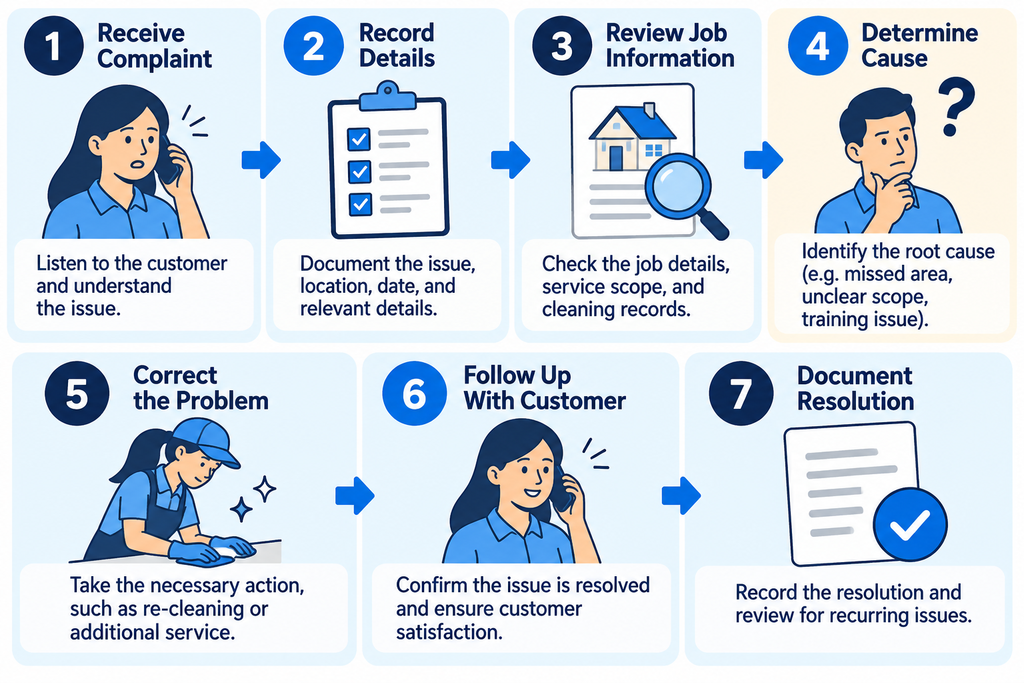
Receive Complaint → Record Details → Review Job Information → Determine Cause → Correct the Problem → Follow Up With Customer → Document Resolution
The goal is not simply to make the complaint disappear.
Look for the operational cause.
Was the service scope unclear?
Was the cleaner insufficiently trained?
Was the schedule unrealistic?
Was the inspection skipped?
Recurring complaints often reveal a process problem.
FIGURE 3 — CLEANING SERVICE RECOVERY PROCESS
12. Employee Training
Document how new cleaners become ready to work independently.
A simple training process may include:
- Company orientation
- Safety training
- Equipment training
- Cleaning procedure training
- Shadowing
- Supervised cleaning
- Quality inspection
- Approval for independent work
Use your Cleaning Business Training Checklist to make onboarding more consistent.
Training should also continue after onboarding.
Inspection results, customer feedback, and recurring mistakes can help identify where additional training is needed.
13. Attendance and Call-Out Procedures
Employees need to know exactly what to do if they cannot work.
Document:
- Who they must contact
- How they should contact them
- How much notice is expected when possible
- What information they must provide
- Who arranges replacement coverage
- How schedule changes are communicated
Detailed employment policies may belong in your employee handbook, but the operational response to an absence belongs in the operations manual.
14. Incidents, Damage, and Lost Property
Create a clear reporting process for unexpected situations.
Examples include:
- Property damage
- Employee injury
- Customer injury
- Lost keys
- Security problems
- Broken equipment
- Missing property
- Chemical spills
- Unsafe conditions
STOP / SECURE AREA → NOTIFY SUPERVISOR → DOCUMENT INCIDENT → TAKE REQUIRED ACTION → CUSTOMER COMMUNICATION → FOLLOW-UP
Employees should know that hiding a mistake usually creates a larger problem than reporting it quickly.
15. Billing and Payment Procedures
The level of detail depends on who handles billing.
At minimum, document:
- When invoices are created
- Who sends them
- Payment terms
- Accepted payment methods
- How failed payments are handled
- Who follows up on overdue invoices
- Who can issue credits or refunds
- Where payment records are stored
If cleaners do not handle billing, they do not need access to unnecessary financial information.
The manual should document the process for the people responsible for it.
16. Opening and Closing Procedures
If your business has an office, warehouse, supply room, or company vehicles, document routine opening and closing tasks.
Opening
- Review the day’s schedule
- Confirm staffing
- Check urgent customer messages
- Confirm equipment availability
- Review special job instructions
Closing
- Confirm jobs were completed
- Review unresolved issues
- Record incidents
- Restock supplies
- Charge equipment
- Secure keys
- Prepare for the next day
These small routines reduce preventable operational problems.
How to Build Your Operations Manual Step by Step
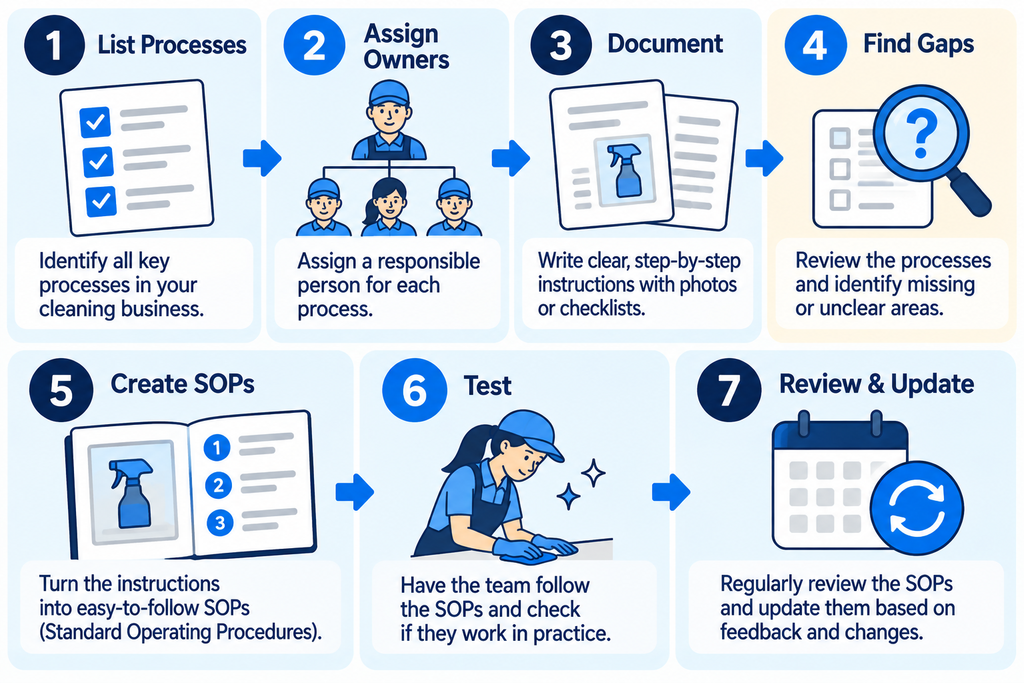
Step 1: List Your Core Operations
Write down the recurring processes that keep the company running.
Start with:
- Leads
- Estimates
- Customer onboarding
- Scheduling
- Cleaning
- Quality control
- Customer communication
- Billing
- Employee onboarding
- Safety
Step 2: Assign Process Owners
Every important process should have someone responsible for it.
That does not mean they personally perform every task. It means they are responsible for making sure the process works.
Step 3: Document the Current Process
Document what actually happens today.
Do not write an imaginary “perfect” process that nobody follows.
Step 4: Identify Gaps
Look for:
- Unclear responsibilities
- Repeated mistakes
- Missing approvals
- Duplicate work
- Customer complaints
- Tasks that depend entirely on the owner
Step 5: Create or Link SOPs
If a process requires detailed instructions, create a separate SOP and link it from the manual.
Step 6: Test the Manual
Give the procedure to someone who does not normally perform the task.
Can they understand what should happen?
If not, the documentation probably needs improvement.
Step 7: Review It Regularly
Your operations manual should change when your business changes.
Review important sections when you:
- Add services
- Hire new roles
- Change software
- Change equipment
- Change pricing processes
- Experience recurring quality problems
- Introduce new safety procedures
FIGURE 4 — HOW TO BUILD A CLEANING OPERATIONS MANUAL
Free Cleaning Business Operations Manual Template
You do not need to build the document from a blank page.
The OpsButler Cleaning Business Operations Manual Template gives you a starting structure that you can customize for your own company.
The template includes:
- Company Overview
- Roles & Responsibilities
- Customer Onboarding
- Estimating & Pricing
- Scheduling & Crew Assignment
- Cleaning Procedures & SOP Library
- Equipment & Supply Management
- Safety Procedures
- Quality Control
- Customer Communication
- Complaints & Service Recovery
- Employee Training
- Attendance & Call-Out Procedures
- Incidents & Damage
- Billing & Payments
- Opening & Closing Procedures
- Document Review & Revision Log
Keep the Manual Practical
The best operations manual is not necessarily the longest one.
A 150-page manual that nobody opens has little operational value.
A shorter manual that employees actually use can be far more effective.
Focus first on processes that:
- Happen frequently
- Affect customers
- Affect safety
- Affect money
- Cause recurring mistakes
- Depend too heavily on one person
Then expand the manual as the business grows.
Your Operations Manual Should Be a System, Not a Binder
The real value of an operations manual is not the document itself.
It is the system behind it.
OPERATIONS MANUAL → SOPs → CHECKLISTS → TRAINING → QUALITY CONTROL → IMPROVEMENT
When these pieces work together, employees have clearer expectations, managers have better processes to follow, and the business becomes less dependent on the owner remembering everything.
Start with your most important workflows, document what actually happens, and improve the manual as your cleaning business grows.