
Cleaning staff productivity is not simply about how fast your cleaners can finish a job.
A crew that finishes quickly but misses tasks, creates complaints, or requires rework is not truly productive.
For a cleaning business, productivity means using labor efficiently while consistently meeting the required service standard.
That makes productivity an important number to track as your business grows.
By measuring labor hours, job revenue, property size, and quality results, you can identify which jobs are operating efficiently and which ones need closer attention.
In this guide, we will look at practical ways to measure and improve cleaning staff productivity without encouraging rushed or lower-quality work.
If your main goal is reducing unnecessary labor expense, also see our guide on how to reduce cleaning labor costs without hurting quality.
What Is Cleaning Staff Productivity?
Cleaning staff productivity describes how efficiently labor is used to complete cleaning work at the required quality level.
There is no single productivity number that works for every cleaning company or every job.
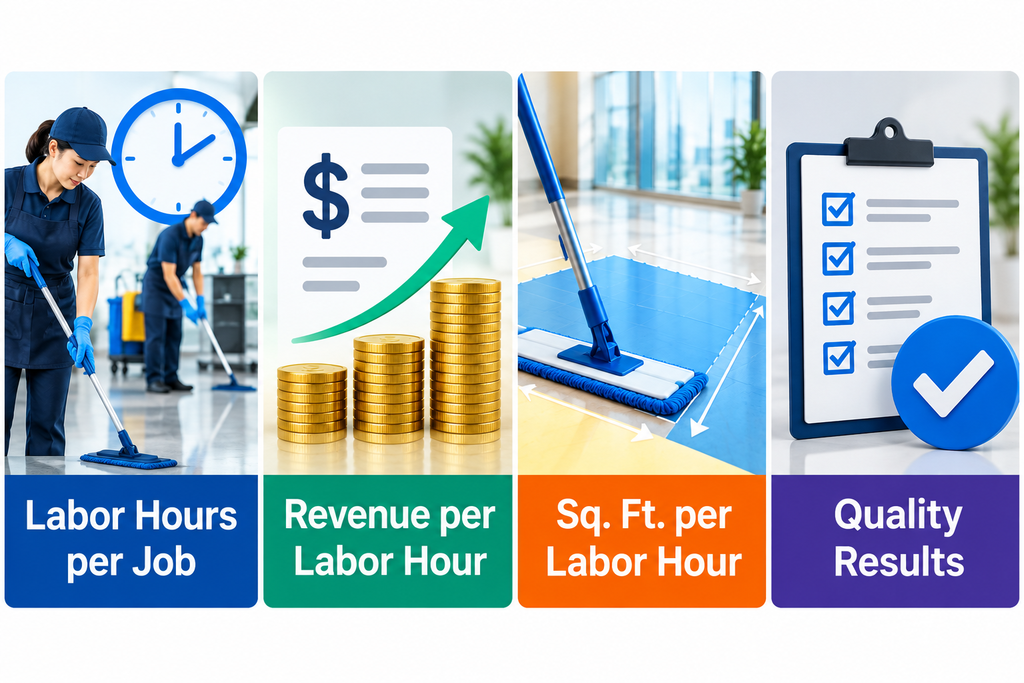
You may measure productivity using:
- Labor hours per job
- Revenue per labor hour
- Square feet cleaned per labor hour
- Estimated labor hours vs. actual labor hours
- Jobs completed per day
- Quality inspection results
- Callbacks or rework
The right metric depends on what you are trying to understand.
For example, square feet per labor hour can be useful when comparing similar commercial properties, while labor hours per job may be more useful for recurring residential cleaning.
FIGURE 1 — WAYS TO MEASURE CLEANING PRODUCTIVITY
Do Not Measure Productivity by Speed Alone
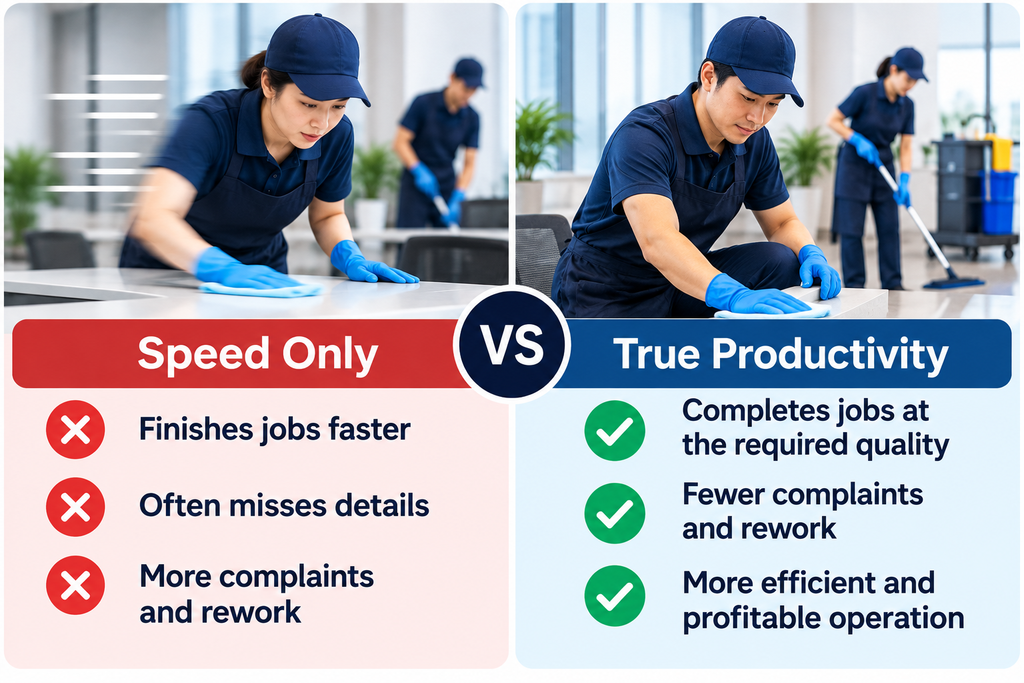
One of the easiest mistakes is assuming that the fastest cleaner is automatically the most productive cleaner.
Speed is only one part of the picture.
Consider two crews completing similar jobs.
Crew A finishes faster but regularly misses details and requires return visits.
Crew B takes slightly longer but consistently passes quality inspections and rarely creates customer complaints.
Looking only at completion time could make Crew A appear more productive even though the business may be spending additional labor on rework.
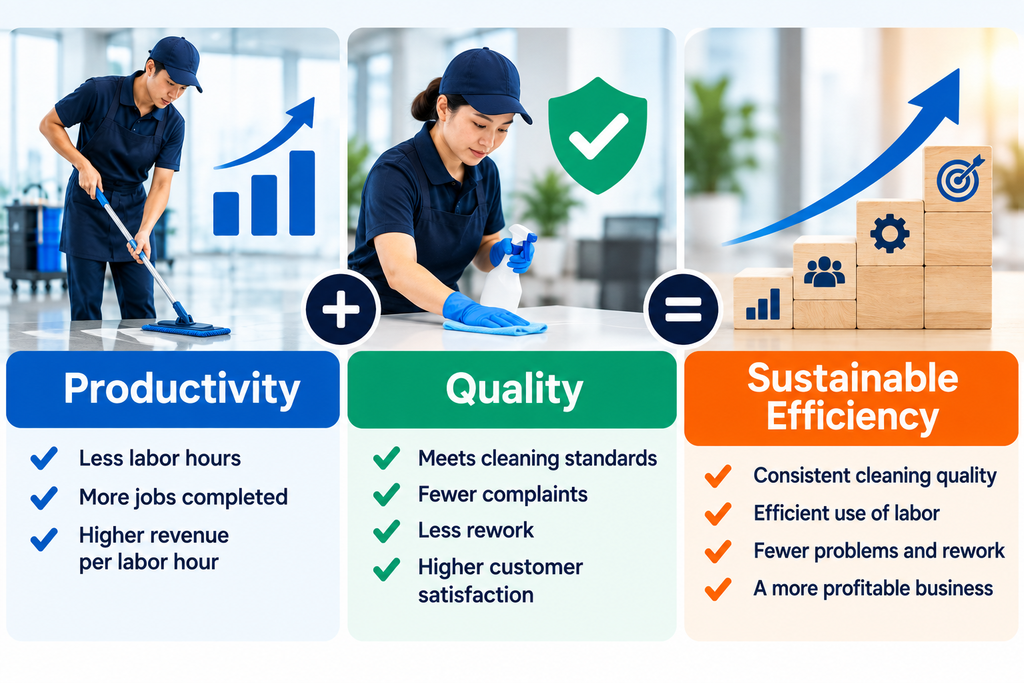
A useful productivity system should therefore consider both efficiency and quality.
FIGURE 2 — SPEED VS TRUE PRODUCTIVITY
1. Track Labor Hours per Job
Start with one of the simplest measurements: how many total labor hours each job requires.
Remember that job duration and labor hours are not necessarily the same.
If three cleaners work for two hours, the job uses:
3 cleaners × 2 hours = 6 labor hours
Track this number for recurring jobs so you can establish a realistic baseline.
If a property normally requires 6 labor hours but begins taking 7 or 8, investigate what changed.
Possible reasons include:
- The service scope increased
- The crew changed
- Equipment is slowing down the work
- The customer added new requirements
- Training is needed
- The original estimate was unrealistic
One unusual visit may not mean anything. Repeated differences are much more useful.
2. Measure Revenue per Labor Hour
Revenue per labor hour shows how much job revenue your business generates for each labor hour used.
The formula is:
Revenue per Labor Hour = Job Revenue ÷ Total Labor Hours
For example, if a job generates $480 and requires 8 labor hours:
$480 ÷ 8 = $60 per labor hour
If another similar job generates $480 but requires 10 labor hours:
$480 ÷ 10 = $48 per labor hour
The second job generates less revenue for every labor hour used.
That does not automatically mean the crew is performing poorly. The job may have a larger scope, difficult layout, special requirements, or an inaccurate price.
Use the metric as a signal to investigate rather than as a final judgment.
3. Measure Square Feet per Labor Hour When It Makes Sense
For some commercial cleaning jobs, square feet cleaned per labor hour can provide another useful productivity benchmark.
The basic formula is:
Square Feet per Labor Hour = Cleaned Square Feet ÷ Total Labor Hours
For example, if a crew cleans 12,000 square feet using 6 labor hours:
12,000 ÷ 6 = 2,000 square feet per labor hour
But this metric should be used carefully.
Cleaning 10,000 square feet of open office space is very different from cleaning 10,000 square feet containing restrooms, kitchens, stairs, detailed fixtures, or high-touch areas.
Service frequency, floor type, equipment, occupancy, and required tasks can also affect production rates.
For that reason, compare similar jobs rather than applying one square-feet target to every property.
4. Compare Estimated Hours With Actual Hours
Your original estimate gives you another useful productivity benchmark.
Compare:
- Estimated labor hours
- Actual labor hours
Suppose a job was estimated at 5 labor hours but consistently requires 6.5.
The difference is:
6.5 − 5 = 1.5 additional labor hours
Instead of immediately blaming the crew, review the estimate, scope, process, equipment, and customer requirements.
If actual labor consistently exceeds estimated labor, either the operation needs improvement or the original estimate needs to change.
Our Cleaning Labor Cost Calculator can help you translate those labor hours into actual labor cost.
Cleaning Staff Productivity Calculator
Enter the details for one cleaning job to calculate labor hours, revenue per labor hour, and square feet per labor hour.
Productivity benchmarks vary by property type, service scope, cleaning frequency, equipment, and required quality. Use these results to compare similar jobs rather than as universal performance targets.
The calculator shows:
- Total labor hours
- Revenue per labor hour
- Square feet per labor hour
- Average job duration based on the crew hours entered
These numbers can help you compare similar jobs and identify accounts that may deserve a closer review.
Do not treat any single result as a universal target. Property type, cleaning scope, equipment, frequency, and required quality all affect productivity.
5. Track Quality Alongside Productivity
Productivity improvements are only valuable if the required cleaning standard is maintained.
Track operational metrics alongside quality indicators such as:
- Inspection scores
- Customer complaints
- Callbacks
- Rework hours
- Missed tasks
- Customer retention
If labor hours fall while complaints and callbacks increase, the apparent productivity improvement may actually be creating additional cost.
Use our Cleaning Business Quality Control Checklist to create a repeatable inspection process.
FIGURE 3 — PRODUCTIVITY + QUALITY = SUSTAINABLE EFFICIENCY
6. Compare Similar Jobs, Not Every Job
Productivity data becomes misleading when completely different properties are compared as though they should perform the same way.
Group jobs by characteristics such as:
- Residential vs. commercial
- Property size
- Service type
- Cleaning frequency
- Level of detail required
- Flooring and surface types
- Occupancy
A small medical facility and an open-plan office may have similar square footage but very different cleaning requirements.
Comparing similar jobs gives you a much more useful benchmark.
7. Standardize the Cleaning Process
It is difficult to compare productivity when every employee uses a different cleaning method.
Standard operating procedures help establish a consistent process for common tasks.
A documented process can define:
- The recommended cleaning sequence
- Required tools and chemicals
- Equipment setup
- Quality checkpoints
- Customer-specific instructions
Standardization reduces unnecessary variation and makes productivity data easier to interpret.
See our guide on creating cleaning business SOPs if your procedures are not yet documented.
8. Improve Training Before Setting Aggressive Targets
Employees need the right process before they can be expected to perform it efficiently.
Training should show cleaners not only what to clean, but also how your company expects the work to be completed.
Focus training on:
- Cleaning sequence
- Safe chemical use
- Equipment operation
- Efficient movement through the property
- Quality standards
- Job-specific requirements
New employees may initially require more labor time than experienced cleaners.
That should be considered when reviewing individual productivity data.
9. Make Sure the Crew Has the Right Equipment
Productivity is not only an employee issue.
Slow or inappropriate equipment can make a capable cleaner less efficient.
Examples include:
- A vacuum that requires frequent maintenance
- Using small equipment for a large floor area
- Missing cleaning tools
- Poorly organized supply carts
- Repeated trips to retrieve products
Before changing labor expectations, make sure the team has the tools needed to meet them.
10. Look for Process Problems Before Employee Problems
If productivity drops, the cleaner is only one possible cause.
Before treating the issue as an employee performance problem, ask:
- Is the job scope accurate?
- Is the schedule realistic?
- Does the crew have enough supplies?
- Is the equipment working properly?
- Are access instructions clear?
- Has the property changed?
- Was the original estimate correct?
A good productivity system helps identify operational problems rather than simply creating pressure to work faster.
Track Productivity by Job, Not Just by Employee
Individual employee data can be useful, but job-level data often provides better context.
If several different crews all take longer than expected at the same property, the problem probably is not one employee.
The job itself may be underpriced, underestimated, poorly organized, or more difficult than expected.
Track information such as:
- Scheduled crew
- Job start and finish times
- Total labor hours
- Service scope
- Job revenue
- Quality results
Over time, this gives you a much clearer picture of how each account performs.
Use Scheduling and Job Data as Your Business Grows
Tracking productivity manually becomes more difficult as you add cleaners, customers, and recurring jobs.
Keeping schedules, crew assignments, customer details, and job information together can make it easier to understand what actually happened on each job.
Manage Your Cleaning Jobs in One Place
Jobber helps cleaning businesses manage scheduling, crew assignments, customer information, jobs, invoicing, and payments in one system.
Software does not replace good management, but organized job data becomes increasingly valuable as the number of employees and customers grows.
Avoid Using Productivity Metrics as a Punishment Tool
Productivity metrics are most useful when they help you understand and improve the operation.
They become less useful when employees believe every number will automatically be used against them.
Avoid:
- Ranking cleaners using one metric alone
- Comparing completely different jobs
- Setting speed targets without considering quality
- Ignoring training or equipment problems
- Rewarding rushed work that creates rework
Use productivity data to find patterns, ask better questions, and improve your systems.
The goal is consistent, profitable cleaning—not simply faster cleaning.
Build a Productivity Baseline Before You Try to Improve It
Before setting new productivity targets, collect enough data to understand how your jobs currently perform.
Start with a few simple measurements:
- Total labor hours
- Job revenue
- Estimated vs. actual hours
- Quality results
Add square footage or other metrics when they are useful for the type of cleaning you provide.
Then compare similar jobs and look for repeated patterns.
Once you know your baseline, you can improve training, scheduling, equipment, SOPs, estimating, and pricing based on real operating data instead of guesswork.
Cleaning staff productivity should ultimately answer one question:
Can your team consistently deliver the required cleaning quality using a predictable and sustainable amount of labor?
If the answer is yes, you are building a more efficient cleaning business—not simply a faster one.