
Labor is usually one of the largest costs in a cleaning business.
That means even a small improvement in labor efficiency can have a meaningful impact on your profit.
But reducing labor costs does not mean paying cleaners less, rushing through jobs, or lowering your cleaning standards.
The better approach is to reduce wasted labor hours.
That can mean improving scheduling, assigning the right crew size, reducing travel time, standardizing cleaning procedures, improving training, and identifying jobs that consistently take longer than expected.
In this guide, we will show you practical ways to reduce cleaning labor costs while protecting service quality.
If you have not calculated your true labor cost yet, start with our Cleaning Labor Cost Calculator. Knowing your real hourly labor cost makes the strategies below much easier to measure.
Reduce Labor Waste, Not Cleaning Quality
The goal is not simply to make cleaners work faster.
The goal is to eliminate time that does not create value for the customer.
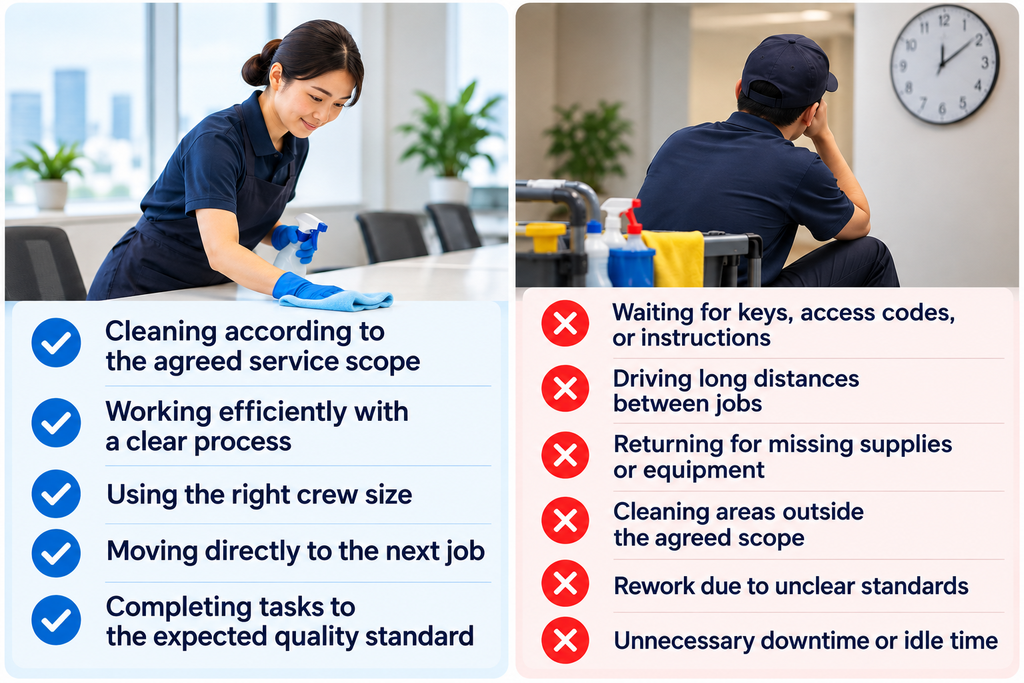
Examples of avoidable labor time include:
- Driving inefficient routes between jobs
- Waiting for keys, access codes, or customer instructions
- Returning to the office for missing supplies
- Cleaning areas that are outside the agreed service scope
- Redoing work because quality standards were unclear
- Sending more cleaners than a job actually requires
- Spending too much time searching for equipment or supplies
- Repeatedly answering questions that should already be covered by an SOP
Removing these problems can reduce labor costs without asking your team to cut corners.
FIGURE 1 — PRODUCTIVE LABOR VS WASTED LABOR
1. Measure Estimated Labor Hours vs. Actual Labor Hours
You cannot improve labor efficiency if you do not know where the extra hours are going.
For each job, compare:
- Estimated labor hours
- Actual labor hours
For example, suppose you estimate that a recurring cleaning job should require 6 labor hours.
If the crew regularly uses 7.5 labor hours, the job is consuming 1.5 more labor hours than expected.
That difference may look small on one visit, but it becomes significant when the same problem happens every week.
The important question is why the job is taking longer.
Possible causes include:
- The original estimate was too low
- The service scope has increased
- The crew needs additional training
- The property layout creates inefficiencies
- The wrong crew size is being assigned
- Equipment or supplies are slowing the team down
Track the variance consistently instead of assuming that every overrun is an employee performance problem.
2. Standardize Your Cleaning Procedures
When every cleaner follows a different process, cleaning times become unpredictable.
A documented standard operating procedure (SOP) gives employees a repeatable method for completing common tasks.
For example, a restroom cleaning SOP might define:
- The order in which surfaces are cleaned
- Which chemicals and tools are used
- Required dwell times
- How supplies are restocked
- What must be checked before leaving the room
The purpose is not to micromanage every movement. It is to remove unnecessary decisions and make the expected process clear.
If you need to build these procedures, see our guide on how to create cleaning business SOPs.
3. Improve Employee Training
New cleaners are rarely as efficient as experienced team members.
That is normal.
The problem is allowing employees to learn entirely through trial and error.
A structured training process can shorten the time it takes for a cleaner to become productive while also protecting quality.
Training should cover:
- Your cleaning sequence
- Equipment use
- Chemical safety
- Quality standards
- Customer-specific requirements
- Time expectations
- What to do when a problem occurs
Use a consistent training checklist so every new employee receives the same core instruction.
4. Match Crew Size to the Job
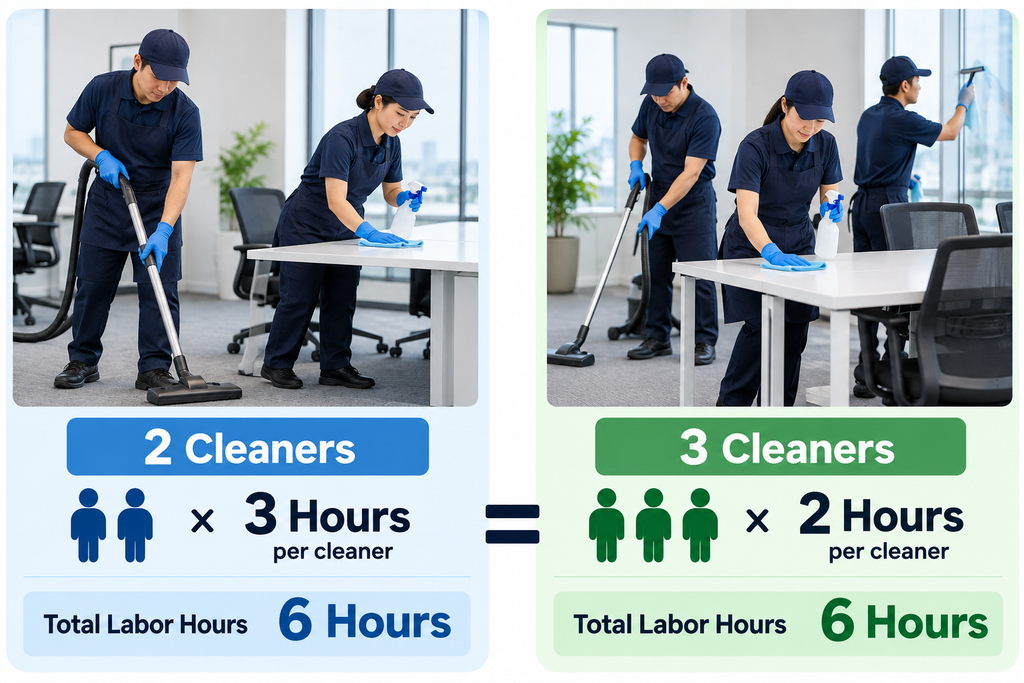
More cleaners do not automatically make a job more efficient.
Adding another cleaner may reduce the amount of time spent at the property, but it does not necessarily reduce total labor hours.
For example:
2 cleaners × 3 hours = 6 labor hours
and
3 cleaners × 2 hours = 6 labor hours
Both crews use the same total number of labor hours.
In some properties, adding more cleaners can even create inefficiency because employees get in each other’s way or duplicate tasks.
Test different crew sizes and compare actual labor hours rather than judging efficiency only by how quickly the crew leaves the property.
FIGURE 2 — CREW SIZE VS TOTAL LABOR HOURS
5. Reduce Travel Time Between Cleaning Jobs
Travel time can quietly consume a large amount of paid labor.
If cleaners spend 20 extra minutes driving between several jobs each day, those minutes add up across the week.
Look for opportunities to:
- Schedule nearby customers on the same day
- Avoid unnecessary trips back to the office
- Assign crews based partly on location
- Keep commonly used supplies in vehicles when appropriate
- Leave enough travel time between appointments
Route efficiency becomes increasingly important as your customer base grows.
6. Make Sure Crews Have the Right Supplies Before the Job
A missing bottle of cleaner, vacuum attachment, trash liner, or microfiber cloth can create unnecessary downtime.
Before crews leave for the day, they should know:
- Which jobs they are completing
- Which supplies each job requires
- Whether any customer requires special products
- Whether equipment needs to be replaced or repaired
A simple vehicle or supply checklist can prevent paid cleaning time from being lost to avoidable supply problems.
7. Define the Cleaning Scope Clearly
Scope creep increases labor cost without automatically increasing revenue.
A customer may gradually ask for additional tasks that were not included in the original estimate.
If cleaners complete those tasks without documenting them, the job can become less profitable over time.
Your work order or job instructions should clearly identify:
- Areas included in the service
- Tasks included
- Tasks excluded
- Frequency of periodic tasks
- Special customer instructions
If the scope changes permanently, review the cleaning price and labor estimate instead of absorbing the additional labor indefinitely.
8. Prevent Rework With Quality Control
Cutting five minutes from a cleaning job does not save money if the crew has to return later and fix the work.
Rework can create:
- Additional labor hours
- Additional travel time
- Customer service time
- Possible refunds or discounts
- Lower customer retention
That is why labor efficiency and quality control should be managed together.
Use consistent inspection standards and track recurring quality problems. Our Cleaning Business Quality Control Checklist can help you build a repeatable inspection process.
Measure Labor Efficiency
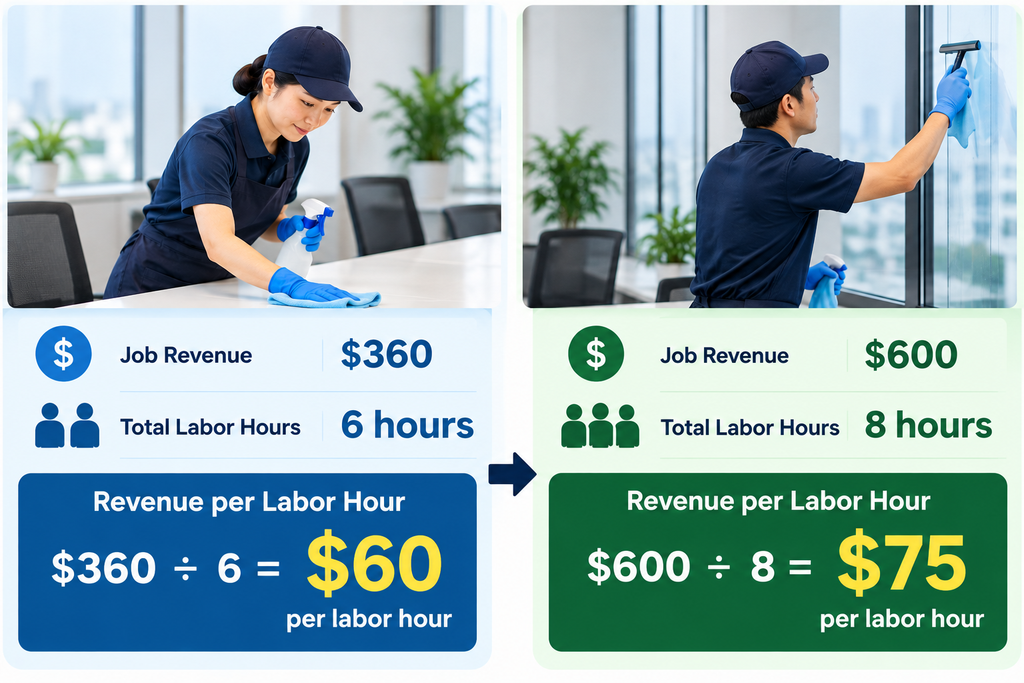
One useful way to monitor labor performance is to measure how much revenue the business generates for each labor hour used.
A simple formula is:
Revenue per Labor Hour = Job Revenue ÷ Total Labor Hours
Suppose a cleaning job generates $360 in revenue and requires 6 total labor hours.
$360 ÷ 6 = $60 revenue per labor hour
This number does not tell you your profit by itself. You still need to account for wages, labor burden, supplies, overhead, and other expenses.
However, tracking revenue per labor hour can help you compare jobs and identify accounts that may need closer attention.
FIGURE 3 — REVENUE PER LABOR HOUR
Cleaning Labor Efficiency Calculator
Use the calculator below to compare your estimated labor hours with the hours actually used on a cleaning job.
Enter the job revenue, estimated labor hours, actual labor hours, and your true hourly labor cost.
Cleaning Labor Efficiency Calculator
Compare your estimated labor hours with the actual hours used on a cleaning job.
Estimated Labor Cost = Estimated Labor Hours × True Hourly Labor Cost
Actual Labor Cost = Actual Labor Hours × True Hourly Labor Cost
Extra Labor Cost = Actual Labor Cost − Estimated Labor Cost
The calculator shows:
- Revenue per actual labor hour
- Estimated labor cost
- Actual labor cost
- Extra labor cost caused by the overrun
- Labor-hour variance
This makes it easier to see whether a job is performing close to your original estimate or consistently consuming more labor than planned.
9. Review Low-Performing Jobs Before Cutting Labor
If a job has poor labor efficiency, do not immediately tell the crew to work faster.
Review the job first.
Ask:
- Was the original estimate realistic?
- Has the service scope changed?
- Is the customer requesting extra work?
- Is the crew using the correct process?
- Is the equipment appropriate for the property?
- Would a different crew size work better?
- Does the price need to be adjusted?
Sometimes the labor problem is actually a pricing problem.
If the job cannot be completed profitably at a reasonable pace and quality standard, increasing the price may be more appropriate than trying to force labor hours lower.
Use our house cleaning pricing guide and calculator to review how labor fits into your overall price.
10. Use Scheduling Software as the Business Grows
Manual scheduling becomes harder as you add customers, cleaners, recurring jobs, and schedule changes.
A field service management system can help centralize job schedules, customer information, crew assignments, and other operational details.
Put Your Cleaning Operations Into One System
Jobber helps cleaning businesses manage scheduling, crew assignments, customer information, jobs, invoicing, and payments in one place.
Software will not fix an inefficient cleaning process by itself, but it can reduce administrative friction once your business has enough jobs and employees to make manual coordination difficult.
Do Not Reduce Labor Cost by Creating Bigger Problems
Some labor-cutting decisions can save money in the short term while damaging the business later.
Be careful about:
- Scheduling unrealistic cleaning times
- Skipping employee training
- Using too few cleaners for difficult jobs
- Removing necessary quality checks
- Ignoring safety procedures to save time
- Allowing workloads that encourage rushed work
Labor efficiency should make the cleaning operation better organized, not simply more demanding.
Track Labor Efficiency Over Time
One slow job does not necessarily mean you have a problem.
Look for patterns.
Track estimated and actual labor hours by customer, property type, crew, and service type.
Over time, this information can help you improve:
- Job estimates
- Pricing
- Crew assignments
- Training
- Scheduling
- SOPs
Your estimates should become more accurate as you collect more information from completed jobs.
That is one of the biggest advantages of tracking labor instead of relying only on intuition.
Reduce Waste Before You Reduce Labor
The safest way to reduce cleaning labor costs is to remove inefficiency before reducing the resources available to your team.
Start by knowing your true labor cost. Then compare estimated labor hours with actual results, standardize your procedures, improve training, optimize scheduling, control scope creep, and monitor quality.
Small improvements across many jobs can add up quickly.
The goal is not to get the maximum amount of cleaning from every paid minute.
The goal is to build a cleaning operation that produces consistent quality with a predictable amount of labor.