
Customer acquisition cost tells you how much it costs to win a new cleaning customer.
Customer lifetime value asks the next question:
How much revenue can that customer generate over the entire relationship with your business?
A customer who books one $200 cleaning and never returns is very different from a customer who pays $150 every two weeks for several years.
That difference matters when deciding:
- How much you can afford to spend on marketing
- Which customers are worth acquiring
- Whether recurring service is improving the business
- Which customer segments deserve more attention
Customer lifetime value — often shortened to CLV or LTV — helps connect those decisions.
This guide shows you how to calculate CLV, compare it with customer acquisition cost, and use it without confusing revenue with profit.
What Is Customer Lifetime Value in a Cleaning Business?
Customer lifetime value estimates the total value a customer generates during their relationship with your cleaning business.
A simple revenue-based formula is:
Customer Lifetime Value = Average Job Value × Jobs per Year × Average Customer Lifespan
FIGURE 1 — HOW CLEANING CUSTOMER LIFETIME VALUE WORKS
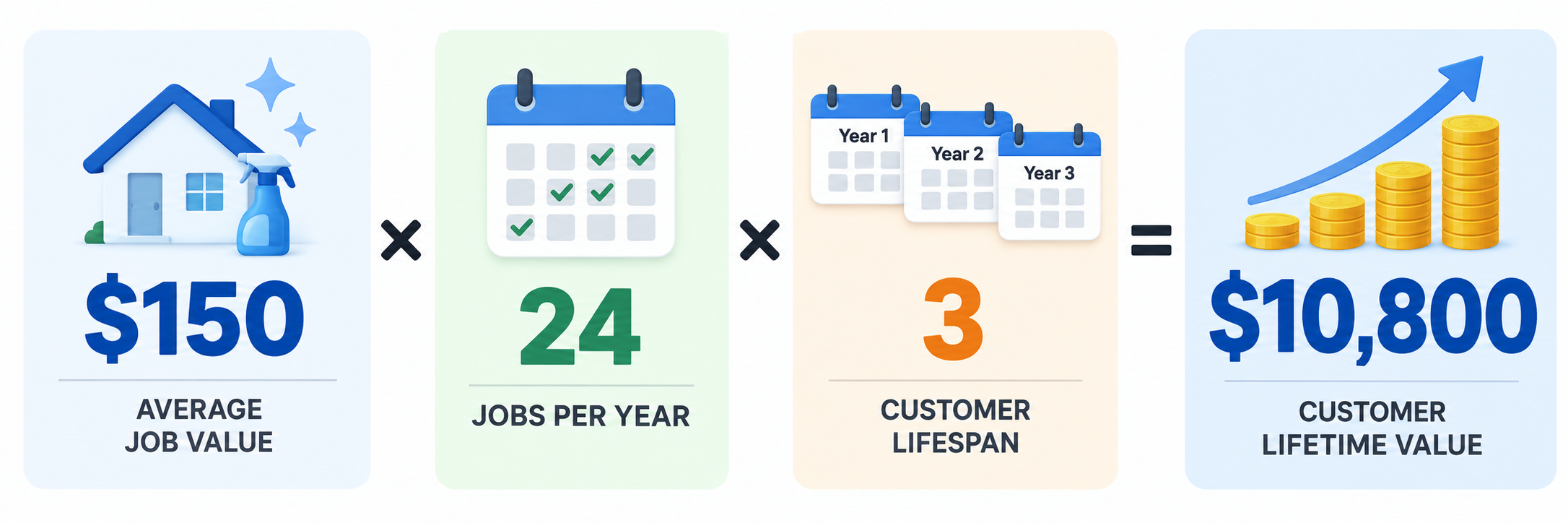
That does not mean the business earns $10,800 in profit.
We will separate revenue from profit later in this guide.
Why Customer Lifetime Value Matters
Looking only at the first cleaning can distort the economics of acquiring a customer. A recurring customer may not look dramatically more valuable on day one, but that can change substantially over time.
CLV helps you evaluate the longer customer relationship by connecting acquisition cost with the revenue a customer generates through repeat bookings and retention.
This gives you a better basis for deciding how much you can afford to spend to acquire different types of customers.
Cleaning Business Customer Lifetime Value Calculator
Use the calculator below to estimate the revenue a customer may generate over their relationship with your cleaning business.
Enter the customer’s average job value, expected number of jobs per year, average lifespan, and acquisition cost.
Use realistic averages rather than your best customer.
The purpose is to create a useful planning estimate — not the largest possible CLV number.
CLV is an estimate, not guaranteed future revenue.
Customer frequency, pricing, cancellations, retention, and service needs can all change over time.
The Three Numbers Behind a Simple CLV Calculation
The basic CLV formula becomes easier to use when you understand what drives it.
| CLV Driver | What It Measures | Example |
|---|---|---|
| Average Job Value | Average revenue per completed job | $150 |
| Jobs per Year | Average annual service frequency | 24 |
| Customer Lifespan | Average length of the relationship | 3 years |
Changing any one of these factors changes estimated lifetime value.
That means CLV is not only a marketing metric.
Pricing, service frequency, retention, and customer experience can all influence it.
One-Time and Recurring Customers Have Different Economics
Consider what happens after the first job.
A one-time customer may generate revenue once.
A recurring customer creates repeated opportunities to generate revenue without requiring the business to acquire that same customer again for every visit.
FIGURE 2 — ONE-TIME VS RECURRING CUSTOMER VALUE
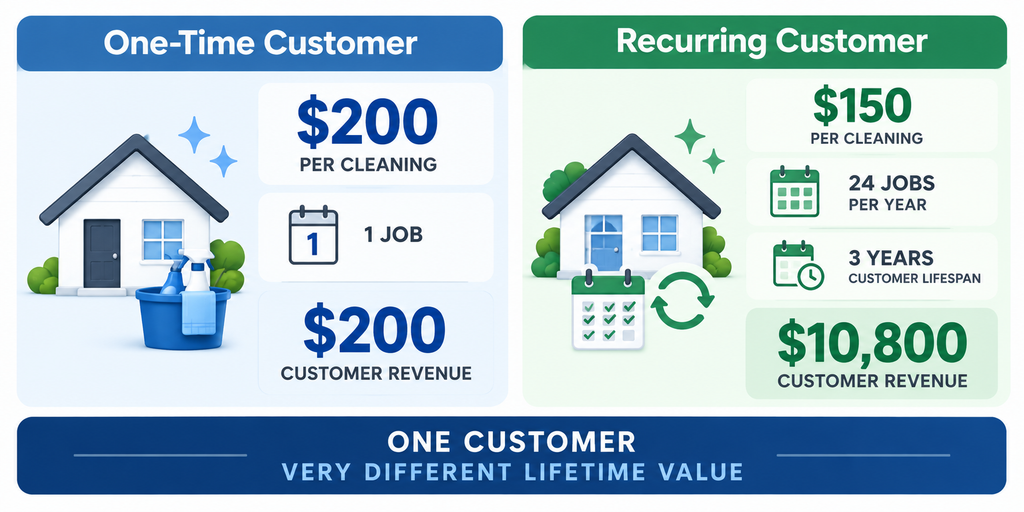
This does not mean recurring work is automatically more profitable.
It means customer frequency and retention can dramatically change how much revenue one acquisition produces.
Revenue CLV Is Not Profit CLV
This distinction is important.
The simple formula used above calculates revenue-based CLV.
But revenue is not profit.
A cleaning business still has expenses associated with delivering those jobs.
Instead of repeating the revenue calculation, compare the two approaches:
| Metric | Revenue-Based CLV | Profit-Based CLV |
|---|---|---|
| Focus | Customer revenue | Customer contribution/profit |
| Easier to Calculate | Yes | Requires margin data |
| Useful for Early Tracking | Yes | Yes, when cost data is reliable |
| Includes Service Costs | No | Yes |
| Better for Profit Decisions | Limited | Stronger |
A simplified profit-based approach is:
Profit-Based CLV = Revenue CLV × Contribution Margin
For example, a $10,800 revenue CLV with a 30% contribution margin produces an estimated profit-based CLV of $3,240.
Use the same margin definition consistently when comparing customers or acquisition channels.
Do not treat revenue CLV as money available to spend on marketing.
Labor, supplies, travel, overhead, and other costs still have to be paid.
1. Compare CLV With Customer Acquisition Cost
CLV becomes much more useful when compared with CAC.
Suppose two marketing channels both produce customers at a $150 CAC.
If one channel produces mostly low-value one-time jobs while the other produces long-term recurring customers, the same acquisition cost can have very different economics.
FIGURE 3 — SAME CAC, DIFFERENT CLV
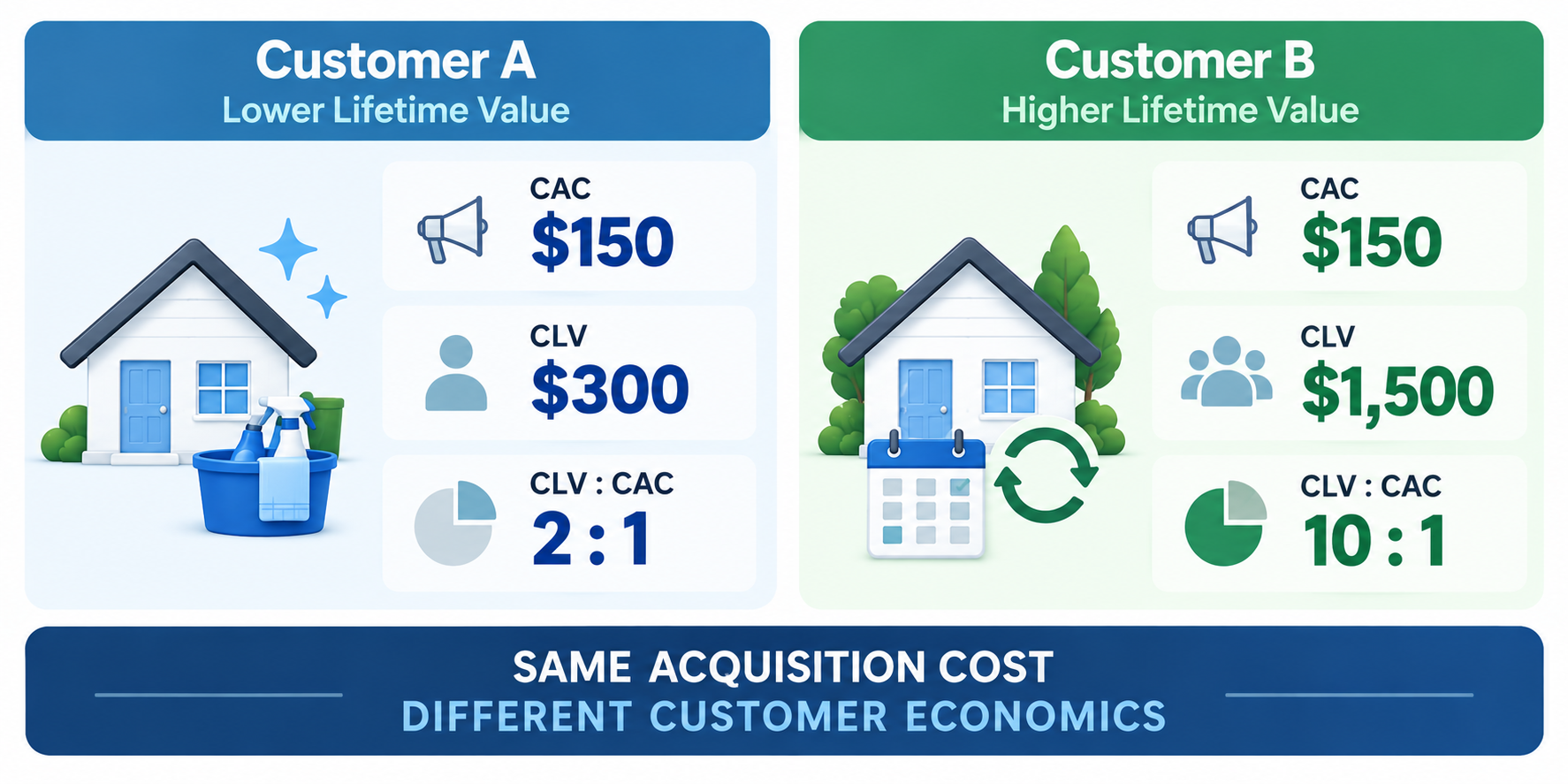
This is why CAC should not be judged alone.
Our Cleaning Business Customer Acquisition Cost guide explains how to calculate CAC and compare acquisition efficiency across marketing channels.
CLV-to-CAC Ratio
A simple way to connect customer value with acquisition cost is:
CLV-to-CAC Ratio = Customer Lifetime Value ÷ Customer Acquisition Cost
A higher ratio means more lifetime value is being generated relative to the cost of acquiring the customer. However, make sure you are comparing ratios calculated using the same CLV definition.
A revenue-based CLV:CAC ratio should not be compared directly with one based on profit or contribution margin.
2. Customer Retention Can Increase CLV
Customer lifespan is one of the main variables in the simple CLV formula.
If average job value and frequency stay the same, customers who remain longer generate more lifetime revenue.
FIGURE 4 — CUSTOMER LIFESPAN CHANGES CLV
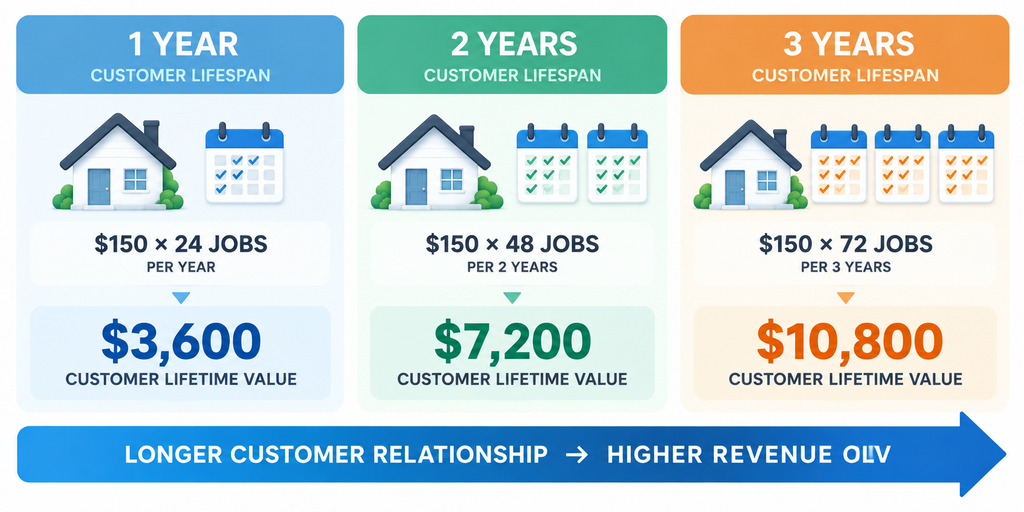
This is why retention affects more than your churn rate.
Keeping profitable customers longer can increase the economic value generated from acquisition spending already incurred.
Our Cleaning Business Customer Retention guide explains how to calculate retention and churn separately.
3. Service Frequency Changes Customer Value
Two customers can stay with your business for the same length of time but book at different frequencies.
A weekly customer, biweekly customer, and monthly customer should not automatically be assigned the same lifetime value.
Rather than treating all recurring customers as one group, segment them when the difference is meaningful.
| Service Frequency | Approx. Jobs per Year | Why It Matters |
|---|---|---|
| Weekly | 52 | More annual service opportunities |
| Biweekly | 26 | Strong recurring frequency |
| Every 4 Weeks | 13 | Lower annual frequency |
| Quarterly | 4 | Much lower annual frequency |
Use actual operating data when available.
The table is a frequency illustration, not a promise of customer behavior.
4. Average Job Value Also Changes CLV
Increasing customer lifespan is not the only way to increase lifetime value.
Average job value matters too.
If customers purchase relevant, profitable additional services, revenue per visit can increase without increasing acquisition spending for that existing customer.
Examples might include deep-cleaning upgrades, interior window cleaning, oven cleaning, or other services your business already provides profitably.
The goal is not to push unnecessary add-ons.
It is to offer services that genuinely match the customer’s needs.
Our How to Increase Average Job Value in Your Cleaning Business guide covers that strategy in more detail.
5. Calculate CLV by Customer Segment
A single company-wide CLV can hide useful differences.
Instead, compare customer groups that have meaningfully different economics.
For example:
| Customer Segment | Why Track Separately? |
|---|---|
| One-Time Cleaning | Little or no recurring frequency |
| Recurring Residential | Repeat revenue and retention matter |
| Move-In / Move-Out | Higher-value but often one-time work |
| Commercial Accounts | Different contract values and sales cycles |
| Referral Customers | May have different acquisition and retention behavior |
You do not need dozens of segments.
Create separate CLV estimates only when the distinction helps you make a decision.
6. Compare CLV by Marketing Channel
This is where CLV becomes especially useful for marketing.
CAC tells you how expensive a channel is.
CLV helps you understand what those acquired customers may be worth.
A channel with a higher CAC can still produce stronger economics if its customers stay longer, book more frequently, or purchase higher-value services.
A practical channel report can combine:
| Channel | CAC | Estimated CLV | CLV:CAC |
|---|---|---|---|
| Referrals | $60 | $900 | 15:1 |
| Organic Search | $100 | $1,200 | 12:1 |
| Google Ads | $180 | $1,440 | 8:1 |
| Paid Social | $120 | $600 | 5:1 |
Do not choose a channel based on the ratio alone.
Volume, margins, lead quality, service capacity, and the reliability of your CLV estimate still matter.
7. Do Not Inflate Customer Lifespan
CLV becomes misleading quickly when customer lifespan is based on unrealistic assumptions.
If you do not yet have enough historical data, use a conservative estimate rather than assuming customers will stay for several years.
Build a more reliable lifespan estimate over time by recording each customer’s start date, last service date, and whether they are still active.
As your customer history grows, replace assumptions with actual retention and lifespan data.
8. Do Not Treat Every Customer as Average
An average is useful for planning, but it can hide major differences in customer behavior. One customer may stay for four years, another may cancel after the second cleaning, and another may book only occasional seasonal services.
That is why CLV becomes more useful when you calculate it for meaningful customer segments instead of assuming every customer behaves like the company-wide average.
Build a Simple CLV Scorecard
You do not need a complicated analytics system to start.
A useful CLV scorecard connects the metrics that actually drive customer economics.
| Metric | Why Track It |
|---|---|
| Average Job Value | Revenue generated per visit |
| Jobs per Customer | Service frequency |
| Average Customer Lifespan | Length of relationship |
| Revenue CLV | Estimated lifetime revenue |
| Contribution Margin | Helps move toward profit-based CLV |
| Customer Acquisition Cost | Cost to acquire the customer |
| CLV:CAC Ratio | Connects customer value with acquisition cost |
| Retention Rate | Helps explain customer lifespan |
| Customer Segment | Prevents unlike customers being mixed together |
Reviewing these metrics together is more useful than watching CLV alone.
How to Increase Customer Lifetime Value
There are three primary levers in the simple CLV formula:
FIGURE 5 — THREE LEVERS THAT INCREASE CLV
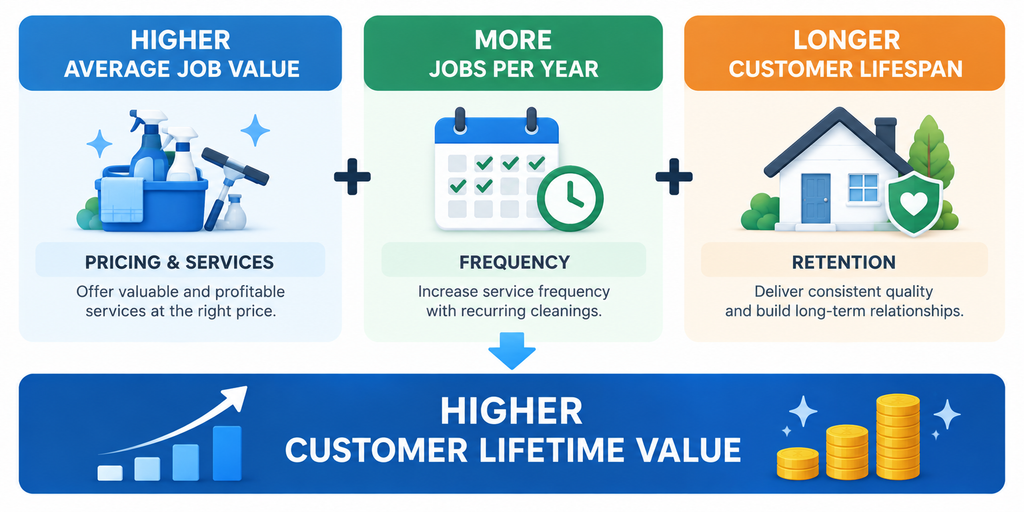
The strongest strategy is not to maximize one CLV driver at any cost. Improve the combination while protecting profitability and service quality.
Keep Customer History Connected
CLV becomes difficult to estimate when customer, job, and revenue data are stored separately.
Keep each customer’s job history, revenue, service frequency, and retention status connected so you can calculate CLV from consistent records.
Manage Customers, Quotes, Jobs, and Payments in One Place
Jobber helps cleaning businesses manage customer information, quotes, scheduling, jobs, invoicing, and payments in one system.
Customer Lifetime Value Gives CAC Context
Customer acquisition cost tells you what it costs to acquire a customer. Customer lifetime value adds the other side of the equation by estimating what that customer may generate over the relationship.
Neither metric should be used alone. Start with a simple CLV estimate based on realistic customer data, then refine it as you collect better information about margins, retention, customer segments, and acquisition sources.
The goal is not to produce the largest possible CLV number. It is to understand which customers create sustainable value for your cleaning business — and what it costs to acquire and keep them.