
A professional cleaning estimate does more than tell a customer how much a job will cost.
It defines what is included, shows how the price was calculated, and gives the customer a clear next step to approve the work.
That matters whether you run a one-person cleaning business or manage multiple crews.
In this guide, you’ll learn what to include in a cleaning estimate, see realistic examples, and get a simple template you can copy and use for your own business.
If you are still deciding what to charge, start with our house cleaning pricing guide and calculator before building your estimate.
What Is a Cleaning Business Estimate?
A cleaning business estimate is a document that gives a potential customer an expected price for a cleaning job based on the information currently available.
Instead of sending a message that simply says “$180,” a professional estimate explains what the customer is actually getting for that price.
A typical estimate may include:
- Your cleaning business information
- Customer and service address
- Estimate number and date
- Type of cleaning service
- Scope of work
- Individual services or add-ons
- Estimated price
- Taxes, when applicable
- Terms and exclusions
- How long the estimate is valid
This makes it easier for the customer to understand your offer and reduces confusion about what is included in the job.
It also gives you a written record of what you originally agreed to provide.
What to Include in a Cleaning Estimate
Your estimate does not need to be complicated.
It does need to be specific.
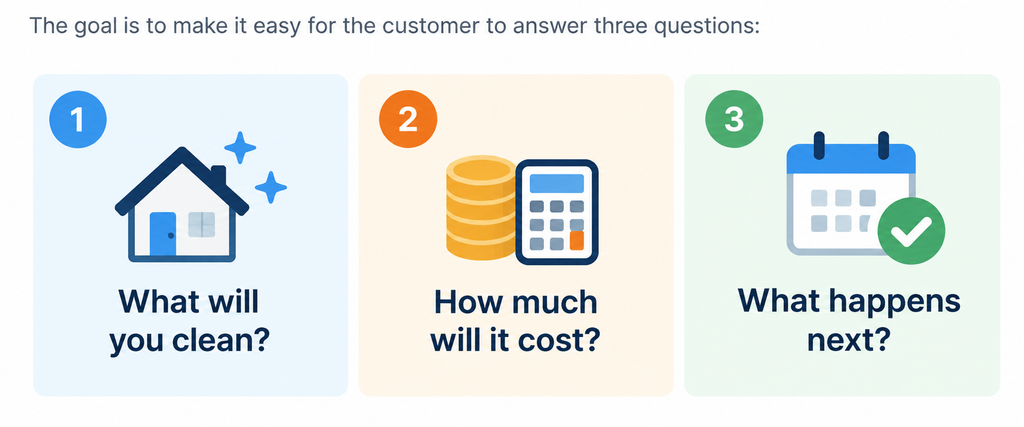
The goal is to make it easy for the customer to answer three questions:
Business and Customer Information
Start with the basic details that identify both parties.
Include:
- Business name
- Business phone number
- Email address
- Website, if applicable
- Customer name
- Customer phone or email
- Service address
- Estimate number
- Estimate date
Using unique estimate numbers becomes increasingly useful as your business grows because you can quickly match estimates with customers and jobs.
Scope of Work
The scope of work explains exactly what you are agreeing to clean.
For example:
- 3 bedrooms
- 2 bathrooms
- Kitchen
- Living room
- Dining area
- Vacuuming and mopping floors
- Dusting accessible surfaces
- Cleaning kitchen counters and exterior appliance surfaces
- Cleaning sinks, toilets, tubs, and showers
Avoid descriptions such as:
“Full house cleaning.”
That can mean different things to different customers.
The more clearly you define the scope, the easier it is to prevent disagreements later.
Line Items and Pricing
You can show your estimate as one flat price or break the job into individual line items.
For example:
| Service | Price |
|---|---|
| Standard home cleaning | $160 |
| Inside oven | $35 |
| Inside refrigerator | $30 |
| Estimated Total | $225 |
Itemized estimates are especially useful when customers request optional services because they can see exactly what increases the total price.
If you are unsure whether your base price is high enough, use the OpsButler House Cleaning Price Calculator.
Add-On Services
Add-ons are services outside your standard cleaning package.
Common examples include:
- Inside oven cleaning
- Inside refrigerator cleaning
- Interior window cleaning
- Baseboard detailing
- Cabinet interior cleaning
- Laundry
- Bed linen changes
- Pet hair removal
List these separately whenever possible.
This keeps your base service easy to understand while giving customers the option to purchase additional work.
Terms, Expiration, and Payment Details
Your estimate should also explain any important conditions.
Depending on your business, these might include:
- How long the estimate remains valid
- Payment methods accepted
- When payment is due
- Cancellation or rescheduling policies
- Whether the price may change if the actual condition differs significantly from the information provided
- Services specifically excluded from the estimate
For example:
This estimate is valid for 14 days and is based on the property information provided by the customer. Additional services or conditions requiring substantially more work may require customer approval of a revised price before work continues.
Your exact terms should reflect your business and applicable local laws.
Free Cleaning Business Estimate Template
You do not need complicated software to create your first professional cleaning estimate.
Here is a simple template you can copy and customize.
Cleaning Estimate Template
Download the Free Cleaning Business Estimate Template
Use the free OpsButler Excel estimate template to create professional cleaning estimates. Enter your services, quantities, and rates, and the template automatically calculates line-item amounts, subtotal, and estimated total.
Download Free Excel Estimate Template
File format: Excel (.xlsx). You can also upload the file to Google Sheets to edit it online.
[YOUR CLEANING BUSINESS NAME]
Phone: [PHONE NUMBER]
Email: [EMAIL ADDRESS]
Website: [WEBSITE]ESTIMATE
Estimate #: [0001]
Estimate Date: [DATE]
Valid Until: [DATE]Customer
Name: [CUSTOMER NAME]
Service Address: [ADDRESS]
Phone/Email: [CONTACT INFORMATION]Service
[STANDARD CLEAN / DEEP CLEAN / MOVE-OUT CLEAN / OTHER]Scope of Work
- [SERVICE / AREA]
- [SERVICE / AREA]
- [SERVICE / AREA]
- [SERVICE / AREA]
Pricing
Base Cleaning: $[AMOUNT]
Add-On: [SERVICE] — $[AMOUNT]
Add-On: [SERVICE] — $[AMOUNT]
Tax, if applicable: $[AMOUNT]Estimated Total: $[TOTAL]
Terms / Notes
[PAYMENT TERMS]
[CANCELLATION POLICY]
[PRICE ADJUSTMENT OR SCOPE CONDITIONS]
[OTHER IMPORTANT INFORMATION]Customer Approval: ____________________
Date: ____________________
Save a blank master version and duplicate it for each new customer.
That way, you only need to update the customer details, scope, and pricing.
Cleaning Estimate Examples
Templates are useful, but realistic examples make it easier to see how an estimate works in practice.
The following prices are examples only. Your actual prices should reflect your labor costs, overhead, market, property condition, and desired profit.
Standard House Cleaning Example
Suppose a customer requests a standard cleaning for a 3-bedroom, 2-bathroom home.
Your estimate might look like this:
| Service | Estimated Price |
|---|---|
| Standard cleaning — 3 bed / 2 bath | $165 |
| Inside oven | $35 |
| Estimated Total | $200 |
The scope could state that the standard cleaning includes:
- Dusting accessible surfaces
- Vacuuming carpets and rugs
- Mopping hard floors
- Cleaning kitchen surfaces
- Cleaning exterior appliance surfaces
- Cleaning bathrooms
- Emptying household trash bins
The oven cleaning is clearly listed as an add-on rather than being silently included in the standard package.
Deep Cleaning Example
A deep cleaning estimate might include more detailed work.
| Service | Estimated Price |
|---|---|
| Deep cleaning | $280 |
| Inside refrigerator | $30 |
| Interior windows | $60 |
| Estimated Total | $370 |
The scope might include everything in your standard cleaning plus services such as detailed baseboards, heavier buildup removal, cabinet fronts, and other tasks defined in your deep-cleaning package.
The important part is not the example price.
It is making sure the customer can see what makes a deep cleaning different from a standard cleaning.
How to Create a Cleaning Estimate Step by Step
Once you have a reusable template, creating an estimate becomes much easier.
Here is a simple five-step process.
Step 1: Define the Scope
Before calculating a price, collect enough information about the job.
For residential cleaning, that might include:
- Home size
- Number of bedrooms
- Number of bathrooms
- Current condition
- Pets
- Type of cleaning requested
- Frequency of service
- Requested add-ons
For larger or unusual jobs, photos, a video walkthrough, or an in-person visit may help you estimate the work more accurately.
Step 2: Calculate Your Price
Do not choose a price simply because a competitor charges something similar.
Your price needs to cover:
- Labor
- Cleaning supplies
- Travel
- Insurance
- Software and administration
- Marketing
- Other overhead
- Profit
Our house cleaning pricing guide can help you build a starting price.
Then use the Cleaning Business Profit Margin Calculator to check whether that price actually leaves enough profit after your costs.
Step 3: List Services Clearly
Write down exactly what the customer receives.
Instead of:
Deep clean — $300
consider listing the major tasks included in your deep-cleaning package and separating optional add-ons.
The customer should not have to guess whether oven interiors, refrigerator interiors, windows, or other detailed tasks are included.
Step 4: Add Terms and Exclusions
Think about situations that could create a disagreement.
For example:
- What happens if the property is much dirtier than described?
- Are interior windows included?
- Are dishes or laundry included?
- What happens if the customer cancels?
- How long is the estimate valid?
Put important conditions in writing before the customer approves the job.
Step 5: Send the Estimate and Follow Up
Send the estimate while the customer is still actively considering the service.
Make it clear how they can accept it or contact you with questions.
If they do not respond, follow up.
A simple message such as:
Hi [Name], just checking that you received the cleaning estimate I sent over. Let me know if you have any questions about the scope or pricing.
is often enough to restart the conversation without being pushy.
If generating leads is the bigger problem, see our guide on how to get clients for a cleaning business.
Estimate vs. Quote vs. Invoice: What’s the Difference?
These terms are sometimes used interchangeably in everyday conversation, but they serve different purposes.
| Document | Purpose | When It Is Used |
|---|---|---|
| Estimate | Provides an expected cost based on available information | Before the customer approves the work |
| Quote | Typically presents a more definite price for a defined scope | Before the customer approves the work |
| Invoice | Requests payment for work or charges owed | After or according to the agreed billing schedule |
For cleaning businesses, the distinction between an estimate and a quote can matter when the actual condition of a property is difficult to determine before the job.
For example, a customer may describe a home as needing a normal clean, while the crew arrives to find conditions that require substantially more labor.
Clearly state whether the document is an estimate or a fixed quote and explain any conditions that could change the final price.
Rules governing quotes, estimates, taxes, contracts, and consumer transactions can vary by location, so check the requirements that apply to your business.
Common Cleaning Estimate Mistakes
A professional-looking document will not help much if the estimate itself creates confusion.
Watch for these common mistakes.
Giving Only a Total Price
“Cleaning: $250” tells the customer almost nothing.
Define the service and scope so both sides know what the price covers.
Forgetting Add-Ons
If services such as oven cleaning or interior windows cost extra, show them separately.
Underestimating Labor
A job that looks profitable at first can become unprofitable if it takes significantly longer than expected.
Track actual job times and compare them with your estimates.
Ignoring Profit Margin
Revenue is not profit.
Before discounting an estimate to win a customer, check what the lower price does to your margin with our Profit Margin Calculator.
Leaving the Estimate Open-Ended
Prices and operating costs can change.
Consider including an expiration date rather than leaving every estimate valid indefinitely.
Should You Use an Estimate Template or Software?
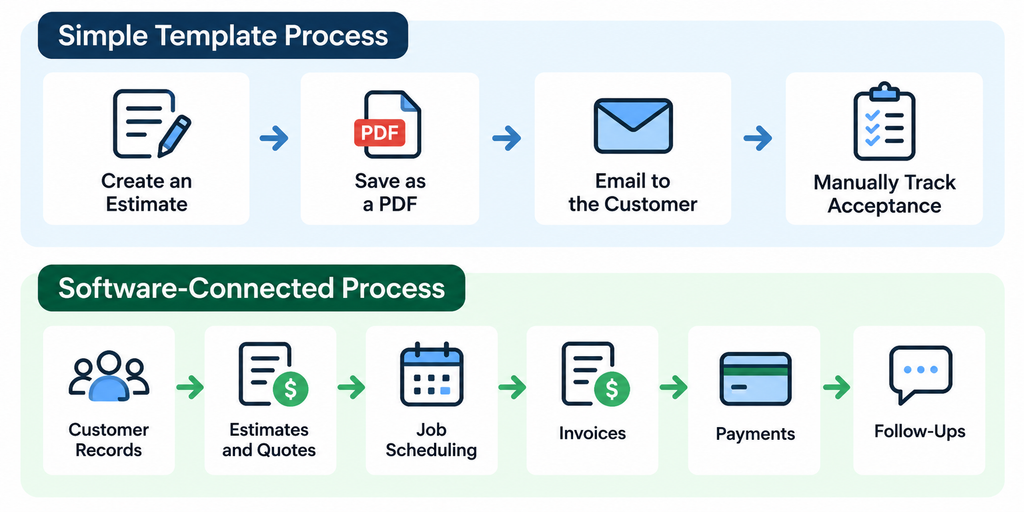
For example, some field-service platforms allow businesses to create an estimate, send it digitally, track its status, and convert approved work into the next stages of the job and billing workflow.
If you are reaching the point where spreadsheets and PDFs are becoming difficult to manage, compare the options in our guide to the best cleaning business software.
For businesses mainly struggling with calendars, crews, and recurring appointments, see our comparison of the best scheduling software for cleaning businesses.
How to Turn More Estimates Into Booked Jobs
Getting the price right is only part of the process.
A strong estimate should make the decision easy for the customer.
Before sending one, check that it:
- Clearly identifies your business
- Explains exactly what is included
- Separates optional add-ons
- Shows the total price clearly
- Explains important terms
- Provides a simple way to accept or respond
Then follow up on estimates that have not received a response.
You can also test different service packages instead of presenting every customer with only one option.
For example:
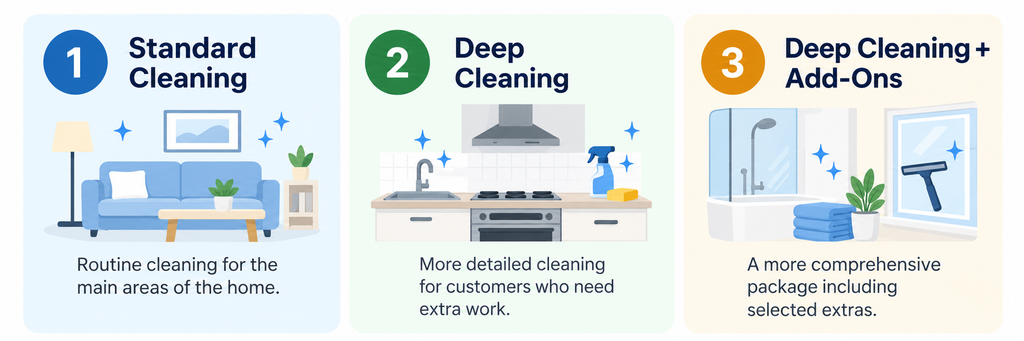
The goal is not to overwhelm the customer.
It is to make the scope and value of each option easy to compare.
Final Take
A cleaning estimate should do more than display a number.
It should clearly explain the scope of work, price, optional services, and important conditions so both you and the customer know what to expect.
Start with a simple reusable template.
As your business grows, track how long jobs actually take, compare estimated costs with real costs, and refine your pricing over time.
Before sending your next estimate, use the House Cleaning Price Calculator to build your price and the Profit Margin Calculator to make sure the job is worth taking.
A professional estimate can help win the job.
A profitable estimate helps build the business.