
A cleaning business can be profitable on paper and still run short of cash.
You may have recurring customers, a full schedule, and invoices waiting to be paid—but payroll, supplies, insurance, and other expenses still need to be covered on time.
That is why cash flow management matters.
The question is not only how much money your cleaning business earns. It is whether enough cash will be available when payments are due.
This guide explains how cleaning business cash flow works, how to build a practical cash flow forecast, and how to reduce the risk of running short of money as your business grows.
What Is Cash Flow in a Cleaning Business?
Cash flow is the movement of money into and out of your business over a period of time.
Cash inflows include customer payments and other money received. Cash outflows include payroll, supplies, rent, insurance, taxes, equipment purchases, loan payments, and other cash expenses.
Your net cash flow is the difference between those two amounts.
Net Cash Flow = Cash Inflows − Cash Outflows
Positive net cash flow means more cash entered the business than left during the period. Negative net cash flow means more cash left than entered.
Neither result, by itself, tells you whether the business is profitable.
FIGURE 1 — PROFIT VS CASH FLOW
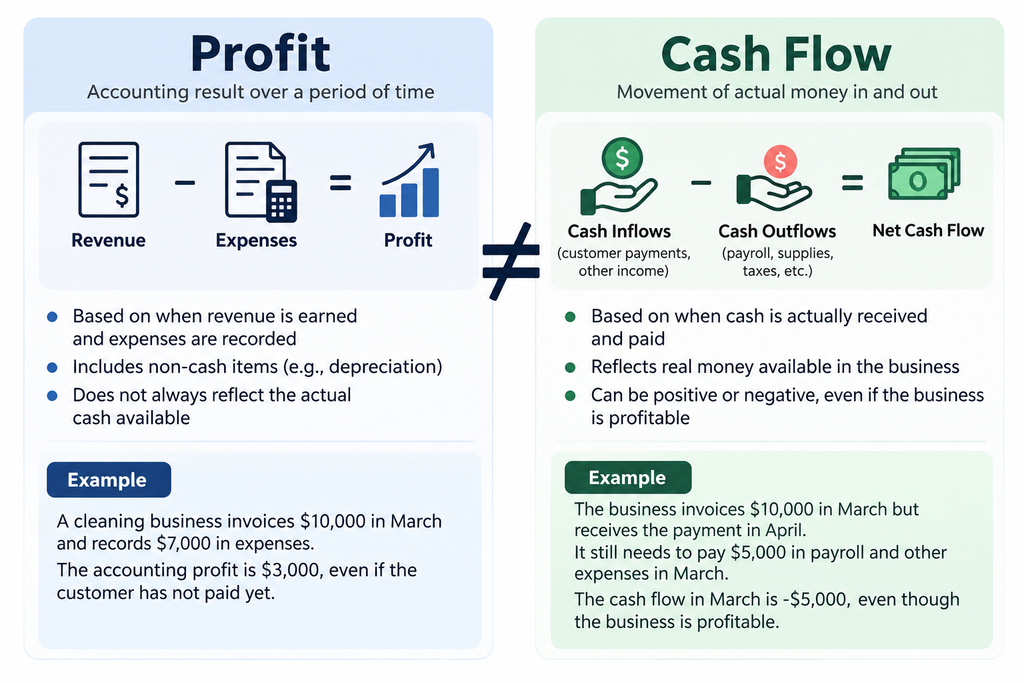
Profit and cash flow are not the same.
Revenue may be recorded before a customer pays, while expenses and cash payments may occur at different times. Loan principal payments and equipment purchases can also affect cash without affecting accounting profit in the same way.
Cleaning Business Cash Flow Forecast Calculator
A cash flow forecast estimates how much cash your business will have after expected incoming and outgoing payments.
Use the calculator below to test a future week or month.
Enter your expected cash receipts and payments for the same week or month. Results update automatically.
This is a planning estimate, not an accounting profit calculation. Use the same forecast period for all inputs. A positive ending balance does not guarantee sufficient cash on every day within that period.
The calculator estimates your ending cash balance and compares it with your chosen minimum cash reserve. It does not calculate accounting profit.
Use amounts you realistically expect to receive or pay during the selected period—not simply invoices issued or expenses recorded.
The Four Numbers Behind a Cash Flow Forecast
A useful starting forecast needs four inputs.
| Input | What to Include | Important Distinction |
|---|---|---|
| Starting Cash | Available business cash at the beginning of the period | Exclude unpaid invoices |
| Expected Cash Inflows | Customer payments and other cash expected to arrive | Use expected payment dates |
| Expected Cash Outflows | Payroll, suppliers, taxes, debt payments, and other cash payments | Use actual due dates |
| Minimum Cash Reserve | Cash you want to retain for upcoming obligations and unexpected costs | This is a planning threshold |
The basic calculation is:
Ending Cash Balance = Starting Cash + Expected Cash Inflows − Expected Cash Outflows
Your reserve position is then:
Reserve Surplus or Shortfall = Ending Cash Balance − Minimum Cash Reserve
A positive reserve position means the forecast ending balance is above your chosen reserve threshold. A negative position means it is below that threshold.
However, a positive month-end balance does not guarantee that you will have enough cash throughout the month.
Why Payment Timing Matters More Than Invoice Volume
Cleaning businesses often complete work before receiving payment.
That creates a timing difference between providing the service and collecting the cash.
For example, a commercial cleaning company may pay its cleaners weekly while a customer pays invoices 30 days after billing.
The work can be profitable, but the business still needs enough cash to fund payroll before payment arrives.
FIGURE 2 — THE CASH FLOW TIMING GAP
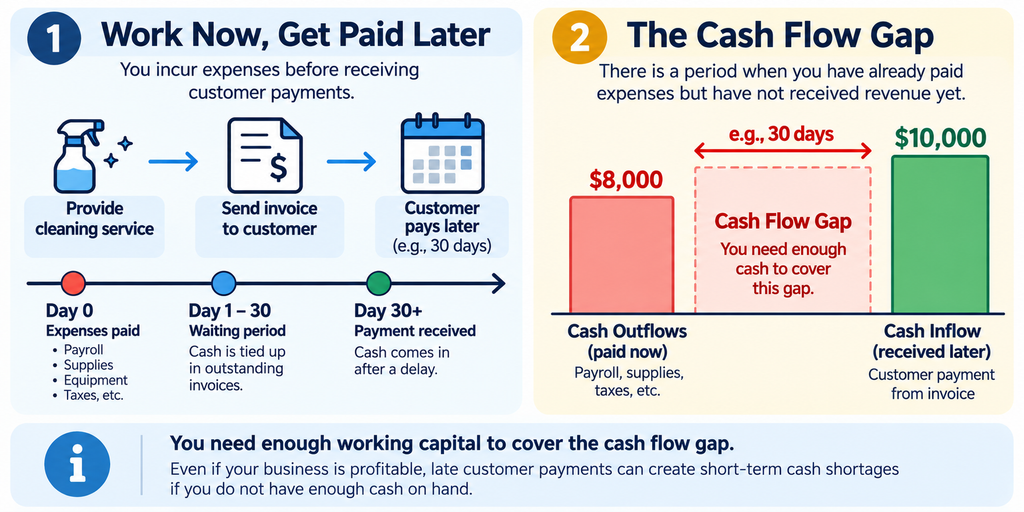
The important distinction is between three events:
| Event | What Happens |
|---|---|
| Service Completed | Cleaning work has been delivered |
| Invoice Issued | The customer is asked to pay |
| Payment Received | Cash becomes available to the business |
For cash flow forecasting, the third event is the one that increases your available cash.
An invoice that has not been paid is not money you can use to cover payroll.
Build a Weekly Cash Flow Forecast
A monthly forecast is useful for planning, but it can hide shortages that occur between the beginning and end of the month.
A weekly forecast makes those timing problems easier to identify.
Start with the cash available at the beginning of the week. Add payments expected to arrive, subtract payments due, and carry the ending balance into the following week.
| Forecast Item | Week 1 | Week 2 | Week 3 | Week 4 |
|---|---|---|---|---|
| Starting Cash | $8,000 | $6,500 | $4,500 | $7,000 |
| Cash Inflows | $4,000 | $3,000 | $7,000 | $5,000 |
| Cash Outflows | $5,500 | $5,000 | $4,500 | $6,000 |
| Ending Cash | $6,500 | $4,500 | $7,000 | $6,000 |
In this example, the business finishes the fourth week with $6,000.
But its lowest projected week-end balance is $4,500.
If management looks only at the final monthly number, it may overlook the tighter cash position earlier in the month.
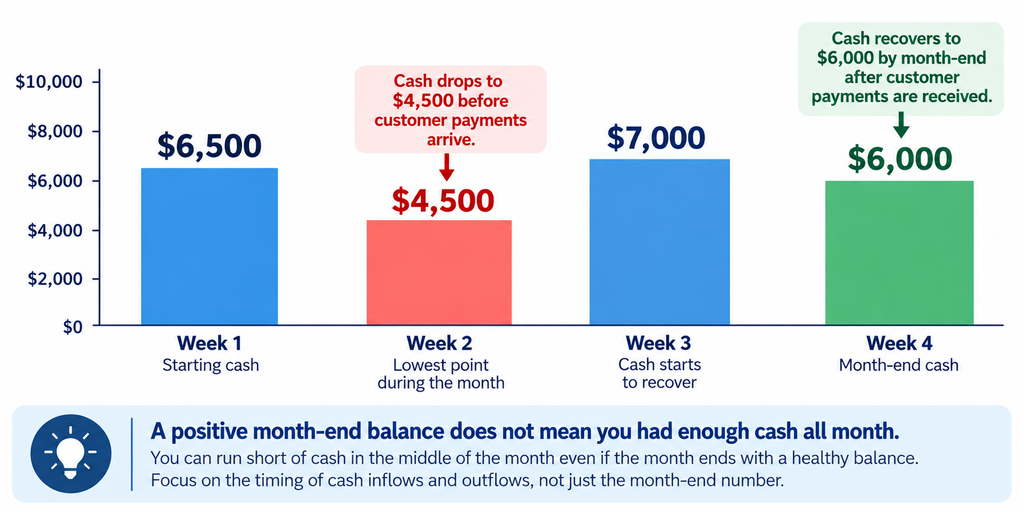
For a more accurate forecast, use actual payment dates rather than assuming all money arrives or leaves at the end of each week. A weekly table is a starting point; daily monitoring may be necessary when cash is tight.
1. Forecast Customer Payments Realistically
Expected revenue and expected cash receipts should not be treated as interchangeable.
A customer who normally pays late should not automatically be forecast to pay on the invoice due date.
Review payment behavior and distinguish between money that is likely to arrive on time and money that remains uncertain.
| Payment Category | Forecast Approach |
|---|---|
| Already Received | Include in starting cash if available at the period start |
| Confirmed Upcoming Payment | Use the expected receipt date |
| Recurring Customer With Reliable History | Forecast using typical payment timing |
| Overdue Invoice | Use a realistic collection estimate |
| Unconfirmed Future Work | Keep separate from committed receipts |
This prevents optimistic sales assumptions from making the forecast appear safer than it really is.
2. Put Payroll at the Center of Your Forecast
Payroll is one of the most important cash obligations in a labor-intensive cleaning business.
Customer payment delays do not eliminate the need to pay employees on time.
Forecast payroll based on actual pay dates, expected hours, overtime, payroll taxes, and other cash obligations related to compensation.
Do not rely only on average monthly payroll expenses when the business pays employees weekly or biweekly.
The exact timing of each payroll run matters.
Payroll should be treated as a scheduled obligation, not a flexible payment.
If your forecast shows insufficient cash for an upcoming payroll, the issue needs attention before the payment date—not after it.
3. Track Receivables Before They Become a Cash Problem
Accounts receivable represents money customers owe for work already billed.
A growing receivables balance can create cash pressure even when reported revenue is increasing.
Use a simple aging report to distinguish recent invoices from payments that are becoming overdue.
| Invoice Status | Management Action |
|---|---|
| Not Yet Due | Confirm the invoice was delivered correctly |
| 1–15 Days Overdue | Send a professional payment reminder |
| 16–30 Days Overdue | Follow up and confirm the payment date |
| More Than 30 Days Overdue | Escalate according to your payment terms and collection policy |
The specific follow-up schedule should reflect your contracts, customer relationships, and applicable requirements.
A consistent process is more useful than waiting until cash becomes tight before contacting customers.
4. Separate Recurring Expenses From Irregular Cash Payments
Some expenses appear every week or month. Others create larger, less frequent cash demands.
Both need to be included in a realistic forecast.
| Recurring Cash Payments | Irregular Cash Payments |
|---|---|
| Payroll | Equipment replacement |
| Rent or storage | Annual insurance premiums |
| Software subscriptions | Tax payments |
| Regular supplies | Vehicle repairs |
| Loan installments | Major equipment purchases |
Irregular payments are especially easy to overlook when a forecast is based only on the previous month's expenses.
Maintain a calendar of upcoming obligations so predictable annual or quarterly payments do not become unexpected cash shortages.
5. Understand How Growth Can Create Cash Pressure
Winning more cleaning contracts can increase the amount of cash needed to operate.
New customers may require additional employees, equipment, supplies, transportation, and supervision before their first payments arrive.
That means a growing cleaning company can experience increasing cash pressure even when its future revenue outlook is strong.
FIGURE 4 — GROWTH CAN INCREASE CASH PRESSURE
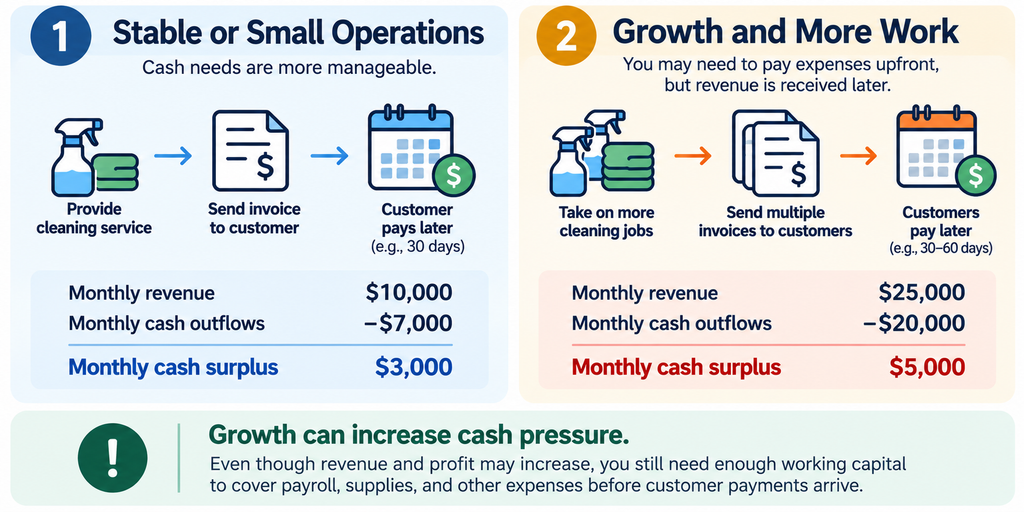
Before accepting a large new contract, estimate the working capital required to deliver the service until the customer pays.
A useful contract review includes:
| Question | Why It Matters |
|---|---|
| When will the first payment arrive? | Determines the funding gap |
| How many payroll cycles occur before payment? | Estimates upfront labor funding |
| Are new supplies or equipment required? | Identifies startup cash needs |
| Is a deposit or earlier billing possible? | May reduce the funding gap |
| What happens if payment is delayed? | Tests the downside scenario |
A contract can have a positive expected margin and still require more working capital than the business currently has available.
6. Build a Minimum Cash Reserve
A cash reserve gives your business more room to handle payment delays, seasonal changes, unexpected expenses, and temporary revenue declines.
There is no universal reserve amount that fits every cleaning business.
A useful starting point is to estimate the cash needed for essential obligations over a chosen period.
Cash Reserve Target = Essential Monthly Cash Outflows × Reserve Months
The appropriate reserve depends on factors such as customer concentration, payment terms, payroll frequency, recurring revenue, access to financing, and business stability.
For example, a company with predictable residential payments may face different cash risks from a commercial cleaning company with long invoice terms and concentrated customers.
The reserve should reflect those differences.
7. Use a Cash Flow Stress Test
A forecast based only on expected conditions can provide false confidence.
Test what happens when payments arrive later than expected or costs increase unexpectedly.
| Scenario | What to Change in Your Forecast |
|---|---|
| Customer Pays Late | Move the expected receipt to a later period |
| Major Customer Cancels | Remove the expected future receipts |
| Payroll Increases | Raise projected cash outflows |
| Equipment Fails | Add an unexpected repair or replacement payment |
| Sales Slow Down | Reduce new cash receipts |
| New Contract Starts | Add startup costs before the first customer payment |
The purpose is not to predict every possible problem.
It is to identify which realistic changes would push your cash balance below the reserve you need.
8. Improve Cash Flow Without Simply Increasing Sales
More sales can help cash flow, but additional revenue is not always the fastest solution.
Sometimes the more immediate problem is how quickly cash is collected or when obligations must be paid.
Consider the following improvements.
| Improvement | Cash Flow Benefit |
|---|---|
| Invoice Promptly | Starts the collection process sooner |
| Offer Convenient Payment Methods | Reduces payment friction |
| Review Payment Terms | Aligns collection timing with operating needs |
| Follow Up on Overdue Invoices | Reduces avoidable collection delays |
| Schedule Major Purchases | Avoids unnecessary cash concentration |
| Forecast Payroll and Taxes | Makes upcoming obligations visible |
Changes to payment terms should be clearly communicated and consistent with customer agreements. Supplier payments and employee wages must also follow applicable contractual and legal requirements.
The objective is to improve the timing and predictability of cash—not to create problems for customers, employees, or suppliers.
Cash Flow vs. Profit vs. Break-Even
These three financial concepts are connected, but each answers a different question.
| Metric | Main Question |
|---|---|
| Profit | Is the business earning more than its expenses? |
| Break-Even Point | How much revenue is needed to cover the relevant costs? |
| Cash Flow | Will enough cash be available when payments are due? |
A business needs all three perspectives.
Profitability helps evaluate whether the operating model is financially worthwhile. Break-even analysis identifies the revenue threshold. Cash flow forecasting helps determine whether the business can meet its obligations as they arise.
For a closer look at the revenue threshold, see our guide to Cleaning Business Break-Even Point: How to Calculate It (2026).
Build a Simple Cleaning Business Cash Flow Dashboard
You do not need a complicated financial reporting system to begin monitoring cash.
Start with a small group of metrics that help you identify shortages before they occur.
| Metric | What It Shows |
|---|---|
| Available Cash | Cash currently accessible to the business |
| Expected Cash Inflows | Payments expected during the forecast period |
| Scheduled Cash Outflows | Payments the business expects to make |
| Forecast Ending Cash | Expected cash remaining |
| Minimum Cash Reserve | Management's chosen safety threshold |
| Lowest Forecast Balance | Tightest expected cash position |
| Overdue Receivables | Customer payments requiring attention |
FIGURE 5 — CASH FLOW HEALTH DASHBOARD
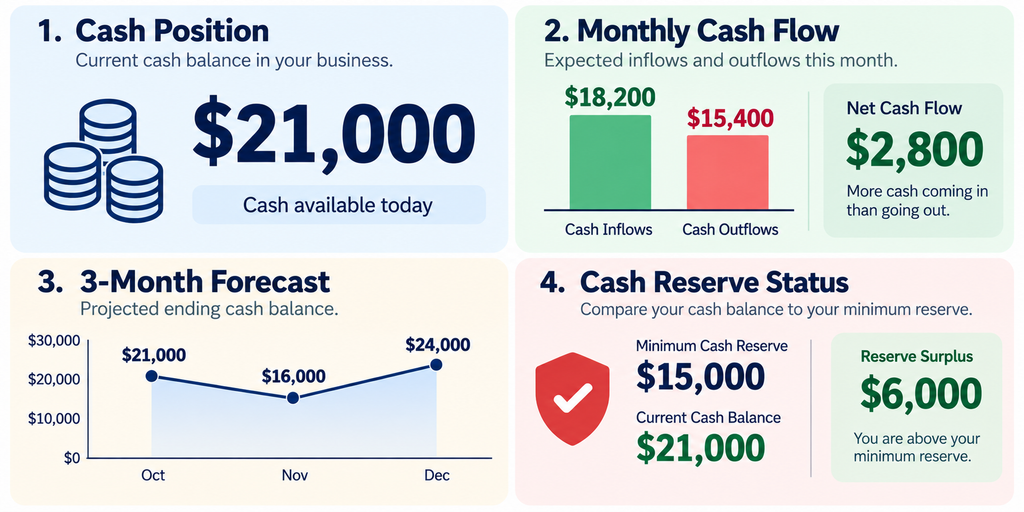
Review the dashboard regularly and update it when expected payment dates or major expenses change.
The most valuable forecast is not the one with the most detailed spreadsheet. It is the one that helps you make decisions before a cash shortage occurs.
What to Do When Your Forecast Shows a Cash Shortfall
If the forecast indicates that available cash may fall below upcoming obligations, start by identifying the timing and size of the gap.
Confirm whether expected customer payments are realistic, review overdue invoices, and distinguish essential payments from discretionary purchases that can legitimately be rescheduled.
Then prepare a revised forecast showing the effect of each realistic action.
If the shortfall threatens payroll, taxes, or other critical obligations, seek appropriate professional financial advice promptly. Do not assume that an unconfirmed customer payment or new contract will solve the problem.
A cash flow forecast is valuable because it gives you time to respond.
Manage Cash Flow Before It Becomes a Crisis
Cash flow management is not just about keeping more money in the bank.
It is about understanding when money will arrive, when it must leave, and whether the business can safely cover the difference.
Start with a realistic forecast, pay particular attention to payroll and customer payment timing, and maintain a reserve appropriate to your operating risks.
As your cleaning business grows, update the forecast to reflect new contracts, staffing requirements, expenses, and collection patterns.
A financially healthy cleaning business needs more than profitable jobs. It needs enough cash, at the right time, to deliver those jobs and keep operating.