
Running a cleaning business with employees requires more than teaching people how to clean.
Your team also needs to understand how your company handles attendance, customer property, dress standards, workplace conduct, safety, communication, timekeeping, and other everyday expectations.
That is where an employee handbook can help.
A cleaning business employee handbook puts important workplace policies in one place so employees have a consistent reference from the beginning.
It can also make onboarding more organized as your team grows.
This guide explains what to include in a cleaning company employee handbook and provides a practical template you can adapt for your business.
Important: Employment laws and required workplace policies vary by country, state, and locality. Use this guide as a starting point, and have your final handbook reviewed for compliance with the laws that apply to your business.
What Is a Cleaning Business Employee Handbook?
An employee handbook is a document that explains your company’s workplace policies, expectations, and general employment practices.
It answers questions such as:
- How should employees report an absence?
- What should cleaners wear to work?
- How should employees handle customer keys?
- What happens if something is damaged?
- How should working time be recorded?
- What conduct is expected inside customer properties?
- How should employees report workplace concerns?
The goal is not to create a giant rulebook.
The goal is to give employees a clear reference for the policies they are expected to follow.
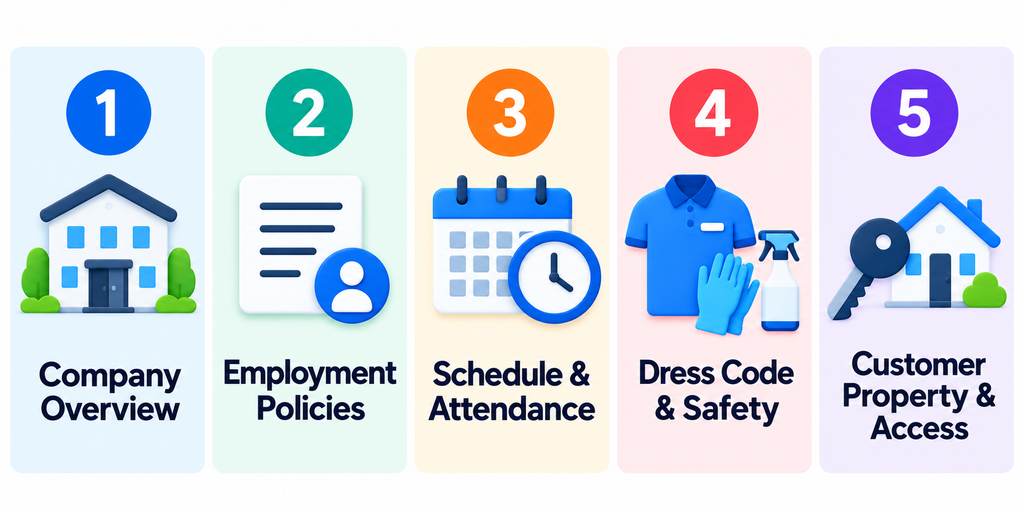
FIGURE 1 — CORE CLEANING BUSINESS EMPLOYEE HANDBOOK SECTIONS

Employee Handbook vs. SOP: What’s the Difference?
Employee handbooks and standard operating procedures serve different purposes.
An employee handbook generally explains company-wide workplace policies and expectations.
An SOP explains how a particular process should be performed.
For example:
Employee Handbook
“Employees must immediately report any damage to customer property.”
SOP
- Stop the affected task.
- Do not attempt an unauthorized repair.
- Take required documentation.
- Contact the designated supervisor.
- Follow the company’s incident-reporting procedure.
The handbook establishes the expectation.
The SOP explains the process.
If you have not created your operating procedures yet, see our Cleaning Business SOP Guide and Template.
Why Cleaning Companies Need Clear Employee Policies
Cleaning employees often work differently from employees in a traditional office.
They may:
- Travel between multiple customer locations
- Work without a manager physically present
- Enter homes or businesses when customers are away
- Handle keys or access codes
- Use cleaning chemicals and equipment
- Work alone or in small teams
- Interact directly with customers
- Handle valuable or fragile property
That makes clear expectations especially important.
A useful handbook can help:
- Make onboarding more consistent
- Reduce confusion about company rules
- Give managers a reference when questions arise
- Explain responsibilities before problems occur
- Standardize expectations across cleaning teams
- Support a more professional employee experience
A handbook does not replace good management.
It gives management and employees a common reference point.
1. Welcome and Company Overview
Start with a short introduction to the company.
This section does not need to be long.
Explain:
- What your cleaning company does
- The types of customers you serve
- Your basic service philosophy
- What employees can expect from the company
- What the company expects from employees
Example
Welcome to [Company Name].
Our goal is to provide reliable, professional cleaning services while treating customers, coworkers, and customer property with respect.
Every team member contributes to the quality and reputation of our company. This handbook explains important workplace policies and expectations that apply to our team.
Keep the introduction practical.
Employees should quickly understand the purpose of the handbook.
2. Employment Policies
Your handbook should explain the basic policies that govern employment at your company.
Exactly what belongs here depends on where your business operates and how your workforce is structured.
Possible topics include:
- Equal employment opportunity
- Anti-discrimination policies
- Anti-harassment policies
- Employment classifications
- Introductory or probationary periods, where applicable
- Workplace accommodations
- Personnel records
- Required employment documentation
Do not copy employment language from another company’s handbook without checking whether it applies to your business and jurisdiction.
Employment requirements can vary significantly by location.
3. Work Schedules and Availability
Cleaning schedules can change based on customer demand.
Employees should understand how schedules are communicated and what they are responsible for checking.
Your policy might address:
- Where schedules are published
- When schedules are normally available
- How employees confirm assignments
- How schedule changes are communicated
- Whether employees must update their availability
- Who employees contact about scheduling problems
Example Policy
Employees are responsible for reviewing their assigned schedule through [Scheduling System].
Schedule changes may occur based on customer needs, cancellations, staffing, or operational requirements.
Employees should promptly notify [Manager / Scheduler] if they identify a problem with an assigned shift or job.
If scheduling becomes difficult as your team grows, see our Best Scheduling Software for Cleaning Businesses.
4. Attendance and Call-Off Policy
A last-minute absence can affect several cleaning appointments in one day.
Your attendance policy should explain exactly how employees report an absence or late arrival.
Include:
- Who employees contact
- The approved communication method
- How much notice should be provided when possible
- What employees should do if they are running late
- Whether a text message alone is acceptable
- What happens if the manager does not respond
- How repeated attendance problems are handled
Example Call-Off Policy
If you cannot report to work as scheduled, contact [Manager] as soon as reasonably possible using [Approved Method].
Include your name, scheduled start time, and the jobs or shift affected.
Employees should not independently cancel customer appointments unless authorized to do so.
The handbook defines the policy.
Your internal SOP can define the manager’s process for finding replacement coverage.
5. Timekeeping and Working Time
Employees need clear instructions for recording their working time.
Depending on your business, employees may clock in through:
- A mobile app
- Field-service software
- A timekeeping system
- An office terminal
- Another approved method
Your handbook should explain:
- How employees record working time
- When employees should clock in and out
- How missed punches are corrected
- How travel between jobs is recorded when applicable
- How employees report timekeeping errors
- Who approves corrections
Avoid creating policies that encourage employees to perform work without recording their time.
Your timekeeping practices should comply with the wage-and-hour rules that apply to your business.
6. Dress Code and Personal Appearance
Cleaning employees represent your company inside customer homes and businesses.
Set clear expectations.
Possible requirements include:
- Company shirt or uniform
- Appropriate work pants
- Closed-toe or other required footwear
- Required personal protective equipment
- Visible employee identification
- Clean and professional appearance
Example Dress Code
Employees should arrive at assigned jobs wearing:
- Approved company shirt or uniform
- Clean work pants
- Required footwear
- Required protective equipment
- Company identification when provided
Clothing should be suitable for physical cleaning work and should not interfere with safe job performance.
If your company provides uniforms, explain how they are issued, maintained, and returned.
7. Customer Property and Personal Belongings
Customers trust your employees inside their homes and workplaces.
Your handbook should make expectations around customer property unmistakable.
Employees should:
- Treat customer property carefully
- Avoid using customer belongings unless required for the service and authorized
- Never remove customer property from a location
- Immediately report accidental damage
- Report suspicious or unusual situations to a supervisor
- Avoid moving valuable items unnecessarily
Example Policy
Employees must treat all customer property with care and respect.
If an item is accidentally damaged, the employee must report it immediately according to company procedure. Employees should not hide damage or make unauthorized promises to the customer regarding reimbursement or replacement.
This is an area where a separate damage-reporting SOP can provide the exact steps employees should follow.
8. Keys, Alarm Codes, and Property Access
Cleaning companies may have access to sensitive customer security information.
Your handbook should establish basic access rules.
Employees should never:
- Copy customer keys without authorization
- Share access codes with unauthorized people
- Store customer access information in unapproved personal notes
- Allow unauthorized people into customer properties
- Use customer access outside an assigned job
Employees should follow your company’s approved process for receiving, using, storing, and returning keys or access credentials.
For detailed operational procedures, your employee handbook can point employees to the relevant access-control SOP.
9. Customer Privacy and Confidentiality
Cleaners may see personal information while working inside homes or offices.
That could include:
- Documents
- Computer screens
- Financial information
- Family information
- Business records
- Personal photographs
- Security systems
Employees should understand that being able to see something does not mean they are entitled to discuss, photograph, copy, or share it.
Example Confidentiality Policy
Information observed or accessed while performing cleaning services should be treated as confidential.
Employees should not photograph, copy, discuss, post, or share customer information or property except when required for an authorized business purpose.
This expectation should also apply to social media.
10. Cell Phone and Social Media Use
Personal phone use can create productivity, safety, privacy, and customer-service problems.
Your handbook should explain when employees may use personal devices.
Possible rules include:
- No unnecessary personal phone use while actively cleaning
- No photographing customer properties without authorization
- No posting customer locations or belongings on social media
- Personal calls should be limited to appropriate breaks except for emergencies
- Company apps may be used when required for scheduling or job documentation
Make the policy realistic.
Employees may legitimately need their phones for navigation, scheduling, communication, timekeeping, or job documentation.
The objective is to distinguish authorized business use from inappropriate personal use.
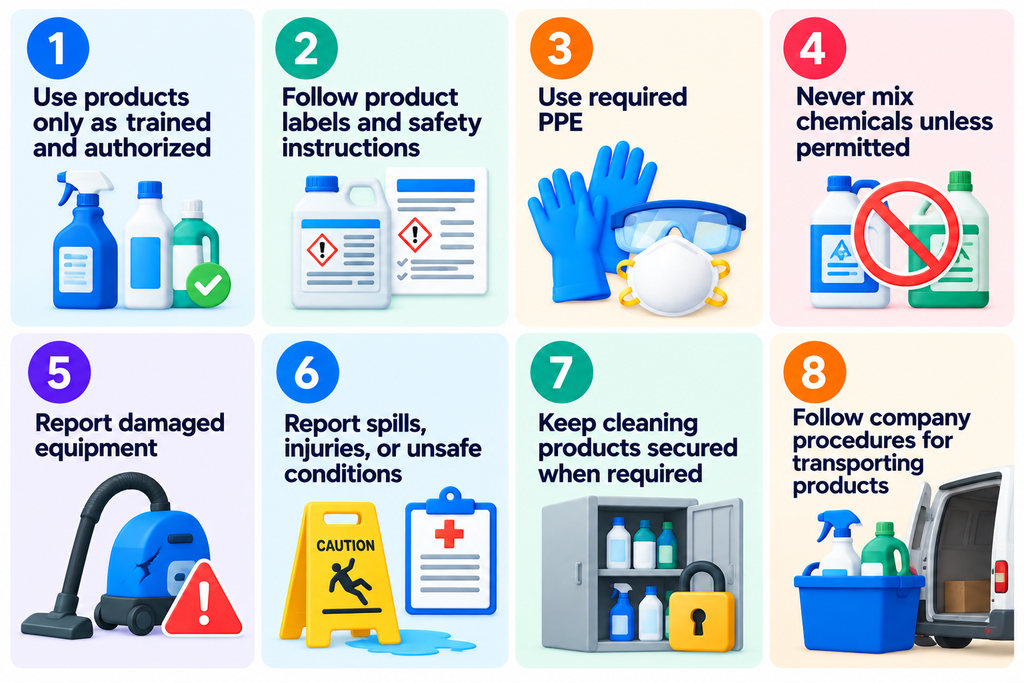
11. Cleaning Products, Equipment, and Safety
Employees should follow company training and product instructions when using cleaning chemicals and equipment.
Your handbook can establish broad safety expectations.
Employees should:
- Use products only as trained and authorized
- Follow product labels and safety instructions
- Use required personal protective equipment
- Never mix chemicals unless specifically permitted by product instructions and company training
- Report damaged equipment
- Report spills, injuries, or unsafe conditions
- Keep cleaning products secured when required
- Follow company procedures for transporting products
Detailed instructions for individual products or equipment belong in training materials and SOPs rather than making the handbook excessively long.
FIGURE 2 — CLEANING EMPLOYEE SAFETY BASICS
12. Injuries, Accidents, and Incidents
Employees should know what to do when something goes wrong.
Your handbook should explain how employees report:
- Workplace injuries
- Vehicle incidents
- Customer property damage
- Chemical exposure
- Equipment accidents
- Security incidents
- Other unusual events
Example Incident Policy
If an injury, accident, property-damage event, or other significant incident occurs:
- Address immediate safety concerns.
- Contact emergency services when necessary.
- Notify the designated manager as soon as possible.
- Document the incident according to company procedure.
- Do not conceal or intentionally delay reporting the incident.
Your exact procedures should reflect applicable safety, insurance, and reporting requirements.
13. Customer Communication
Employees should understand what they may and may not promise customers.
For example, cleaners may receive questions about:
- Pricing
- Additional services
- Refunds
- Schedule changes
- Complaints
- Damage
- Discounts
Your handbook can establish a simple rule.
Example
Employees should be courteous and helpful when communicating with customers.
Questions involving pricing, refunds, discounts, service changes, complaints, or compensation should be referred to [Manager / Office] unless the employee has been specifically authorized to handle them.
This prevents employees from accidentally making commitments the company cannot honor.
14. Professional Conduct
Employees are representing your company while working.
Your conduct policy may address:
- Respectful communication
- Customer interactions
- Coworker interactions
- Fighting or threatening behavior
- Harassment
- Dishonesty
- Theft
- Inappropriate language
- Unauthorized visitors
- Working under the influence of prohibited substances
- Deliberate damage to company or customer property
Use clear language.
Employees should understand both the expected behavior and how to report serious workplace concerns.
15. Company Vehicles and Driving
If employees drive company vehicles—or drive between customer locations—your handbook may need a driving policy.
Depending on your operations, it might address:
- Authorized drivers
- Driver’s license requirements
- Seat belt use
- Distracted driving
- Vehicle cleanliness
- Fuel procedures
- Accident reporting
- Traffic violations
- Personal use of company vehicles
- Transporting unauthorized passengers
Example Driving Rule
Employees must operate vehicles safely and comply with applicable traffic laws.
Employees should not use handheld devices while driving except as permitted by law and company policy.
Any vehicle accident occurring during authorized company activity must be reported according to company procedure.
Driving policies should reflect your insurance requirements and local laws.
16. Company Equipment and Supplies
Explain how employees should handle company property.
This may include:
- Vacuums
- Cleaning machines
- Mops
- Cleaning products
- Uniforms
- Mobile devices
- Keys
- Credit cards
- Fuel cards
Employees should know:
- What equipment they are responsible for
- Where equipment is stored
- How damaged equipment is reported
- How supplies are replenished
- Whether equipment may be taken home
- What must be returned when employment ends
Clear accountability can reduce missing equipment and last-minute supply problems.
17. Performance and Quality Expectations
Employees should understand how work quality is evaluated.
Your company might use:
- Cleaning checklists
- Supervisor inspections
- Customer feedback
- Re-clean rates
- Attendance records
- Job completion records
- Training assessments
Avoid vague statements such as:
“Employees must always do a good job.”
Define the standards employees can actually follow.
For example:
Employees are expected to complete assigned services according to company training, applicable SOPs, and job-specific checklists.
If an employee is unsure about the required service, the employee should contact the designated supervisor rather than guessing.
Our Professional House Cleaning Checklist can also help structure recurring quality checks.
18. Training and Onboarding
Your handbook should explain the basic onboarding process.
New employees may need training on:
- Company policies
- Cleaning procedures
- Product use
- Equipment
- Safety
- Customer communication
- Property access
- Scheduling software
- Timekeeping
- Quality standards
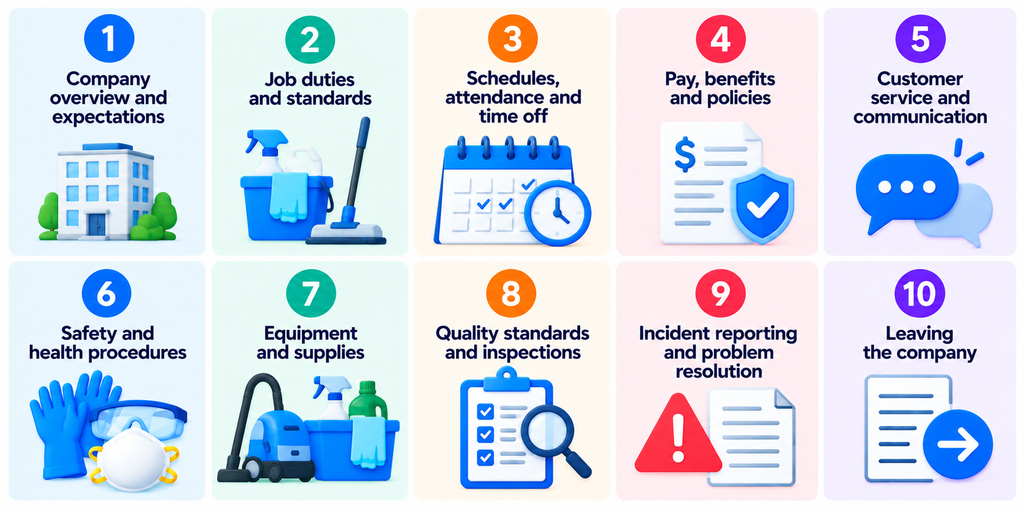
A simple onboarding sequence could be:
Orientation → Demonstration → Supervised Practice → Assessment → Independent Work
FIGURE 3 — CLEANING EMPLOYEE ONBOARDING PROCESS
For more help building your team, see How to Hire Cleaners for Your Cleaning Business.
19. Complaints and Workplace Concerns
Employees should know how to raise workplace concerns.
Your handbook should identify:
- Who employees can contact
- Alternative contacts when the normal manager is involved
- How concerns can be reported
- How urgent safety concerns should be handled
- The company’s expectations regarding retaliation and cooperation with investigations
Policies in this area may carry specific legal requirements.
Have them reviewed for the laws that apply to your workforce and location.
20. Policy Violations and Corrective Action
Explain that violations of company policies may lead to corrective action.
Avoid creating promises you may not legally or practically be able to follow in every situation.
Your policy might state that the company considers factors such as:
- Nature of the issue
- Severity
- Frequency
- Previous incidents
- Applicable company policies
- Applicable law
Your final language should be reviewed for your jurisdiction and employment practices.
21. Leaving the Company
Explain what employees should do when employment ends.
This may include returning:
- Customer keys
- Company keys
- Uniforms
- Equipment
- Mobile devices
- Documents
- Access cards
- Company credit or fuel cards
Employees should also understand that customer access information and confidential information remain protected after they leave the company where applicable.
22. Employee Handbook Acknowledgment
Add an acknowledgment page at the end of the handbook.
This gives you a record that the employee received the handbook.
A simple acknowledgment might look like this:
EMPLOYEE HANDBOOK ACKNOWLEDGMENT
I acknowledge that I received the [Company Name] Employee Handbook.
I understand that I am responsible for reading the handbook and asking my supervisor or designated company representative if I have questions about its contents.
I understand that company policies may be updated, subject to applicable law.
Employee Name: __________________________
Employee Signature: _______________________
Date: ___________________________________
Company Representative: ___________________
The acknowledgment should not contain promises or legal language that conflicts with applicable employment law.
Free Cleaning Business Employee Handbook Template
You do not need to start with a blank document.
Use the structure below to build your first handbook.
CLEANING BUSINESS EMPLOYEE HANDBOOK
Company Name:
[Company Name]
Effective Date:
[Date]
Version:
[Version Number]
1. Welcome and Company Overview
[Introduce the company, services, values, and expectations.]
2. Employment Policies
[Insert policies required or appropriate for your jurisdiction.]
3. Scheduling and Availability
[Explain how schedules are issued and changed.]
4. Attendance and Call-Offs
[Explain absence, lateness, and call-off procedures.]
5. Timekeeping
[Explain how working time is recorded and corrected.]
6. Dress Code
[Explain uniform, appearance, footwear, and PPE requirements.]
7. Customer Property
[Explain expectations for handling customer belongings and reporting damage.]
8. Keys and Property Access
[Explain rules for keys, codes, alarms, and customer access.]
9. Privacy and Confidentiality
[Explain customer privacy expectations.]
10. Cell Phones and Social Media
[Explain acceptable device use and photography/social-media rules.]
11. Safety
[Explain general chemical, equipment, PPE, and hazard-reporting expectations.]
12. Incident Reporting
[Explain how injuries, accidents, and damage are reported.]
13. Customer Communication
[Explain what employees may handle and what should be escalated.]
14. Professional Conduct
[Explain workplace behavior expectations.]
15. Driving and Vehicles
[Include if applicable.]
16. Company Equipment and Supplies
[Explain responsibility for company property.]
17. Performance and Quality
[Explain how service quality is evaluated.]
18. Training and Onboarding
[Explain required training.]
19. Workplace Concerns
[Explain reporting channels.]
20. Policy Violations
[Explain the company’s general approach to policy violations.]
21. Separation and Return of Property
[Explain what must be returned when employment ends.]
22. Employee Acknowledgment
[Add acknowledgment language and signature fields.]
Once customized, have the handbook reviewed for the employment laws and requirements that apply to your business.
How to Introduce a New Employee Handbook
Do not simply email employees a document and assume the job is finished.
A better rollout is:
- Review the handbook for your business and jurisdiction.
- Customize every placeholder.
- Remove sections that do not apply.
- Add required local policies.
- Give employees access to the current version.
- Review important policies during onboarding.
- Give employees an opportunity to ask questions.
- Collect acknowledgments when appropriate.
- Store documentation securely.
- Update the handbook when policies or legal requirements change.
If your team already exists, explain major changes rather than silently replacing the handbook.
Common Employee Handbook Mistakes
1. Copying Another Company’s Handbook
Another business may operate in a different state, use different employment classifications, or follow policies that do not fit your company.
2. Using Policies You Do Not Actually Follow
Your documented rules should reflect how the company genuinely operates.
3. Making the Handbook Too Complicated
Employees need a usable reference.
Avoid unnecessary corporate language.
4. Mixing Policies and Detailed Procedures
Keep broad workplace policies in the handbook.
Put detailed operational instructions in your SOPs.
5. Forgetting Cleaning-Specific Risks
Generic handbooks may overlook customer keys, property access, cleaning chemicals, driving between jobs, and customer privacy.
6. Never Updating the Handbook
Your company changes.
Laws change.
Your handbook should be reviewed periodically.
7. Treating a Template as Legal Advice
A template can help organize your handbook.
It cannot determine every policy legally required for your particular business.
Build a Simple Operations System Around Your Handbook
The employee handbook should be one part of your operating system.
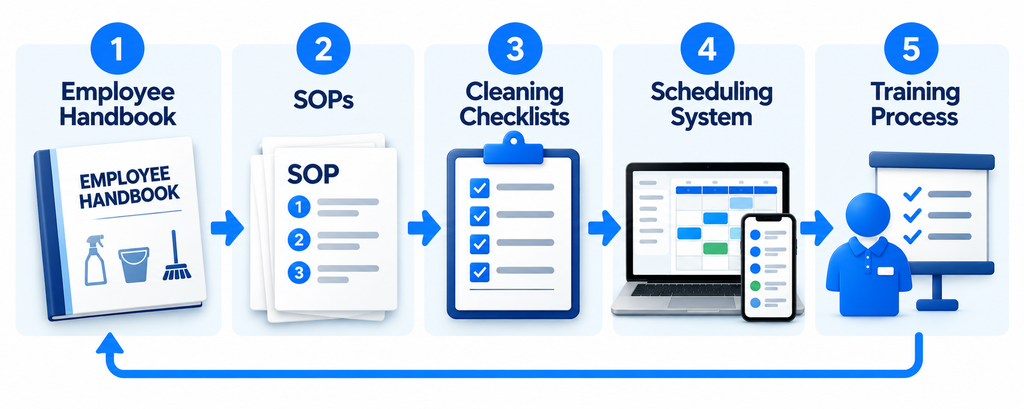
A practical structure is:
Employee Handbook
Defines workplace policies and expectations.
SOPs
Explain how recurring processes are performed.
Cleaning Checklists
Show which cleaning tasks need to be completed.
Scheduling System
Shows where and when employees work.
Training Process
Teaches employees how to apply the standards.
These tools solve different problems.
Together, they reduce the amount of information that has to live only in the owner’s head.
FIGURE 4 — CLEANING BUSINESS OPERATIONS SYSTEM
Final Take
A cleaning business employee handbook gives your team a central reference for workplace policies and expectations.
Start with the issues employees need to understand from day one: attendance, scheduling, timekeeping, customer property, access, safety, conduct, communication, and quality.
Keep policies clear and practical.
Use separate SOPs for detailed procedures and checklists for recurring cleaning tasks.
Most importantly, customize the handbook for your actual company and have employment-related policies reviewed for the laws that apply where you operate.
The goal is not paperwork for the sake of paperwork.
It is to create a business where employees know what is expected and managers do not have to explain the same rules from scratch every time someone joins the team.
Next, combine your handbook with your Cleaning Business SOPs, Professional House Cleaning Checklist, and Cleaning Business Software to build a more repeatable operating system.