
A cleaning business becomes harder to manage when every cleaner does the job differently.
One employee may clean bathrooms first. Another may start with floors. One may know exactly how to handle customer keys, while another has never been told what to do.
That may be manageable when you are working alone or with one helper.
It becomes a problem as the business grows.
Standard operating procedures—usually called SOPs—turn the way your business operates into clear, repeatable instructions.
They can help cleaners understand what is expected, make training more consistent, reduce avoidable mistakes, and make it easier to add employees without explaining every process from scratch.
This guide explains how to create cleaning business SOPs and includes a practical template you can adapt for your own company.
What Is a Cleaning Business SOP?
A standard operating procedure is a documented process explaining how a specific task or workflow should be completed.
An SOP is more specific than a general company policy.
For example:
Policy: Employees must secure customer properties when leaving.
SOP: Check all designated doors and windows, return the key to the approved location, activate the alarm if required, and record completion before leaving the property.
The policy explains the rule.
The SOP explains how to follow it.
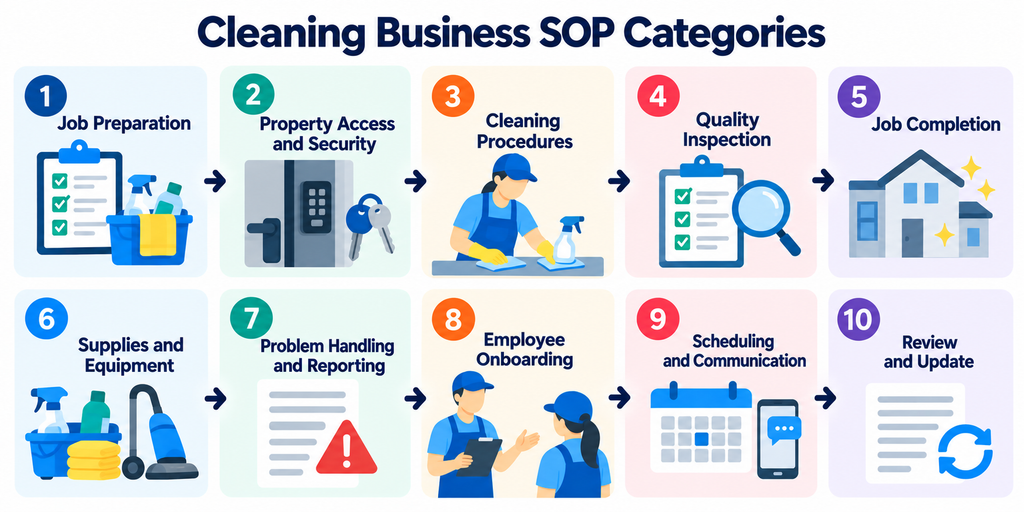
A cleaning business might create SOPs for:
- Opening and closing a job
- Residential cleaning
- Commercial cleaning
- Bathroom cleaning
- Kitchen cleaning
- Floor care
- Equipment use
- Supply management
- Customer keys and access
- Quality inspections
- Customer complaints
- Damage reporting
- Employee call-offs
- New cleaner onboarding
- End-of-day procedures
You do not need to document everything at once.
Start with the processes that happen frequently or create the biggest problems when they are performed incorrectly.
FIGURE 1 — CORE CLEANING BUSINESS SOP CATEGORIES
Why SOPs Matter as Your Cleaning Business Grows
When the owner performs most of the work, many procedures exist only in the owner’s head.
You know which products to use.
You know how customers want their properties handled.
You know what to do when a cleaner is late or when something gets damaged.
New employees do not automatically know those things.
Without documented processes, training can become:
“Watch me and remember what I do.”
That creates inconsistency.
SOPs give employees a reference point that does not depend entirely on the owner being available.
Well-designed SOPs can help you:
- Create more consistent service
- Train new cleaners more efficiently
- Reduce repeated questions
- Clarify employee responsibilities
- Standardize quality expectations
- Reduce preventable mistakes
- Make problems easier to diagnose
- Build processes that can scale with the company
SOPs do not eliminate the need for training or supervision.
They make both easier to standardize.
1. Identify the Processes You Need to Document
Do not begin by trying to write a giant operations manual.
Start by listing the recurring processes in your business.
One useful approach is to group them by stage.
Before the Job
Examples include:
- Reviewing the day’s schedule
- Confirming job information
- Loading supplies
- Checking equipment
- Reviewing access instructions
- Traveling to the property
During the Job
Examples include:
- Entering the property
- Following the cleaning sequence
- Using cleaning products
- Handling customer belongings
- Completing special requests
- Reporting unexpected problems
After the Job
Examples include:
- Performing a final inspection
- Taking required documentation
- Securing the property
- Returning keys
- Recording job completion
- Reporting supply shortages
Business Operations
Examples include:
- Scheduling
- Customer communication
- Quote follow-up
- Complaint handling
- Employee onboarding
- Equipment maintenance
- Inventory management
You can then prioritize which processes need an SOP first.
2. Prioritize High-Impact SOPs First
Not every process deserves equal attention.
A procedure performed once a year is usually less urgent than something cleaners do five times every day.
Start with processes where inconsistency creates:
- Customer complaints
- Rework
- Safety concerns
- Property damage
- Scheduling problems
- Lost time
- Training difficulties
- Confusion between employees
For many cleaning companies, the first SOPs may include job arrival, cleaning sequence, quality inspection, property access, damage reporting, and job completion.
Think about the questions employees repeatedly ask you.
Those questions often reveal processes that need better documentation.
3. Observe How the Work Is Actually Done
Do not write an SOP based only on how you think the process works.
Observe the real workflow.
If you are documenting a standard house-cleaning visit, follow the process from arrival to departure.
Write down:
- What happens first
- What tools are needed
- Which steps follow each other
- Where decisions must be made
- What commonly goes wrong
- What must be checked before completion
If experienced cleaners perform the process, ask for their input.
They may know practical details that are easy to miss from an office.
The goal is to document a process that can actually be followed in the field.
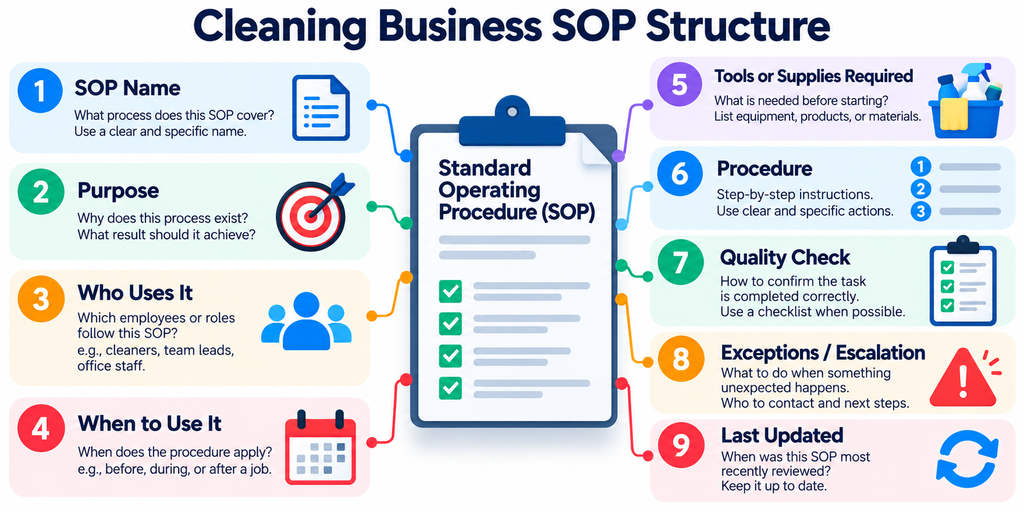
4. Use a Simple SOP Structure
Employees are more likely to use an SOP when they can understand it quickly.
A useful cleaning business SOP does not need complicated corporate language.
Use a consistent structure.
Cleaning Business SOP Structure
SOP Name
What process does this SOP cover?
Purpose
Why does this process exist?
Who Uses It
Which employees or roles follow the SOP?
When to Use It
When does the procedure apply?
Tools or Supplies Required
What does the employee need before starting?
Procedure
What steps should be followed?
Quality Check
How does the employee confirm the task was completed correctly?
Exceptions / Escalation
What should the employee do when something unexpected happens?
Last Updated
When was the SOP most recently reviewed?
Using the same format for every SOP makes your operations manual easier to navigate.
FIGURE 2 — SIMPLE CLEANING BUSINESS SOP STRUCTURE
5. Write the Procedure as Clear Actions
Avoid vague instructions.
For example:
Too vague:
“Clean the bathroom properly.”
That leaves the employee to decide what “properly” means.
A clearer procedure might say:
- Put on the required protective equipment.
- Remove trash and replace the liner.
- Apply the approved cleaner to the toilet, sink, shower, and other designated surfaces.
- Allow required dwell time according to product instructions.
- Clean mirrors and glass.
- Wipe and disinfect designated surfaces.
- Clean the toilet.
- Clean the sink and fixtures.
- Clean the shower or tub when included in the service.
- Mop the floor.
- Restock approved supplies when required.
- Perform a final visual inspection.
The exact process should reflect your services, products, training, and safety requirements.
The important point is that employees should not have to guess what the instruction means.
6. Define the Quality Standard
Completing the steps does not necessarily mean the result meets your standard.
Your SOP should explain what “finished” looks like.
For a bathroom, a quality check might include:
Before leaving the room, confirm:
- No visible debris remains on the floor
- Mirrors are free of obvious streaks
- Sink and fixtures are visibly clean
- Toilet surfaces are clean
- Trash has been removed
- Supplies have been restocked when included
- Cleaning tools and products have been removed
This turns quality from a vague expectation into something employees can check.
A separate checklist can also help crews verify recurring cleaning tasks.
For residential jobs, our Professional House Cleaning Checklist can provide a starting structure for defining repeatable cleaning tasks.
7. Explain What to Do When Something Goes Wrong
Real jobs do not always follow the ideal process.
An employee may discover:
- A broken item
- A locked room
- A missing key
- An alarm problem
- Unsafe conditions
- An aggressive pet
- Equipment failure
- A customer asking for work outside the agreed scope
Your SOP should explain what happens next.
Do not force cleaners to invent a solution under pressure.
A simple escalation rule might be:
- Stop the affected task if continuing could create additional risk or damage.
- Document the issue according to company procedure.
- Contact the designated supervisor.
- Do not promise additional work or compensation without authorization.
- Follow the supervisor’s instructions.
The exact escalation procedure will depend on your company.
The important part is making responsibility clear.
8. Create SOPs for Customer Access and Security
Cleaning companies frequently work inside properties when customers are not present.
That makes access procedures especially important.
Your SOP may need to address:
- Physical keys
- Key lockboxes
- Door codes
- Alarm systems
- Smart locks
- Restricted areas
- Customer security instructions
Avoid putting sensitive customer access information into general documents that every employee can access unnecessarily.
Instead, define the process for handling that information.
Example Access Procedure
- Review authorized access instructions before arrival.
- Use only the access method assigned to the job.
- Never share customer access credentials outside authorized company systems.
- Secure the property immediately after entry when required.
- Follow the customer’s alarm instructions.
- Before leaving, check designated doors and windows.
- Return keys or access devices according to company procedure.
- Confirm the property is secured before marking the job complete.
Customer trust can be damaged quickly by poor access control.
Treat access procedures as operational controls, not informal instructions.
9. Create a Job Completion SOP
A consistent end-of-job process can prevent many avoidable problems.
Cleaners should know exactly what must happen before they leave.
Example Job Completion SOP
Before leaving the property:
- Complete the required quality check.
- Confirm all assigned areas were serviced.
- Remove cleaning equipment and supplies.
- Check for personal belongings or company equipment.
- Remove trash according to the service agreement.
- Report damage, missing items, or unusual conditions.
- Complete required job notes or photos.
- Secure the property.
- Record the job as completed.
If your business uses scheduling or field-service software, job completion records can also help office staff see which jobs are finished and which still need attention.
For software options, see our Best Cleaning Business Software comparison.
10. Build an Employee Call-Off SOP
A cleaner calling out at the last minute can affect multiple customers.
Do not wait until it happens to decide how employees should report an absence.
Your SOP might define:
- Who employees contact
- Which communication method they use
- How much notice they should provide when possible
- What information they must provide
- Who is responsible for finding replacement coverage
- How schedule changes are communicated to customers
For example:
Example Call-Off Process
- Contact the designated manager as soon as you know you cannot work.
- Use the company’s approved communication method.
- Identify the affected shift or jobs.
- Do not independently cancel customer appointments unless authorized.
- Wait for confirmation that the manager received the message.
- Follow any additional attendance procedures required by the company.
Clear rules reduce confusion when the schedule is already under pressure.
For broader hiring and team-building guidance, see How to Hire Cleaners for Your Cleaning Business.
11. Connect SOPs to Employee Training
Giving a new cleaner a folder of documents is not training.
Use SOPs as part of the training process.
A simple approach is:
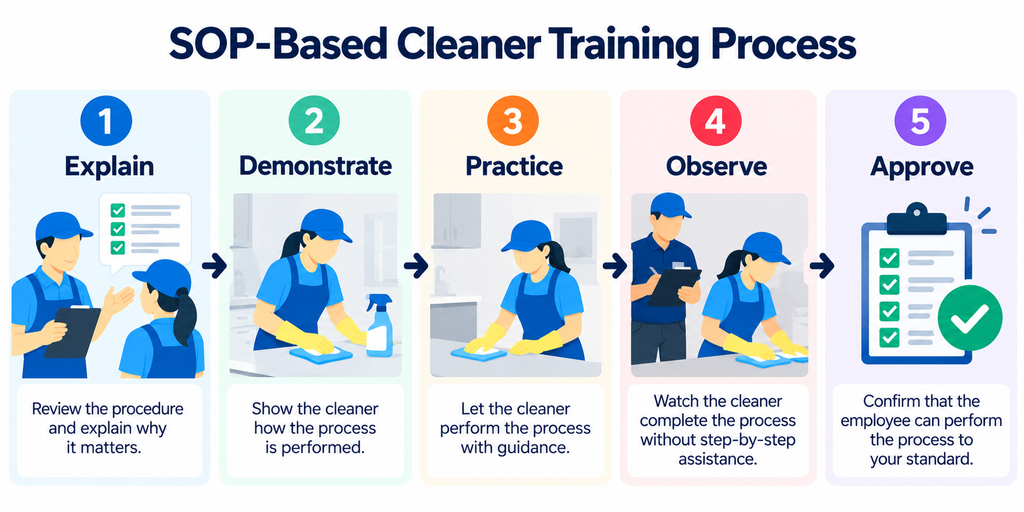
Explain → Demonstrate → Practice → Observe → Approve
Explain
Review the procedure and why it matters.
Demonstrate
Show the cleaner how the process is performed.
Practice
Let the cleaner perform the process with guidance.
Observe
Watch the cleaner complete it without step-by-step assistance.
Approve
Confirm that the employee can perform the process to your standard.
FIGURE 3 — SOP-BASED CLEANER TRAINING PROCESS
The SOP becomes the reference employees can return to after training.
That is much more useful than expecting someone to remember everything from their first few days.
12. Store SOPs Where Employees Can Actually Use Them
A perfect SOP is useless if cleaners cannot find it.
Depending on your business, SOPs might be stored in:
- A shared cloud folder
- Your employee portal
- Your field-service software
- A company knowledge base
- Printed manuals
- QR codes placed near equipment or supply areas
Choose a system that employees can access when they need the information.
Avoid maintaining multiple conflicting versions of the same procedure.
Ideally, there should be one current version.
13. Review and Update Your SOPs
Your processes will change.
You may:
- Introduce new cleaning products
- Change equipment
- Add services
- Adopt new software
- Change scheduling procedures
- Discover a better cleaning sequence
- Identify a recurring quality problem
When the process changes, the SOP should change too.
Include a “Last Updated” field so employees can identify the current version.
You can also schedule periodic reviews—for example, every six or twelve months—rather than waiting for a problem.
Cleaning Business SOP Template
Use this template as a starting point for your own procedures.
STANDARD OPERATING PROCEDURE
SOP Name:
[Name of process]
SOP Number:
[Optional reference number]
Last Updated:
[Date]
Purpose:
[Explain what this procedure is designed to accomplish.]
Who Uses This SOP:
[List applicable roles.]
When to Use It:
[Explain when the procedure applies.]
Tools / Supplies Required:
- [Item]
- [Item]
- [Item]
Procedure
- [First action]
- [Second action]
- [Third action]
- [Fourth action]
- [Continue as needed]
Quality Check
Before marking the process complete, confirm:
- [Quality requirement]
- [Quality requirement]
- [Quality requirement]
Exceptions / Escalation
If [problem or exception] occurs:
- [Immediate action]
- [Person to contact]
- [Required documentation]
- [Next step]
Approved By:
[Name / Role]
You can copy this structure and create separate SOPs for the recurring processes in your cleaning company.
Which Cleaning Business SOPs Should You Create First?
If you are starting from zero, do not try to create 50 SOPs this week.
Start with a small core library.
Recommended Starter SOP Library
- Job Arrival and Property Access
- Standard Cleaning Procedure
- Job Completion and Quality Check
- Customer Key and Security Handling
- Damage and Incident Reporting
- Customer Complaint Handling
- Employee Call-Off Procedure
- Supply Restocking
- Equipment Care
- New Cleaner Onboarding
Once those processes are documented, add SOPs based on the problems your business actually encounters.
The objective is not to create paperwork.
It is to remove ambiguity from recurring work.
SOP vs. Cleaning Checklist: What’s the Difference?
An SOP and a checklist are related, but they are not the same thing.
A checklist usually answers:
What needs to be completed?
An SOP explains:
How should the process be completed?
For example, a cleaning checklist may say:
- Clean toilet
- Clean sink
- Clean mirror
- Mop floor
The bathroom-cleaning SOP explains the sequence, approved method, quality expectations, and what to do when something unexpected happens.
In many cleaning businesses, the two work best together.
Use SOPs to train and standardize the process.
Use checklists to confirm that recurring tasks were completed.
Common Cleaning Business SOP Mistakes
Avoid making your procedures harder to use than the work itself.
- Writing SOPs that are too long
Employees need usable instructions, not unnecessary corporate language. - Being too vague
“Clean thoroughly” is not a repeatable procedure. - Documenting an unrealistic process
Write what employees should actually be able to do in the field. - Ignoring exceptions
Employees need to know what to do when the normal process cannot be followed. - Creating SOPs without training
Documentation supports training; it does not replace it. - Making SOPs difficult to access
Employees will not use documents they cannot quickly find. - Never updating procedures
Outdated SOPs can create more confusion than having no SOP at all. - Trying to document everything immediately
Prioritize the processes with the greatest operational impact.
Final Take
Cleaning business SOPs turn knowledge that may exist only in the owner’s head into repeatable company processes.
Start with the workflows that happen frequently and create the biggest problems when they go wrong.
Document the real process, use clear action steps, define the quality standard, explain exceptions, and make the SOP easy for employees to access.
Then use those procedures during training and update them as your business changes.
You do not need dozens of SOPs to begin.
A small library of clear, practical procedures can give your cleaning team a much stronger operational foundation.
If you are building your operating system from the ground up, combine your SOPs with a Professional House Cleaning Checklist and the right Cleaning Business Software to make the processes easier to follow consistently.