
Winning commercial cleaning contracts is not just about offering the lowest price.
A strong bid starts before you calculate a single number. You need to understand the facility, define the scope, estimate labor accurately, account for your costs, and present the customer with a clear proposal.
Skip one of those steps and you may either lose the contract—or win a job that is difficult to complete profitably.
This guide walks through how to bid on commercial cleaning jobs from the initial opportunity to the final follow-up.
How Commercial Cleaning Bidding Works
A commercial cleaning bid is your offer to provide specific cleaning services for an agreed price.
Depending on the customer, the process may be relatively simple or highly structured.
A small office might ask you to inspect the property and email a quote.
A larger company, property manager, school, or other organization may provide detailed bidding requirements and request a formal proposal.
Either way, the basic process is similar.
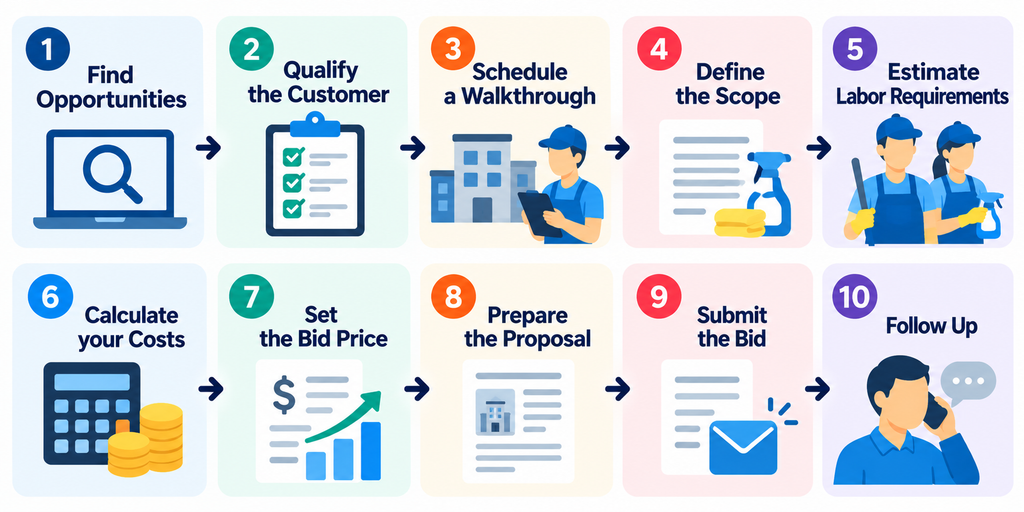
- Find a commercial cleaning opportunity
- Qualify the potential customer
- Schedule a walkthrough
- Define the scope of work
- Estimate labor requirements
- Calculate your costs
- Set the bid price
- Prepare the proposal
- Submit the bid
- Follow up
The objective is not simply to win more bids.
It is to win contracts that fit your operation and can be serviced profitably.
FIGURE 1 — COMMERCIAL CLEANING BID PROCESS
1. Find Commercial Cleaning Opportunities
Before you can submit bids, you need businesses that are actively looking for cleaning services—or may be open to changing providers.
Potential commercial customers can include:
- Offices
- Retail stores
- Medical offices
- Property management companies
- Warehouses
- Gyms
- Restaurants
- Daycare facilities
- Apartment buildings
- Professional service firms
You can generate opportunities through several channels.
These may include:
- Referrals
- Local networking
- Direct outreach
- Website inquiries
- Local search
- Existing customer relationships
- Property managers
- Business associations
- Online lead sources
Do not rely on one channel alone.
A cleaning company that consistently generates opportunities has more freedom to reject contracts that do not fit its pricing or service model.
For broader customer-acquisition strategies, see our Cleaning Business Marketing Plan and How to Get Clients for a Cleaning Business.
2. Qualify the Opportunity Before You Bid
Not every commercial cleaning opportunity deserves a full proposal.
Before investing time in a walkthrough and bid, determine whether the job fits your business.
Ask basic questions such as:
- Where is the property located?
- What type of facility is it?
- How large is the property?
- How often does it need cleaning?
- What services are required?
- When must the cleaning be performed?
- When does the customer want service to begin?
- Are there special access or security requirements?
- Who currently handles the cleaning?
- Why is the customer considering a new provider?
These questions help identify obvious mismatches early.
For example, a facility may be too far outside your service area, require equipment you do not have, or need cleaning at times your team cannot support.
Turning down the wrong opportunity can be more valuable than winning an unprofitable contract.
3. Schedule a Site Walkthrough
Whenever practical, inspect the facility before submitting a commercial cleaning bid.
A walkthrough allows you to see details that may not be obvious from square footage alone.
During the walkthrough, examine:
- Floor types
- Restrooms
- Kitchens and break rooms
- Workstations
- Common areas
- Entrances
- Stairs
- Elevators
- Trash collection points
- High-traffic areas
- Storage areas
- Supply locations
Pay attention to the condition of the property as well.
A relatively clean office may require significantly less work than a similar-sized facility with heavy daily traffic.
Ask the customer to explain what they expect from the cleaning company rather than assuming the scope.
4. Build a Clear Scope of Work
The scope of work defines exactly what your company is agreeing to clean.
This is one of the most important parts of the bidding process.
A commercial cleaning scope may include tasks such as:
- Vacuuming
- Mopping
- Dusting
- Trash removal
- Restroom cleaning
- Break-room cleaning
- Disinfecting high-touch surfaces
- Cleaning entrances
- Spot-cleaning glass
- Restocking consumables
But frequency matters too.
Some tasks may be performed every visit.
Others may be completed weekly, monthly, quarterly, or only when requested.
Example
Every Visit
- Empty trash
- Clean restrooms
- Vacuum high-traffic areas
- Wipe high-touch surfaces
Weekly
- Full dusting
- Mop lower-traffic areas
- Clean interior glass
Monthly
- Detail baseboards
- Dust higher surfaces
- Perform selected deep-cleaning tasks
A detailed scope protects both sides.
The customer knows what the price includes, and your cleaning team knows what must be completed.
5. Estimate the Labor Required
Once you understand the scope, estimate how many labor hours the job will require.
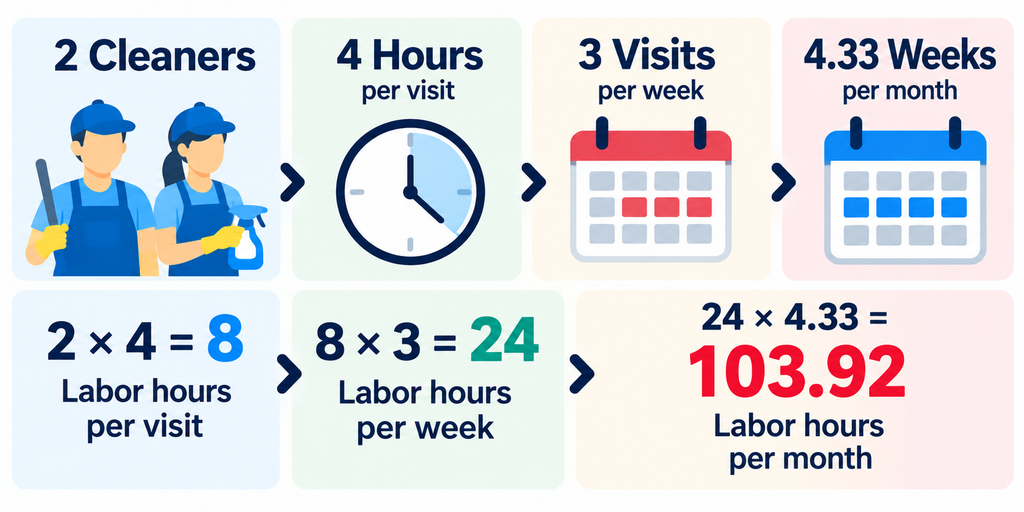
Suppose the facility needs:
- 2 cleaners
- 4 hours per visit
- 3 visits per week
The calculation is:
2 cleaners × 4 hours = 8 labor hours per visit
Then:
8 labor hours × 3 visits = 24 labor hours per week
Using approximately 4.33 weeks per month:
24 × 4.33 = 103.92 labor hours per month
Do not confuse elapsed cleaning time with labor hours.
Two cleaners working for four hours represent eight labor hours—not four.
For a deeper breakdown of labor-based commercial pricing, see How to Price Commercial Cleaning Jobs.
FIGURE 2 — ESTIMATING LABOR FOR A COMMERCIAL CLEANING BID
6. Calculate the Full Cost of the Contract
Labor is only one part of your cost.
Your bid may also need to cover:
- Payroll-related costs
- Cleaning supplies
- Equipment
- Equipment maintenance
- Transportation
- Insurance
- Software
- Administration
- Management
- Other overhead
Suppose your expected monthly costs are:
| Cost | Monthly Amount |
|---|---|
| Labor | $2,500 |
| Supplies | $250 |
| Transportation | $150 |
| Allocated overhead | $400 |
| Total Estimated Cost | $3,300 |
If you bid $3,300, you are only covering the estimated costs in this example.
There is no operating profit built into the contract.
Our Cleaning Business Expenses Guide explains the major expenses you should consider when calculating your true operating costs.
7. Set Your Commercial Cleaning Bid Price
Once you know the estimated cost, determine the selling price.
Do not simply add an arbitrary dollar amount.
Consider the margin the proposed price would generate.
The basic profit-margin formula is:
Profit Margin = (Revenue − Expenses) ÷ Revenue × 100
Suppose the estimated monthly cost is $3,300 and you bid $4,200.
Your estimated operating profit would be:
$4,200 − $3,300 = $900
Your estimated margin would be:
$900 ÷ $4,200 × 100 = 21.43%
That does not mean 21.43% is the correct margin for every cleaning company or every contract.
The appropriate price depends on your actual costs, market, capacity, risk, and business goals.
Use our Cleaning Business Profit Margin Calculator to test different bid prices before submitting your proposal.
8. Decide How to Present the Price
Commercial cleaning bids can be presented in different ways.
Monthly Price
Example:
$4,200 per month
This can work well for recurring contracts where the scope and schedule are clearly defined.
Price per Visit
Example:
$325 per cleaning visit
This makes the cost of each scheduled service easy to understand.
Base Price Plus Additional Services
You may quote recurring cleaning separately from occasional services.
For example:
Recurring janitorial service: $4,200 per month
Carpet cleaning: Quoted separately
Interior window cleaning: Quoted separately
Floor stripping and waxing: Quoted separately
This can prevent specialized or infrequent services from becoming an undefined part of the regular cleaning contract.
9. Create a Professional Commercial Cleaning Proposal
Your proposal should make it easy for the decision-maker to understand what you are offering.
Do not send only a price.
A commercial cleaning proposal may include:
- Your company information
- Customer information
- Property address
- Scope of work
- Cleaning frequency
- Service schedule
- Areas included
- Services included
- Services excluded
- Pricing
- Payment terms
- Proposal expiration date
- Additional-service pricing
- Relevant terms and conditions
Keep the proposal clear.
More pages do not automatically make a bid more professional.
The customer should be able to quickly identify what you will do, how often you will do it, and what it will cost.
If you need a starting structure, see our Cleaning Business Quote Template and Cleaning Business Estimate Template.
10. Check the Bid Before You Send It
Before submitting the proposal, review your assumptions.
Commercial Cleaning Bid Checklist
- Is the property size correct?
- Is the cleaning frequency correct?
- Is the scope clearly defined?
- Are all important areas included?
- Did you calculate labor hours correctly?
- Did you use total labor cost rather than wages alone?
- Are supplies included?
- Is travel accounted for?
- Is overhead included?
- Does the price produce an acceptable margin?
- Are specialty services clearly separated?
- Are the payment terms clear?
- Is the proposal expiration date included?
A five-minute review can catch mistakes that might otherwise affect the contract for months.
11. Submit the Bid Correctly
Follow the customer’s requested submission process.
If they ask for a PDF by email, send a PDF.
If they use a procurement portal, follow the portal requirements.
If they provide a deadline, submit before the deadline.
For a simple direct proposal, your email does not need to be complicated.
Example Bid Email
Subject: Cleaning Proposal for [Property Name]
Hi [Name],
Thank you for showing me the property and discussing your cleaning requirements.
I’ve attached our proposal based on the scope and schedule we reviewed.
Please let me know if you have any questions or would like to discuss any part of the proposal.
Best,
[Your Name]
[Cleaning Company]
The proposal should do most of the detailed selling.
The email simply gives the customer a clear next step.
12. Follow Up After Submitting the Bid
Do not assume silence automatically means rejection.
The decision-maker may be:
- Comparing multiple proposals
- Waiting for internal approval
- Reviewing budgets
- Speaking with another manager
- Dealing with unrelated priorities
If the customer did not provide a decision date, a short professional follow-up can keep the conversation moving.
Example Follow-Up
Hi [Name],
I wanted to follow up on the cleaning proposal I sent for [Property Name].
Please let me know if you have any questions about the scope, schedule, or pricing.
I’m happy to clarify anything that would help with your review.
Best,
[Your Name]
Avoid repeatedly contacting the customer every day.
The objective is to remain available without making the process uncomfortable.
What If the Customer Says Your Bid Is Too High?
Do not immediately reduce the price.
First, understand what the customer is comparing.
A lower competitor bid may include:
- Fewer cleaning tasks
- Lower service frequency
- Different staffing assumptions
- Different supply responsibilities
- Excluded specialty services
If the customer has a lower budget, consider whether the scope can be adjusted.
For example, you might reduce the frequency of selected tasks rather than promising the same work for a price that does not support it.
Instead of:
“Okay, we can reduce the price by $500.”
Consider:
“We can look at the service scope and see whether there are tasks or frequencies we can adjust to bring the monthly price closer to your target.”
Protecting the economics of the contract matters more than winning every bid.
How to Improve Your Commercial Cleaning Bids Over Time
Your bidding process should improve as you collect real job data.
After winning a contract, compare your original assumptions with actual performance.
Track:
- Estimated labor hours vs. actual labor hours
- Estimated supply costs vs. actual supply costs
- Travel time
- Extra customer requests
- Tasks that consistently take longer than expected
- Profitability by contract
If you repeatedly estimate a certain type of office at five labor hours but your crews consistently need seven, future bids should reflect that information.
Your existing contracts can become one of your best sources of pricing data.
Common Commercial Cleaning Bidding Mistakes
Avoid these common problems.
- Bidding without seeing the property
Important details can be missed when you price from square footage alone. - Failing to define the scope
An unclear proposal creates different expectations between the customer and cleaning company. - Underestimating labor
Small labor-estimation errors can become significant on recurring contracts. - Using wages as the full labor cost
Your actual employment cost may be higher than the cleaner’s hourly wage. - Ignoring overhead
A contract can cover direct cleaning costs while still producing weak overall profitability. - Automatically matching a competitor’s price
You do not know the competitor’s costs, scope, staffing, or margins. - Including unlimited extra work
Additional services should be clearly defined and priced when appropriate. - Never reviewing completed bids
Both won and lost bids can help improve your future estimating process.
Commercial Cleaning Bid Example
Here is a simplified example of how the pieces fit together.
Facility: 12,000 sq. ft. office
Cleaning frequency: 3 times per week
Crew: 2 cleaners
Time: 4 hours per visit
Monthly labor: 103.92 hours
Estimated monthly cost: $3,300
Proposed monthly bid: $4,200
Estimated operating profit: $900
Estimated profit margin: 21.43%
The numbers are examples—not recommended market rates.
Your actual bid should be based on the facility, scope, labor requirements, operating costs, and the economics of your own cleaning business.
Commercial Cleaning Bid vs. Cleaning Estimate
A bid and an estimate can serve similar purposes, but the context may differ.
An estimate generally communicates the expected cost of completing a particular job.
A commercial bid may be part of a more formal process where multiple cleaning companies are competing for the same recurring contract.
In either case, your pricing should be supported by a clear scope and realistic cost assumptions.
For a reusable estimate structure, see our Cleaning Business Estimate Template.
Final Take
Learning how to bid on commercial cleaning jobs is not about finding one universal price per square foot.
A reliable process starts with qualifying the opportunity and inspecting the facility.
Then define the scope, estimate labor, calculate your full costs, determine a sustainable price, and present everything in a clear proposal.
After submitting the bid, follow up professionally—and if you win the contract, compare your estimates with actual job performance.
That feedback will make every future bid more accurate.
Next, use our How to Price Commercial Cleaning Jobs guide to build your numbers, then turn them into a customer-ready proposal with our Cleaning Business Quote Template.