
Getting more cleaning customers is not just about trying as many marketing tactics as possible.
A better approach is to decide who you want to reach, where those customers are likely to find cleaning services, how much you can spend to acquire them, and which marketing channels are actually producing booked jobs.
That is what a cleaning business marketing plan should do.
This guide shows you how to build a practical marketing plan for a cleaning business, choose your channels, set a budget, and track whether your marketing is actually working.
The Basic Cleaning Business Marketing Process
A simple marketing system looks like this:
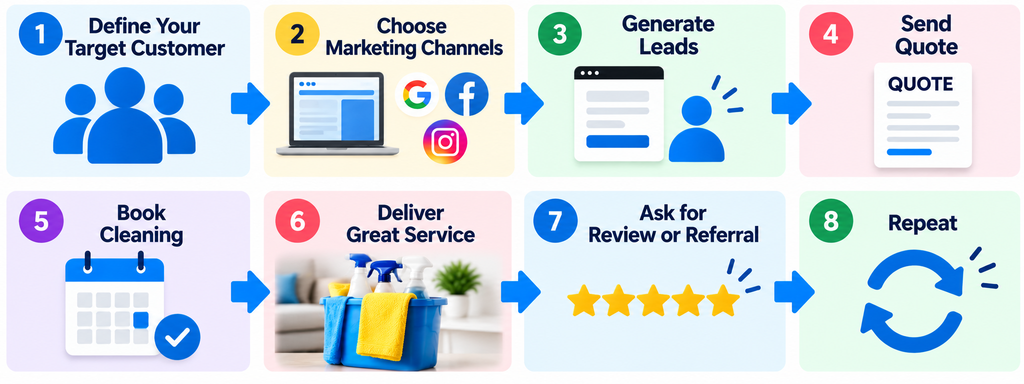
The important point is that marketing does not stop when someone visits your website or calls your business.
The entire process—from attracting attention to converting the lead and generating repeat business—affects the return you get from your marketing.
1. Define Your Target Customer
Before choosing marketing channels, decide what type of customer you actually want.
A residential cleaning company targeting busy families may need a very different marketing strategy from a company trying to win recurring office-cleaning contracts.
Define your target customer by considering:
- Residential or commercial
- Property type
- Service area
- One-time or recurring cleaning
- Typical job value
- Services required
- How frequently they need cleaning
- Why they are looking for a cleaning company
For example, you might decide that your ideal customer is a homeowner within 10 miles of your business who wants biweekly recurring cleaning.
That gives you a much clearer marketing target than simply trying to reach “anyone who needs cleaning.”
Your target customer also affects your pricing, service packages, advertising messages, and where you spend your marketing budget.
2. Define Your Service Area
Cleaning businesses are local businesses.
A lead that lives far outside your normal service area may create more travel time, higher costs, and inefficient scheduling.
Decide where you actually want to operate.
Your service area might be defined by:
- Cities
- ZIP codes
- Neighborhoods
- Driving distance
- Travel time from your normal operating area
A smaller, concentrated service area can sometimes be more valuable than spreading jobs across a large region.
When customers are located closer together, it becomes easier to group jobs geographically and reduce travel time between appointments.
Our cleaning business scheduling guide explains how location affects day-to-day scheduling.
3. Choose Your Main Marketing Channels
You do not need to use every marketing channel at once.
Start with a manageable combination and measure the results.
Common marketing channels for cleaning businesses include:
- Google Business Profile and local search
- Your cleaning business website
- Customer referrals
- Online reviews
- Local partnerships
- Flyers and door hangers
- Social media
- Google Ads
- Meta advertising
- Email or SMS follow-up
The best mix depends on your target customer, competition, service area, budget, and how established your business is.
If you need ideas for individual acquisition channels, see 12 ways to get clients for a cleaning business.
This marketing plan focuses on how those channels work together rather than simply listing tactics.
4. Build a Strong Local Search Presence
When someone searches for a cleaning company in their area, you want your business to be easy to find and easy to evaluate.
Your local search presence can include your website, business profile, customer reviews, service information, and location-related pages.
Make sure your basic business information is consistent.
Check that customers can easily find:
- Business name
- Phone number
- Service area
- Business hours
- Cleaning services
- Website
- Customer reviews
- Contact or booking information
Do not treat your online presence as something you create once and forget.
Add useful information, collect legitimate customer reviews, keep service information current, and make it easy for potential customers to request a quote.
5. Create a Referral System
Referrals can be especially valuable for cleaning businesses because customers are trusting your team inside their homes or businesses.
Satisfied customers already know the quality of your service.
The problem is that many businesses simply hope referrals happen.
Instead, create a repeatable process.
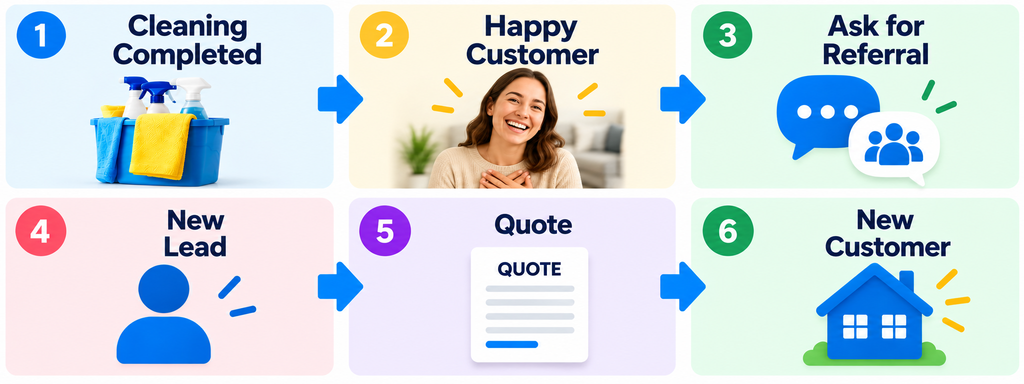
You do not necessarily need an elaborate referral program.
A simple request after a successful cleaning can be enough to remind satisfied customers that referrals are welcome.
If you offer an incentive, make the rules clear and make sure the economics still work for your business.
6. Build a Review Generation Process
Reviews can help potential customers evaluate your business before contacting you.
Instead of asking for reviews randomly, decide when the request should happen.
A logical point is after a successful cleaning when the customer has had a chance to evaluate the service.
A simple review process:
- Complete the cleaning
- Confirm the customer is satisfied
- Send a review request
- Make the review link easy to access
- Respond professionally to customer feedback
Do not make review collection more complicated than necessary.
The easier the process is for the customer, the more likely they are to complete it.
7. Create Local Partnerships
Other local businesses may already serve the same customers you want to reach.
Potential partnerships can include businesses that encounter homeowners, tenants, property managers, or businesses when cleaning services may be needed.
Possible partners include:
- Realtors
- Property managers
- Moving companies
- Contractors
- Interior designers
- Short-term rental managers
- Local offices
- Home service businesses
The goal is not simply to exchange business cards.
Look for partnerships where there is a logical reason for one business to recommend the other.
8. Decide Whether to Use Paid Advertising
Paid advertising can generate leads faster than waiting for organic marketing to build momentum.
But traffic and leads are not the same as profitable customers.
Before spending money on ads, understand what a booked customer is worth to your business.
For example, a recurring customer may be worth significantly more than a one-time cleaning customer because the relationship can generate revenue over multiple visits.
That means you should not judge advertising only by the cost of a single click.
Track the path from advertising spend to actual booked work.
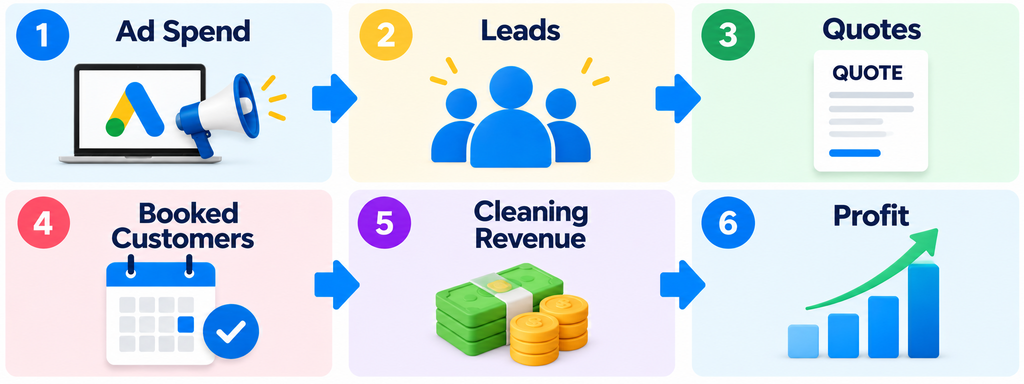
If you cannot track this basic path, it becomes difficult to know whether paid advertising is helping your business or simply generating activity.
9. Set a Marketing Budget
Your marketing budget should reflect your current revenue, available cash, growth goals, and the economics of acquiring a customer.
Instead of choosing a random monthly number, decide what you are trying to achieve.
Ask:
- How many new customers do we want?
- What type of customers do we want?
- What is an average new customer worth?
- How much can we afford to spend to acquire one?
- Which channels are currently producing customers?
- How quickly can we handle additional demand?
A growing cleaning business also needs enough operational capacity to serve the customers marketing generates.
Generating more leads is not useful if you do not have enough cleaners or schedule availability to accept the work.
10. Track Leads From Each Marketing Channel
If every lead is simply recorded as “new customer,” you will not know which marketing activities are working.
Track where each inquiry came from.
Example lead sources:
- Google search
- Google Business Profile
- Customer referral
- Google Ads
- Local partner
- Flyer
- Repeat customer
- Other
You can start with a spreadsheet.
As lead volume grows, CRM software can make it easier to keep customer information, quotes, follow-ups, and lead status together.
See our comparison of the best CRM software for cleaning businesses.
11. Measure More Than Leads
A marketing channel that generates many leads is not necessarily your best channel.
Some leads may never request a quote. Others may receive a quote but never book.
Track the entire funnel.
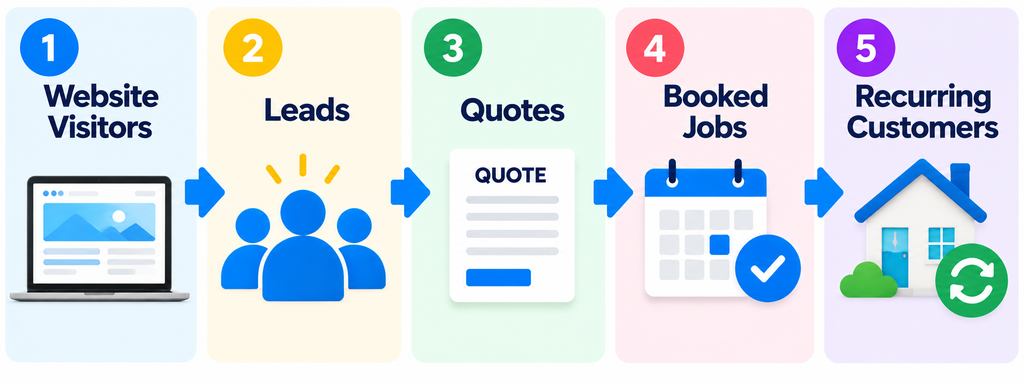
Useful marketing metrics include:
- Leads generated
- Quotes sent
- Jobs booked
- Lead-to-quote conversion rate
- Quote-to-booking conversion rate
- Customer acquisition cost
- Revenue from new customers
- Recurring customers generated
For example, if one channel generates fewer leads but those leads consistently become recurring customers, it may be more valuable than a channel producing many low-quality inquiries.
Your quote process matters here too. See our cleaning business quote guide for ways to move leads from pricing to booked work.
12. Turn New Customers Into Recurring Customers
Customer acquisition becomes much more valuable when a successful first cleaning turns into recurring service.
After completing a one-time cleaning, consider whether the customer is a good fit for ongoing service.
Possible recurring options:
- Weekly cleaning
- Biweekly cleaning
- Monthly cleaning
- Customized recurring schedules
Recurring customers can also make scheduling and revenue more predictable.
Once recurring volume increases, use a consistent scheduling process rather than rebuilding the calendar every week.
See our cleaning business scheduling guide for a practical scheduling workflow.
A Simple 90-Day Cleaning Business Marketing Plan
You do not need to launch every marketing strategy in the first week.
A simple 90-day plan can help you build the system in stages.
Days 1–30: Build the Foundation
- Define your target customer
- Define your service area
- Review your pricing
- Improve your website and contact process
- Complete your local business information
- Create a process for asking for reviews
- Start tracking where leads come from
Days 31–60: Increase Lead Generation
- Ask satisfied customers for referrals
- Build local partnerships
- Publish useful local content
- Test one additional marketing channel
- Track leads and quotes
- Follow up consistently
Days 61–90: Optimize
- Compare lead sources
- Measure booked customers
- Calculate customer acquisition costs
- Reduce spending on weak channels
- Invest more in channels producing valuable customers
- Improve your quote and follow-up process
The goal after 90 days is not simply to have done more marketing.
You should have a better idea of which channels generate leads, which leads become customers, and where your next marketing dollar is most likely to produce useful results.
Cleaning Business Marketing Plan Template
Use this simple structure when creating your own plan.
Target customer:
Service area:
Primary services:
Monthly marketing budget:
Main marketing channels:
Monthly lead target:
Monthly new customer target:
Referral process:
Review process:
Lead tracking method:
Metrics reviewed each month:
Keep the plan simple enough that you will actually use it.
A one-page plan that is reviewed every month is more useful than a complicated marketing document that gets ignored.
Final Take
A cleaning business marketing plan gives structure to customer acquisition.
Start by defining your target customer and service area. Then choose a manageable set of marketing channels, create systems for referrals and reviews, track where leads come from, and measure how many of those leads become paying customers.
As you collect more data, move time and budget toward the channels producing valuable customers instead of simply chasing more leads.
For individual acquisition tactics, read How to Get Clients for a Cleaning Business: 12 Proven Ways.
And once those leads start coming in, use the cleaning business quote guide to turn more inquiries into booked cleaning jobs.