
Commercial cleaning pricing can be harder to calculate than residential cleaning pricing.
A commercial job may involve thousands of square feet, multiple cleaners, recurring service, specialized areas, after-hours access, and different expectations for each facility.
That means copying a competitor’s price or choosing a simple hourly rate can leave you with a contract that generates revenue but very little profit.
This guide explains how to price commercial cleaning jobs using labor, square footage, cleaning frequency, overhead, and your target profit margin.
How Commercial Cleaning Pricing Works
There is no single commercial cleaning rate that works for every building.
A small office cleaned five nights per week has a very different cost structure from a large facility cleaned once per week.
Your price should reflect the actual resources required to complete the work.
A practical commercial cleaning price should account for:
- Labor
- Payroll-related costs
- Cleaning supplies
- Equipment
- Travel
- Job frequency
- Facility size
- Cleaning difficulty
- Overhead
- Profit
The goal is not simply to submit the lowest quote.
The goal is to calculate a price that is competitive enough to win appropriate work while still covering your costs and producing a sustainable margin.
For a broader look at operating costs, see our Cleaning Business Expenses Guide.
1. Estimate the Scope of Work
Before calculating a price, define exactly what the customer expects.
Commercial cleaning contracts can vary significantly in scope.
Start by identifying:
- Total square footage
- Number of rooms
- Number of restrooms
- Break rooms or kitchens
- Entryways
- Common areas
- Floor types
- Trash removal requirements
- High-touch surfaces
- Special cleaning requirements
- Cleaning frequency
- Preferred service times
You should also determine whether services such as carpet cleaning, window cleaning, floor stripping, floor waxing, or deep cleaning are included in the regular contract or priced separately.
A vague scope creates pricing risk.
If you quote a job before understanding what must actually be cleaned, your team may end up performing significantly more work than you priced.
2. Estimate How Many Labor Hours the Job Requires
Labor is one of the most important parts of commercial cleaning pricing.
Estimate how long the property should take to clean during each visit.
For example:
Suppose a commercial property requires:
- 2 cleaners
- 3 hours per visit
- 5 visits per week
The labor requirement is:
2 cleaners × 3 hours = 6 labor hours per visit
Then:
6 hours × 5 visits = 30 labor hours per week
If the service continues for approximately 4.33 weeks per month:
30 × 4.33 = 129.9 labor hours per month
That gives you a much stronger pricing foundation than simply choosing a monthly contract price.
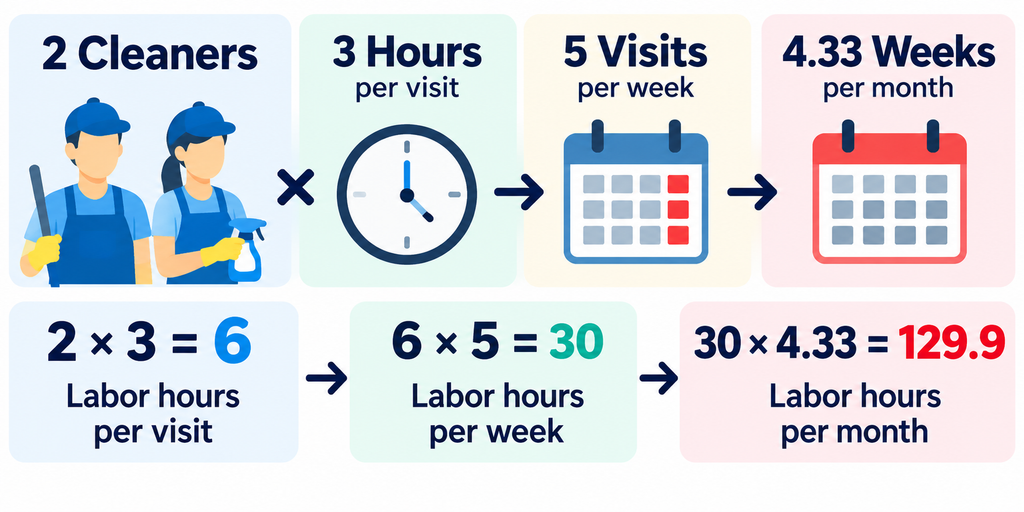
2 Cleaners × 3 Hours = 6 Labor Hours per Visit
6 Hours × 5 Visits = 30 Labor Hours per Week
30 Hours × 4.33 Weeks = 129.9 Labor Hours per Month
3. Calculate Your True Labor Cost
Do not confuse the cleaner’s hourly wage with your actual labor cost.
If a cleaner earns $18 per hour, your business may have additional labor-related expenses.
Depending on your location and employment structure, these may include:
- Payroll taxes
- Workers’ compensation
- Benefits
- Paid time off
- Training
- Payroll processing
- Other employer costs
For pricing purposes, use the cost the business actually incurs—not simply the employee’s base wage.
For example, assume your estimated total labor cost is $23 per hour.
Using the previous example:
129.9 labor hours × $23 = $2,987.70 estimated monthly labor cost
That number is still not your selling price.
You have additional expenses to cover.
4. Add Supplies and Equipment Costs
Commercial cleaning jobs may consume more supplies than smaller residential jobs.
Depending on the contract, expenses may include:
- Cleaning chemicals
- Disinfectants
- Trash bags
- Paper products
- Gloves
- Microfiber cloths
- Mop heads
- Vacuum supplies
- Equipment maintenance
- Equipment replacement
Some customers provide consumables such as paper towels, toilet paper, and hand soap.
Others expect the cleaning company to supply them.
Clarify this before submitting your quote.
If your company supplies customer consumables, consider tracking them separately rather than hiding the entire cost inside a general cleaning-supplies estimate.
5. Account for Travel and Transportation
Travel affects profitability even when customers never see it on an invoice.
Consider:
- Fuel
- Vehicle expenses
- Travel time
- Parking
- Tolls
- Mileage
- Moving equipment between locations
A job located close to several existing customers may be more operationally efficient than an identical contract far outside your normal service area.
Route density matters.
Adding recurring commercial customers in the same geographic area can reduce travel time between jobs and improve scheduling efficiency.
6. Add Your Overhead
Commercial cleaning prices also need to contribute toward expenses that cannot be assigned to one specific job.
These may include:
- Insurance
- Software
- Office expenses
- Accounting
- Marketing
- Management
- Administrative labor
- Phones
- Website costs
- Business licenses
These expenses exist even though they are not directly visible during the cleaning itself.
Ignoring them can make a contract appear profitable when it is actually contributing very little to the business.
See our Cleaning Business Expenses Guide for a complete breakdown of operating expenses.
7. Choose a Commercial Cleaning Pricing Method
There are several ways to present commercial cleaning prices.
The best method depends on the property, scope, and contract.
Hourly Pricing
You charge based on the number of cleaning hours.
For example:
6 labor hours × $45 per hour = $270 per visit
Hourly pricing can be useful when the scope is uncertain or when customers request occasional work.
However, customers may prefer a predictable total price for recurring cleaning.
Flat Rate per Visit
You calculate the job internally and quote a fixed price for each cleaning visit.
For example:
$275 per visit
If the customer schedules five cleanings per week, the monthly contract value can then be estimated from the expected number of visits.
This gives the customer predictable pricing while allowing you to base the quote on your own labor and cost calculations.
Monthly Contract Pricing
Recurring commercial clients are often easier to manage with a predictable monthly price.
For example:
$5,500 per month for the agreed cleaning schedule and scope
The customer sees a simple monthly amount.
Internally, you should still know the expected labor hours, supply costs, overhead, and profit built into that number.
Price per Square Foot
Square-foot pricing can provide a useful starting point for estimating larger commercial properties.
The basic calculation is:
Total Square Feet × Rate per Square Foot = Estimated Price
For example:
20,000 sq. ft. × $0.10 = $2,000
But square footage alone does not tell you how difficult the building is to clean.
Two 20,000-square-foot facilities can require very different amounts of labor.
Use square footage as an estimating tool—not as a substitute for understanding the scope.
8. Understand What Changes the Price
Several factors can increase or decrease the amount of work required.
Commercial Cleaning Pricing Factors
- Facility size — Larger properties generally require more labor.
- Cleaning frequency — Frequent service can change the workload per visit.
- Restrooms — High-use restrooms can require significant cleaning time.
- Floor type — Carpet, tile, concrete, and specialty floors require different work.
- Occupancy — Heavily used facilities may require more cleaning.
- Service time — After-hours or restricted access can affect operations.
- Security requirements — Access procedures can add non-cleaning time.
- Specialty services — Windows, carpets, floor care, and deep cleaning may require separate pricing.
- Location — Travel and parking can affect your costs.
- Supplies — Providing consumables can increase contract costs.
Do not assume that a larger property must always have a proportionally higher price per square foot.
Efficiency can change as building size and layout change.
9. Calculate a Price That Includes Profit
After calculating your expected costs, you still need to build profit into the price.
Suppose your estimated monthly costs for a contract are:
| Cost | Monthly Amount |
|---|---|
| Labor | $2,988 |
| Supplies | $300 |
| Transportation | $200 |
| Allocated overhead | $500 |
| Total Estimated Cost | $3,988 |
Charging $3,988 would only cover the estimated costs in this example.
It would not produce operating profit from the contract.
If you want to evaluate the margin produced by a proposed selling price, use:
Profit Margin = (Revenue − Expenses) ÷ Revenue × 100
For example, if you charge $5,000 per month:
($5,000 − $3,988) ÷ $5,000 × 100 = 20.24%
That example produces an estimated profit margin of about 20.2% before considering any costs that may have been omitted or underestimated.
Use our Cleaning Business Profit Margin Calculator to test different revenue and expense scenarios.
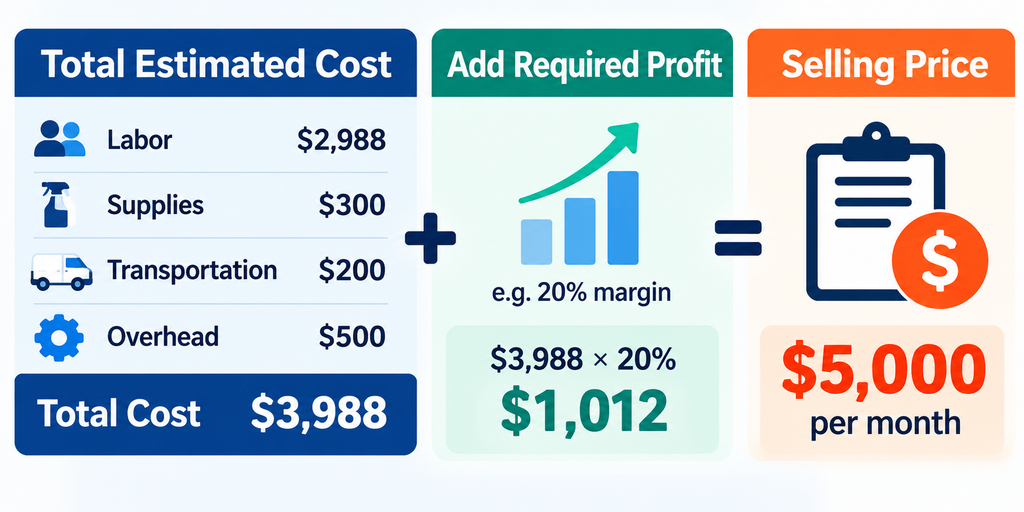
Labor + Supplies + Transportation + Overhead = Total Cost
Total Cost + Required Profit = Selling Price
Selling Price − Total Cost = Profit
10. Convert Your Price Into a Commercial Cleaning Quote
Once you know your price, present it clearly.
A commercial cleaning quote should make it easy for the customer to understand what is included.
Consider including:
- Customer and property information
- Scope of work
- Cleaning frequency
- Areas included
- Services included
- Services excluded
- Price
- Payment terms
- Quote expiration date
- Additional-service pricing
- Terms and conditions
Avoid presenting only a number with no scope.
A $4,000 monthly quote means very little if the customer cannot tell what services that price includes.
For a more detailed quote structure, see our Cleaning Business Quote Template.
11. Review the Job After You Win It
Your original estimate is only an estimate.
Once your team begins cleaning the property, compare the estimate with what actually happens.
Track:
- Actual labor hours
- Supply usage
- Travel time
- Customer requests
- Additional tasks
- Equipment needs
- Problems affecting productivity
If you estimated six labor hours per visit but the team consistently needs eight, the contract may be significantly less profitable than expected.
That information should influence future quotes and, where the contract allows, future pricing discussions.
Commercial Cleaning Pricing Example
Here is a simplified example.
A cleaning company is quoting a recurring office contract.
Property: 15,000 sq. ft. office
Frequency: 5 nights per week
Crew: 2 cleaners
Time: 3 hours per visit
Estimated monthly labor: 129.9 hours
Estimated total monthly cost: $3,988
Proposed monthly price: $5,000
Estimated operating profit: $1,012
Estimated profit margin: 20.24%
This does not mean $5,000 is the correct price for every 15,000-square-foot office.
The example simply shows how labor, expenses, and margin can be combined into a pricing calculation.
Actual pricing should reflect the specific building, market, scope, and operating costs of your business.
Common Commercial Cleaning Pricing Mistakes
Avoid these common mistakes when building quotes.
- Pricing from competitors alone
You do not know another company’s labor costs, productivity, overhead, or required margin. - Using wages instead of total labor cost
Employee wages may represent only part of your actual labor expense. - Ignoring non-cleaning time
Travel, access, setup, and administrative work can consume paid time. - Forgetting overhead
Insurance, software, management, and administrative expenses still need to be funded. - Pricing only by square footage
Square footage does not capture every factor that affects labor. - Failing to define the scope
Unclear responsibilities can turn a profitable quote into an unprofitable contract. - Never reviewing actual job performance
Your future estimates improve when you compare quoted hours with actual hours.
Commercial vs. Residential Cleaning Pricing
Commercial and residential cleaning can use some of the same pricing principles, but the jobs are often structured differently.
Commercial contracts may involve:
- Larger facilities
- More frequent recurring service
- Multiple cleaners
- Formal scopes of work
- After-hours access
- Monthly contracts
- Specialized equipment
Residential cleaning may rely more heavily on per-visit pricing based on home size, condition, service type, and cleaning frequency.
If you also price residential work, use our House Cleaning Pricing Guide and Calculator to compare the approach.
Final Take
Commercial cleaning pricing should start with the work required—not with a number you hope the customer will accept.
Estimate the scope, calculate labor hours, determine your true labor cost, add supplies and transportation, allocate overhead, and then build profit into the final price.
Square footage can help with estimating, but it should not replace a detailed understanding of the property and scope.
Once you begin winning contracts, compare your estimated costs with actual job performance.
That feedback will help you make future quotes more accurate and protect your margins as your cleaning business grows.
Use our Cleaning Business Profit Margin Calculator to test your numbers before submitting a quote, and our Cleaning Business Quote Template to turn the calculation into a customer-ready proposal.