
Running a cleaning business does not automatically mean you are making money.
You can have a full schedule, employees working every day, and thousands of dollars coming in each month—and still struggle to cover your costs.
That is why knowing your break-even point matters.
Your break-even point is the amount of revenue your cleaning business needs to generate before it begins producing a profit.
This guide explains how break-even works for a cleaning company and includes a free calculator you can use to estimate the minimum monthly revenue your business needs.
What Is the Break-Even Point in a Cleaning Business?
The break-even point is where your total revenue equals your total business costs.
At break-even:
Revenue = Total Costs
You are not losing money.
But you are not generating a profit yet either.
Once your revenue moves above the break-even point, the additional contribution can begin producing operating profit.
If revenue falls below it, the business is operating at a loss.
Simple Example
If your cleaning business has:
- $8,000 in monthly fixed and operating costs
- A 40% contribution margin after variable costs
Your approximate break-even revenue would be:
$8,000 ÷ 40% = $20,000
In this example, the business needs approximately $20,000 in monthly revenue to break even.
Free Cleaning Business Break-Even Calculator
Use the calculator below to estimate the monthly revenue your cleaning business needs to cover its costs.
Enter Your Monthly Numbers
Fixed Costs
- Insurance
- Software
- Office expenses
- Advertising commitments
- Vehicle payments
- Other recurring overhead
Variable Cost Percentage
Include costs that generally increase as you complete more cleaning work, such as:
- Cleaner labor
- Payroll-related costs
- Cleaning supplies
- Payment-processing fees
- Job-related transportation or other variable costs
The calculator should return:
Break-Even Revenue
Revenue Needed for Target Profit
If you are not sure what expenses belong in your calculation, start with our Cleaning Business Expenses guide.
How to Calculate Your Cleaning Business Break-Even Point
The basic revenue break-even formula is:
Break-Even Revenue = Fixed Costs ÷ Contribution Margin Ratio
And:
Contribution Margin Ratio = 1 − Variable Cost Ratio
For example, suppose your business has:
- Fixed costs: $6,000 per month
- Variable costs: 60% of revenue
Your contribution margin ratio is:
1 − 0.60 = 0.40
Then:
$6,000 ÷ 0.40 = $15,000
Your estimated monthly break-even revenue is $15,000.
Fixed Costs vs. Variable Costs
The break-even calculation becomes much more useful when you separate fixed costs from variable costs correctly.
Fixed Costs
Fixed costs generally do not change directly with the number of cleaning jobs you complete in a particular month.
Examples may include:
- Business insurance
- Software subscriptions
- Office rent
- Accounting services
- Vehicle payments
- Phone plans
- Website expenses
- Certain recurring marketing costs
These expenses may change over time, but they do not normally rise dollar-for-dollar with every additional cleaning job.
Variable Costs
Variable costs generally increase as your cleaning volume increases.
Examples may include:
- Cleaner wages tied to jobs worked
- Payroll-related costs tied to labor
- Cleaning products
- Disposable supplies
- Credit-card processing fees
- Certain fuel or transportation costs
- Job-specific subcontractor costs
FIGURE 1 — FIXED COSTS VS. VARIABLE COSTS
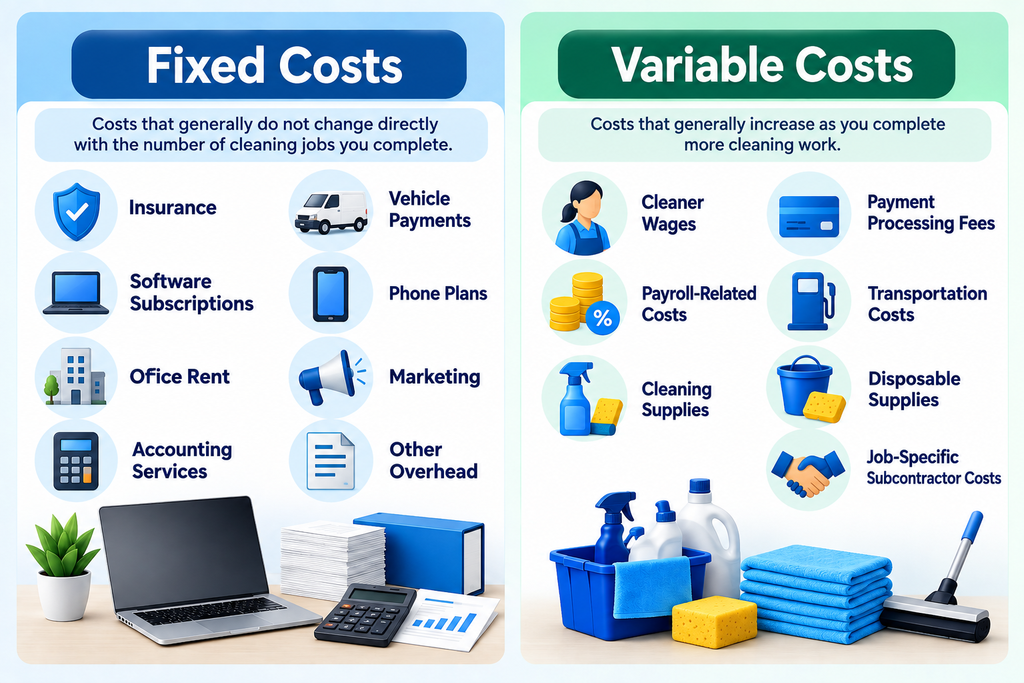
The distinction matters because your variable costs determine how much of each additional dollar of revenue remains available to cover fixed costs and profit.
What Is Contribution Margin?
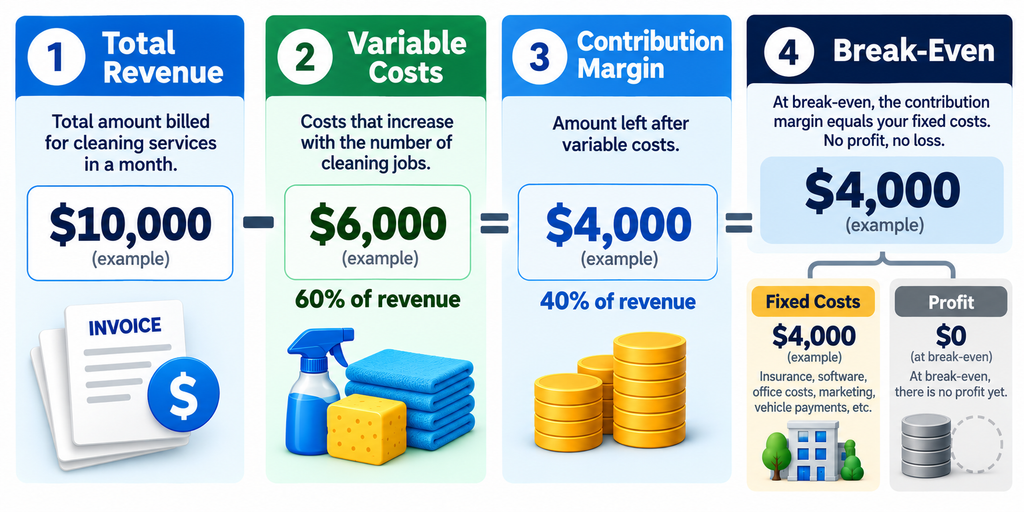
Contribution margin is the portion of revenue left after variable costs.
That remaining amount contributes toward:
- Fixed costs
- Profit
Suppose a cleaning company generates $10,000 in revenue and has $6,000 in variable costs.
Its contribution margin is:
$10,000 − $6,000 = $4,000
Its contribution margin ratio is:
$4,000 ÷ $10,000 = 40%
That means approximately $0.40 of every revenue dollar remains after variable costs to help cover fixed costs and eventually generate profit.
FIGURE 2 — HOW REVENUE FLOWS TO BREAK-EVEN
Cleaning Business Break-Even Example
Consider a cleaning company with the following monthly numbers.
Monthly Fixed Costs
| Expense | Monthly Cost |
|---|---|
| Insurance | $300 |
| Software | $250 |
| Vehicle payments | $900 |
| Office and phone | $350 |
| Marketing | $1,000 |
| Other overhead | $1,200 |
| Total Fixed Costs | $4,000 |
Variable Costs
Assume variable costs equal 65% of revenue.
That leaves a contribution margin of:
100% − 65% = 35%
Break-even revenue:
$4,000 ÷ 0.35 = $11,428.57
The company therefore needs approximately $11,429 in monthly revenue to cover its estimated fixed and variable costs.
This does not mean $11,429 is a good revenue target.
It only means that, based on these assumptions, the business reaches approximately zero operating profit at that level.
Break-Even Revenue vs. Profit Target
Break-even should be treated as a floor—not the goal.
A business owner usually wants revenue high enough to cover costs and produce a target amount of profit.
A useful formula is:
Required Revenue = (Fixed Costs + Target Profit) ÷ Contribution Margin Ratio
Using the previous example:
- Fixed costs: $4,000
- Target monthly profit: $3,000
- Contribution margin ratio: 35%
The calculation becomes:
($4,000 + $3,000) ÷ 0.35 = $20,000
So while the business breaks even at approximately $11,429, it would need approximately $20,000 in monthly revenue to generate a $3,000 operating profit under the same assumptions.
Convert Your Break-Even Point Into Jobs
Revenue targets become more useful when you translate them into actual cleaning jobs.
Suppose your break-even revenue is:
$15,000 per month
And your average cleaning job is:
$200
Then:
$15,000 ÷ $200 = 75 jobs per month
If you operate approximately 20 working days per month:
75 ÷ 20 = 3.75 jobs per day
You would therefore need roughly 75 $200 jobs per month, or an average of about 3.75 jobs per working day, to reach the estimated break-even revenue.
FIGURE 3 — BREAK-EVEN REVENUE TO JOBS
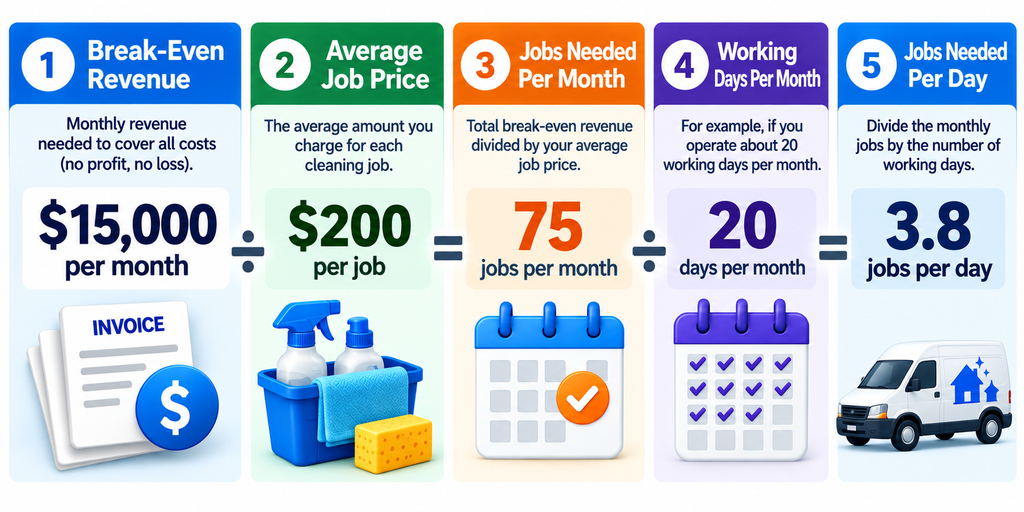
This is where break-even analysis becomes operational.
Instead of thinking only about a dollar target, you can translate the number into:
- Jobs per month
- Jobs per week
- Jobs per day
- Revenue per crew
- Revenue per cleaner
How Pricing Changes Your Break-Even Point
Pricing has a major effect on how much work you need to sell.
If your prices are too low, you may need significantly more jobs just to cover your costs.
Imagine two companies with the same $15,000 monthly break-even revenue.
Company A averages $150 per job:
$15,000 ÷ $150 = 100 jobs
Company B averages $250 per job:
$15,000 ÷ $250 = 60 jobs
The revenue target is identical.
The workload required to reach it is not.
This is one reason pricing should be based on your actual costs and required margin rather than simply copying competitors.
For residential pricing, see How Much to Charge for House Cleaning.
For commercial work, see How to Price Commercial Cleaning Jobs.
Why Your Break-Even Point Changes as You Grow
Your break-even point is not permanent.
It changes when your cost structure changes.
Hiring another cleaner may increase labor costs.
Adding a vehicle may increase fixed expenses.
Buying software may add a monthly subscription.
Increasing advertising may raise overhead.
Moving into an office may create new fixed costs.
At the same time, growth can sometimes improve efficiency.
Better scheduling may reduce unnecessary travel.
Higher job density may allow crews to complete more revenue in the same area.
Better pricing may increase contribution margin without requiring the same increase in job volume.
That is why break-even should be recalculated periodically rather than treated as a one-time startup exercise.
Common Break-Even Calculation Mistakes
1. Treating All Expenses as Fixed
Labor and supplies often change with job volume.
Putting every expense into the fixed-cost bucket can distort the result.
2. Ignoring Payroll-Related Costs
Cleaner wages are not always the full labor cost.
Your actual cost structure may also include employer taxes, insurance, benefits, or other labor-related expenses.
3. Using Revenue Instead of Contribution Margin
Revenue alone does not pay fixed costs.
Variable costs must be covered first.
4. Confusing Break-Even With a Healthy Profit
Breaking even means the business is approximately covering its costs.
It does not mean the business is producing enough profit for the owner’s goals.
5. Using Old Numbers
Your expenses, wages, prices, and job mix change.
Update the calculation when the business changes materially.
6. Forgetting Owner Compensation
How owner compensation should be treated depends on your business structure and accounting setup.
Make sure your financial targets reflect the actual economic cost of operating the business.
How Often Should You Calculate Break-Even?
For a small cleaning business, reviewing break-even monthly can be useful.
You should also recalculate it when you:
- Hire employees
- Change cleaner pay
- Raise or lower prices
- Add major software
- Buy or lease vehicles
- Sign a new office lease
- Increase advertising significantly
- Change your service mix
Simple Monthly Review
Track these five numbers:
- Revenue
- Fixed costs
- Variable costs
- Contribution margin
- Break-even revenue
Then compare your actual revenue with the break-even point.
For a broader view of profitability, use our Cleaning Business Profit Margin Calculator.
Final Take
Knowing your break-even point gives you a clearer answer to one of the most important questions in your cleaning business:
How much revenue do we need before we actually start making money?
Start by identifying your fixed costs.
Then estimate your variable cost percentage and contribution margin.
Use those numbers to calculate your break-even revenue.
After that, convert the revenue target into jobs, crews, or weekly sales targets that you can actually manage.
Break-even is not your destination.
It is the financial floor your business needs to stay above.
Once you understand that floor, use your pricing, scheduling, expense control, and sales targets to build the margin above it.