
Hiring a cleaner is only the beginning.
The real challenge is turning a new employee into someone who can clean safely, follow your standards, communicate professionally with customers, and complete jobs consistently without constant supervision.
Without a structured training process, new cleaners may learn different methods from different employees. Important safety steps can be missed, quality can vary between crews, and owners or managers may spend more time correcting mistakes.
A cleaning business training checklist gives every new cleaner a consistent path from their first day to independent work.
This guide shows you what to include and provides a free checklist you can customize for your cleaning company.
Why Cleaning Businesses Need a Training Checklist
Cleaning may look straightforward from the outside, but professional cleaning involves much more than completing a list of tasks.
Employees may need to learn:
- Company policies
- Customer expectations
- Cleaning sequences
- Product and chemical safety
- Equipment use
- Property-access procedures
- Quality standards
- Communication expectations
- Incident reporting
- Time and schedule procedures
When training is informal, different employees can receive different instructions.
A checklist creates a repeatable process.
A simple training goal:
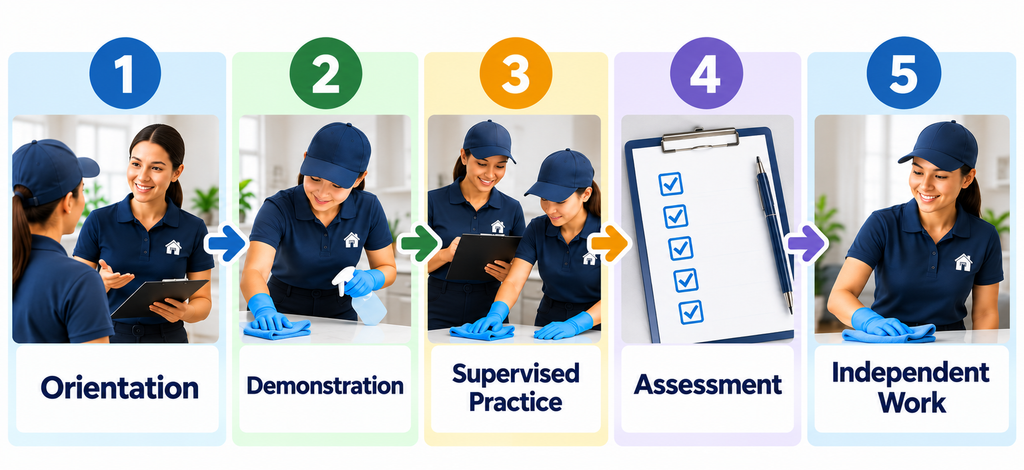
Orientation → Demonstration → Supervised Practice → Assessment → Independent Work
A new cleaner should not simply be shown a task once and immediately expected to perform it independently.
FIGURE 1 — CLEANING EMPLOYEE TRAINING PROCESS
1. Start With Company Orientation
Before teaching cleaning techniques, introduce the employee to how the company operates.
Orientation can cover:
- What services the company provides
- Typical customers and properties
- Work schedules
- Attendance expectations
- Communication procedures
- Timekeeping
- Dress and appearance standards
- Customer privacy
- Keys and access procedures
- Basic workplace conduct
This gives the employee context before job-specific training begins.
Your detailed workplace policies should live in your employee handbook rather than being recreated inside every training document.
See our Cleaning Business Employee Handbook for the broader policy structure.
2. Explain the Cleaner’s Role and Responsibilities
New employees should understand exactly what they are responsible for.
That includes both cleaning tasks and professional expectations.
Explain:
- Which tasks cleaners normally perform
- Which tasks require approval
- How job assignments are received
- When employees should arrive
- What happens when a job takes longer than expected
- Who to contact with questions
- How completed work is documented
- How problems are reported
Do not assume that a new employee automatically understands your definition of a completed job.
Two people can interpret “clean the bathroom” very differently.
Your training should make the expected result clear.
3. Train Employees on Safety Before Speed
A new cleaner should understand basic safety expectations before being pushed to work faster.
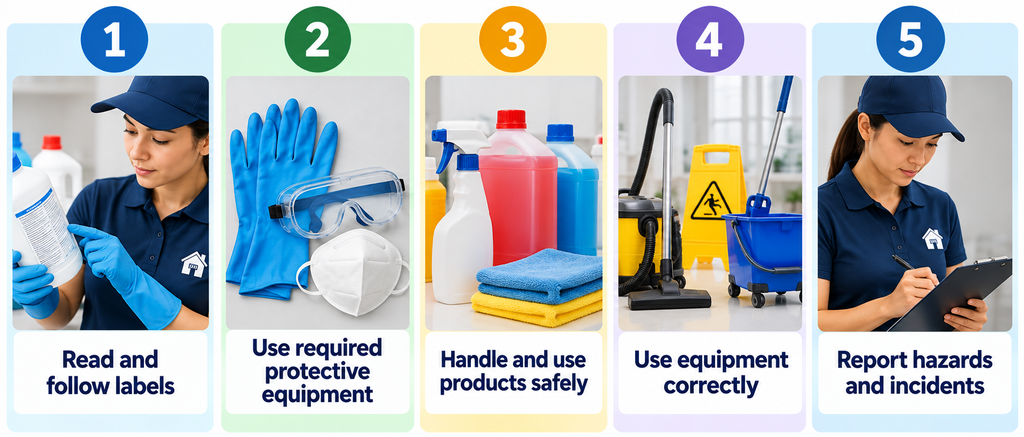
Training may include:
- Reading and following product labels
- Using required personal protective equipment
- Safe product handling
- Avoiding unauthorized chemical mixing
- Proper equipment use
- Safe lifting techniques
- Wet-floor awareness
- Reporting spills
- Reporting damaged equipment
- Reporting injuries and unsafe conditions
Training rule:
Do not treat safety training as a one-time checkbox.
Employees should know both what to do and who to contact when something goes wrong.
FIGURE 2 — NEW CLEANER SAFETY TRAINING BASICS
4. Teach Cleaning Products and Equipment
New cleaners need to know which products and tools your company uses and how they should be handled.
Depending on your services, training may cover:
- General-purpose cleaners
- Bathroom products
- Glass cleaners
- Disinfectants
- Microfiber cloth systems
- Mops
- Vacuums
- Brushes
- Specialty equipment
- Disposable supplies
For each product or tool, employees should understand:
- What it is used for
- Where it should not be used
- How much product to use
- How to use it safely
- How to clean or maintain the equipment
- Where it should be stored
Using too much product can waste money.
Using the wrong product can damage customer property.
Using equipment incorrectly can create safety issues or shorten its useful life.
5. Demonstrate Your Cleaning Process
Written instructions are useful, but new cleaners also need to see your standards in practice.
Demonstrate how your company approaches a cleaning job from beginning to end.
That may include:
- Preparing supplies
- Entering the property
- Reviewing job instructions
- Choosing a cleaning sequence
- Working room by room
- Preventing cross-contamination
- Checking completed work
- Packing equipment
- Securing the property before leaving
The goal is not simply to show individual cleaning tasks.
The employee should understand the entire workflow.
If your company uses documented procedures, connect the training directly to them.
See our Cleaning Business SOP guide for building repeatable operating procedures.
6. Use Cleaning Checklists During Training
A checklist gives new employees a visible definition of what needs to be completed.
Instead of telling a cleaner to “remember everything,” provide a consistent task list.
For example, a bathroom checklist might include:
- Clean and disinfect the toilet
- Clean sink and faucet
- Clean mirror
- Wipe counters
- Clean shower or tub as required
- Empty trash
- Replace liners when required
- Clean floors
- Complete a final inspection
The checklist becomes especially useful during supervised practice because the trainer can compare the employee’s work against the same standard every time.
For a complete task structure, see our Professional House Cleaning Checklist.
7. Teach Customer Property and Access Procedures
Cleaning employees often work inside homes or businesses without the customer directly supervising them.
That makes trust part of the job.
Training should explain how employees are expected to handle:
- Keys
- Alarm codes
- Lockboxes
- Customer belongings
- Valuable or fragile items
- Restricted areas
- Pets
- Doors and windows
- Property damage
- Lost items
Employees should know what to do if they accidentally damage something.
Trying to hide a mistake can create a much larger customer problem than reporting it immediately.
Simple incident rule:
Stop → Protect the area → Document what happened → Contact the designated manager
8. Train Customer Communication
Cleaners represent your company while working at customer properties.
They should understand how to communicate professionally without being expected to solve every customer issue themselves.
Training can cover:
- Greeting customers
- Responding to basic questions
- Avoiding arguments
- Handling special requests
- Reporting complaints
- Avoiding promises they are not authorized to make
- Protecting customer privacy
Employees should know when to handle a simple request and when to refer the customer to a manager or owner.
9. Use Supervised Practice
After orientation and demonstrations, the employee should perform actual cleaning tasks under supervision.
This is where you can see whether the employee can apply the training.
The trainer should observe:
- Cleaning technique
- Product use
- Equipment handling
- Task sequence
- Attention to detail
- Safety
- Pace
- Customer-property awareness
- Communication
- Final quality
Do not evaluate speed alone.
A cleaner who finishes quickly but consistently misses tasks is not fully trained.
10. Assess Quality Before Independent Work
Before a new cleaner begins working independently, complete a basic quality assessment.
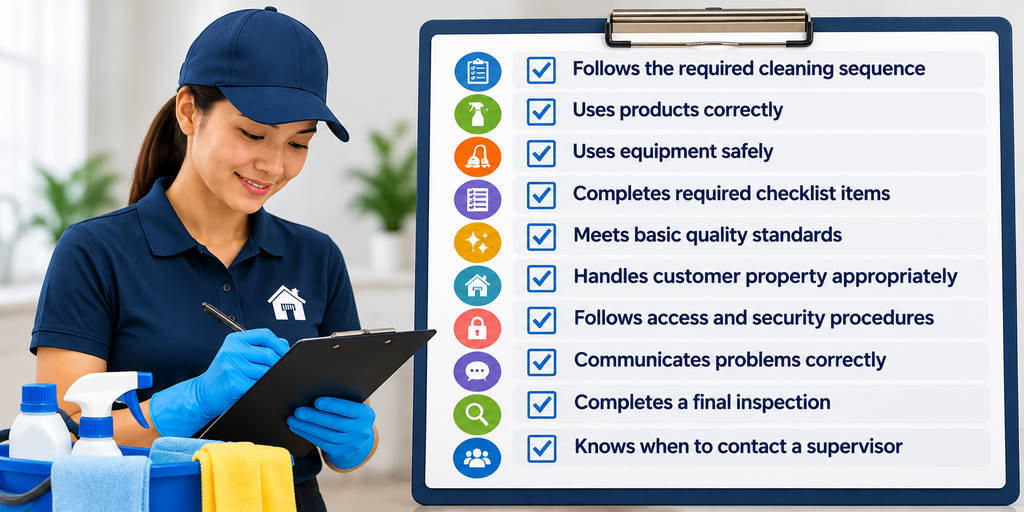
New Cleaner Readiness Check
□ Follows the required cleaning sequence
□ Uses products correctly
□ Uses equipment safely
□ Completes required checklist items
□ Meets basic quality standards
□ Handles customer property appropriately
□ Follows access and security procedures
□ Communicates problems correctly
□ Completes a final inspection
□ Knows when to contact a supervisor
A failed assessment does not necessarily mean the employee cannot do the job.
It identifies where additional training is needed before independent work.
FIGURE 3 — NEW CLEANER READINESS CHECK
11. Train for Quality Control
Training should explain how your company defines acceptable quality.
New employees need to understand that completing a task and completing it to company standard are not always the same thing.
Quality-control training may include:
- Visual inspections
- Cleaning checklist reviews
- Supervisor inspections
- Customer feedback
- Photo documentation when appropriate
- Reclean procedures
- Correction of missed tasks
Employees should also understand what happens when a quality problem is found.
The goal should be consistent improvement—not simply catching mistakes.
12. Teach Time Management Without Encouraging Shortcuts
Cleaning businesses need productivity, but pushing speed too early can create poor habits.
New cleaners should first learn:
Correct process → Consistent quality → Efficient execution
Once the employee can perform the work correctly, trainers can help improve efficiency.
This may include:
- Preparing supplies before starting
- Following a consistent room sequence
- Reducing unnecessary movement
- Keeping frequently used tools accessible
- Avoiding repeated trips to the vehicle
- Coordinating tasks effectively when working in teams
Scheduling also affects productivity.
Better routing and job scheduling can reduce wasted travel time between customers.
See our Cleaning Business Scheduling guide for more on organizing jobs and crews.
Free Cleaning Business Training Checklist
You do not need to build your employee training process from a blank document.
Use the free OpsButler Cleaning Business Training Checklist as a starting point.
The checklist should be customized for your company’s services, equipment, products, policies, and local requirements.
It can be used during:
- New-hire onboarding
- Trainer-led demonstrations
- Supervised cleaning
- Quality assessments
- Follow-up training
- Refresher training
Recommended Training Record
Employee Name: ______________________________
Trainer: ____________________________________
Training Start Date: _________________________
Assessment Date: ____________________________
Approved for Independent Work: □ Yes □ Not Yet
Trainer Signature: ___________________________
Employee Signature: _________________________
How Long Should Cleaner Training Take?
There is no single training period that fits every cleaning business.
The time required depends on factors such as:
- Services offered
- Property types
- Employee experience
- Equipment used
- Complexity of company procedures
- Quality standards
- Whether cleaners work alone or in teams
A simple residential cleaning role may require less training than a role involving specialty equipment or more complex commercial environments.
Instead of relying only on a fixed number of training days, use demonstrated competence as part of the decision.
The employee should be able to perform the required work safely and consistently before being assigned independent responsibility.
Common Cleaner Training Mistakes
1. Training Only Through Verbal Instructions
Employees can forget verbal instructions.
Combine explanation with demonstrations, written procedures, and checklists.
2. Having Different Trainers Teach Different Methods
If every experienced cleaner teaches their personal method, your company can end up with multiple standards.
Use documented SOPs and checklists to create consistency.
3. Focusing on Speed Too Early
Quality and safety should come before speed.
Efficiency can improve after the correct process becomes consistent.
4. Skipping Customer-Service Training
Cleaning quality matters, but employees also represent your company inside customer properties.
Professional communication should be part of training.
5. Ending Training After the First Week
Employees may need follow-up coaching after they begin working independently.
Training should continue when inspections, customer feedback, or performance results identify a gap.
6. Failing to Document Training
A simple training record helps managers understand:
- What was taught
- Who provided the training
- When training occurred
- Which areas need additional work
- Whether the employee was approved for independent work
Build a Repeatable Cleaning Employee Training System
The strongest training process connects several parts of your cleaning business.
Employee Handbook
Defines workplace policies and expectations.
SOPs
Explain how recurring processes should be performed.
Cleaning Checklists
Define the tasks that need to be completed.
Training Checklist
Tracks what the employee has learned and practiced.
Quality Control
Confirms whether the standards are being followed in real jobs.
When these pieces work together, training becomes less dependent on the owner personally explaining every task to every new employee.
Instead, the business develops a system that can be repeated as the team grows.
Final Take
Hiring cleaners does not automatically create a reliable cleaning team.
Training is what turns company standards into consistent employee performance.
Start with orientation.
Teach safety before speed.
Demonstrate your cleaning process.
Use SOPs and cleaning checklists during supervised practice.
Assess quality before independent work.
Then continue coaching based on inspections, customer feedback, and employee performance.
A simple training checklist makes that process easier to repeat—and easier to improve as your cleaning business grows.