
Cleaning a property is only half the job. The other half is making sure the work actually meets the standard your customer expects.
That becomes harder as your cleaning business grows.
When you are doing every job yourself, you can see the results firsthand. Once you hire cleaners, build multiple crews, or service several properties in the same day, you need a repeatable way to check quality without personally watching every task.
A cleaning business quality control checklist gives you that system.
Instead of relying on whether a room “looks clean,” you can inspect specific areas, record problems, and identify patterns before they turn into customer complaints.
In this guide, you will learn how to build a simple quality control process and get a practical inspection checklist you can use directly in your browser.
What Is Quality Control in a Cleaning Business?
Quality control is the process of checking completed cleaning work against a defined standard.
A cleaner may have a list showing what needs to be cleaned. A quality control inspection answers a different question:
Was the work completed to the required standard?
That distinction matters.
For example, a cleaning checklist might say:
* Vacuum bedroom carpet
* Clean bathroom mirror
* Wipe kitchen counters
* Empty trash
A quality control inspection checks the finished result:
* Is the carpet free of visible debris?
* Is the mirror free of streaks and fingerprints?
* Are the counters free of crumbs, grease, and residue?
* Was the trash removed and the liner replaced if required?
The first list tells the cleaner what to do.
The second helps you determine whether it was done properly.
Why Cleaning Businesses Need a Quality Control System
Quality problems often become more difficult as a cleaning company grows.
Different cleaners may have different ideas about what “clean” means. One employee may notice fingerprints on a glass door immediately, while another walks straight past them.
Without a defined inspection standard, the business owner often finds out about the problem only after the customer does.
A simple quality control process can help you:
Catch missed work before the customer does
Small issues can often be corrected before they become complaints.
Create consistent cleaning standards
Employees are evaluated against the same expectations instead of personal opinions.
Identify recurring training problems
If the same inspection item repeatedly fails, you know where additional training may be needed.
Reduce callbacks and rework
Finding problems early can prevent an additional trip to the property.
Protect customer relationships
Documented inspections show that your company actively monitors service quality.
Quality control should not be designed simply to catch employees making mistakes.
Its purpose is to make your cleaning results more predictable.
Free Cleaning Business Quality Control Checklist
You do not need a complicated inspection system to get started.
Use the interactive checklist below during a quality inspection. You can check items directly in your browser and reset the checklist for another job.
Customize the inspection based on your service agreement, property type, and cleaning frequency.
FIGURE 1 — CLEANING QUALITY INSPECTION AREAS
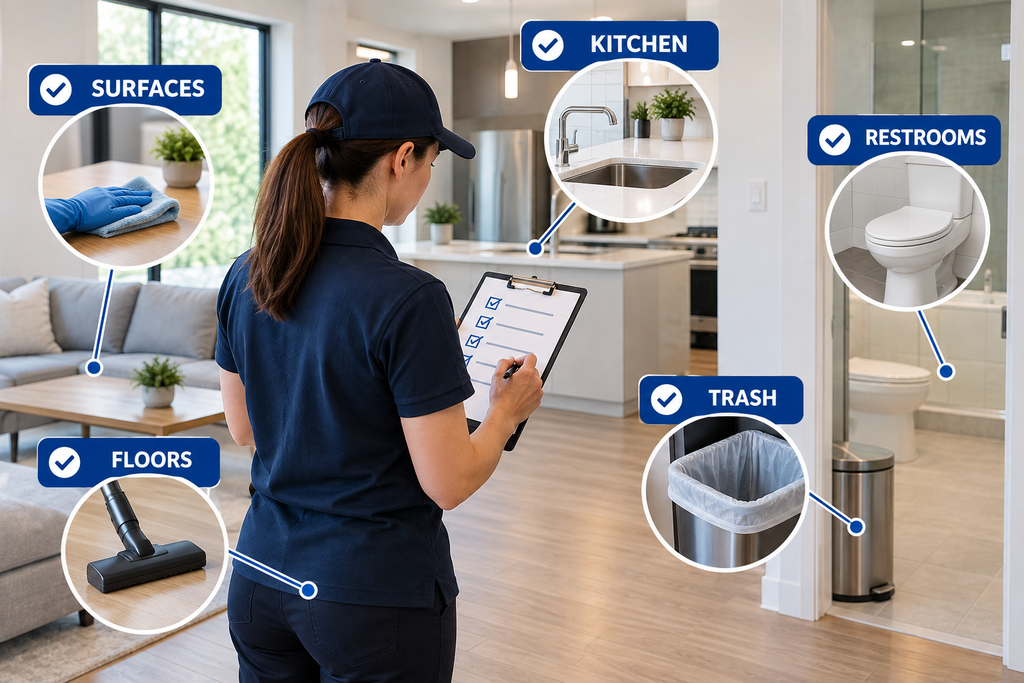
Cleaning Business Quality Control Checklist
Entrance & General Areas
Kitchen / Break Room
Restrooms / Bathrooms
Floors
Dusting & Surfaces
Final Check
How to Score a Cleaning Inspection
A simple pass/fail system is enough for many small cleaning businesses.
Each inspection item can receive one of three results:
PASS — The result meets your cleaning standard.
FAIL — The result does not meet the standard and needs correction.
N/A — The item does not apply to this property or service.
If you want to track performance over time, you can calculate an inspection score.
Inspection Score = Passed Items ÷ Applicable Items × 100
For example:
If an inspection contains 25 applicable items and 23 pass:
23 ÷ 25 × 100 = 92%
Cleaning Inspection Score Calculator
Enter the number of passed items and applicable inspection items to calculate your cleaning quality score.

The important part is not choosing a perfect target percentage.
The value comes from using the same scoring method consistently so you can compare jobs, employees, properties, and time periods.
Simple visual showing: 23 Passed ÷ 25 Applicable × 100 = 92% Quality Score. Large numbers, minimal text, clean OpsButler styling.
What Should You Inspect?
Your inspection checklist should match the actual scope of work.
Do not fail an employee for something the customer did not purchase or something that was not scheduled for that visit.
For example, suppose you notice dust on a high shelf.
If high dusting is included quarterly and was not scheduled that day, it should not automatically count as a failed inspection item.
Start with the service agreement or job checklist and inspect the work that was actually required.
For most cleaning businesses, the highest-value inspection areas include:
* Entrances and first-impression areas
* Restrooms and bathrooms
* Floors
* Trash removal
* Kitchens and break rooms
* Glass and mirrors
* Dusting and visible surfaces
* High-touch points included in the service
* Client-specific priority areas
For commercial accounts, build the checklist around the contracted scope.
For residential cleaning, customize the inspection based on the service type — standard cleaning, deep cleaning, move-out cleaning, or another package.
Make Inspection Standards Specific
One of the biggest quality control mistakes is using vague inspection language.
Consider these two standards:
“Bathroom is clean.”
and
“Mirror is free of visible streaks and fingerprints.”
The second standard is easier to inspect because the expected result is observable.
Try to avoid checklist items such as:
* Looks good
* Clean properly
* Bathroom completed
* Kitchen acceptable
Instead, describe the result you expect:
* Mirror is free of visible streaks
* Trash receptacle is emptied
* Carpet has no visible loose debris
* Sink is free of visible residue
* Entry glass has no obvious fingerprints
Specific standards make inspections easier for supervisors and expectations clearer for cleaners.
How Often Should You Inspect Cleaning Jobs?
You probably do not need to inspect every job forever.
A small cleaning business can use a risk-based approach.
Inspect more frequently when:
* A cleaner is new
* A new client has just started service
* The property has complicated requirements
* A customer recently complained
* A cleaner’s quality has become inconsistent
* You changed the cleaning process or scope
Once performance becomes consistent, inspections can become less frequent while still being performed periodically.
The goal is to create enough oversight to identify problems without turning quality control into unnecessary administrative work.
A practical system might include inspections after early jobs for new cleaners, periodic spot checks for established employees, and additional inspections after complaints or service changes.
What to Do When an Inspection Fails
Finding a problem is only useful if something happens next.
Use a simple corrective process:
1. Record the problem
Identify the specific inspection item that failed.
2. Correct the work
If possible, fix the problem before the customer encounters it.
3. Identify the cause
Was the task missed? Was the standard unclear? Was there not enough time? Was equipment unavailable?
4. Coach or update the process
Correct the underlying reason instead of simply telling the employee to “do better.”
5. Verify the correction
Confirm that the issue was actually resolved.
FIGURE 3 — Cleaning Quality Control Process
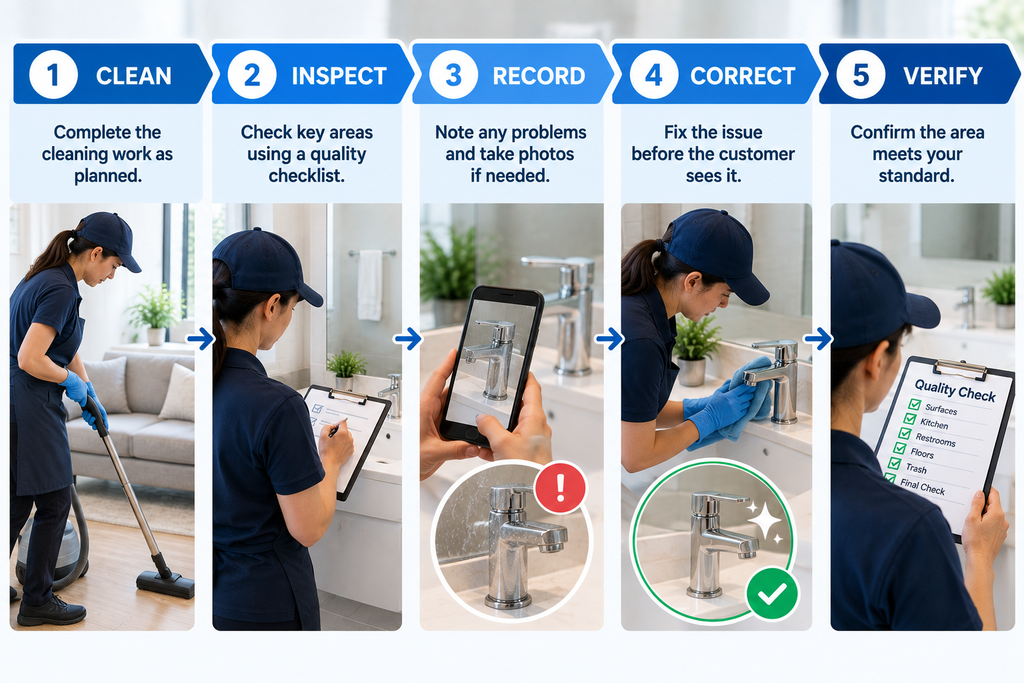
Horizontal process graphic: CLEAN → INSPECT → RECORD → CORRECT → VERIFY. Five large steps only. No small supporting text.
Repeated failures in the same area can indicate a larger problem.
For example, if several employees repeatedly miss the same task, the issue may be your training or standard operating procedure rather than one employee.
If that happens, review your cleaning business training checklist and your cleaning business SOP instead of treating every failure as an isolated mistake.
Use Photos When They Add Useful Evidence
Photos can make quality control easier, especially when supervisors cannot inspect every property immediately.
They can document:
* Before-and-after conditions
* Completed high-priority areas
* Damage discovered before cleaning
* Unusual conditions at the property
* Problems that require follow-up
But requiring dozens of photos after every job can create unnecessary work.
Focus photo requirements on areas where documentation has a clear purpose.
Also make sure your process respects customer privacy. Avoid photographing personal information, private documents, people, or areas that do not need to be documented.
Track Patterns, Not Just Individual Mistakes
The real value of inspections appears over time.
Suppose one cleaner receives these scores:
Week 1 — 96%
Week 2 — 92%
Week 3 — 84%
Week 4 — 80%
One imperfect inspection may not mean much.
A repeated decline does.
You can also track failures by category.
If bathroom inspections consistently score lower than floors or kitchens, you now have a specific training problem to address.
This is much more useful than telling your team:
“We need to improve quality.”
You know exactly what needs improvement.
Connect Quality Control to Employee Training
Inspection data should feed directly back into training.
If new cleaners frequently miss edges when mopping, add edge inspection to supervised practice.
If mirrors repeatedly have streaks, demonstrate the correct process again.
If cleaners forget client-specific instructions, improve the job notes or checklist they receive before arriving.
This creates a simple improvement loop:
Train → Clean → Inspect → Coach → Improve
Quality control then becomes part of employee development instead of simply a scorecard.
For a complete onboarding process, see our Cleaning Business Training Checklist.
Quality Control for Residential vs. Commercial Cleaning
The basic inspection process is similar, but the checklist should reflect the type of customer.
Residential Cleaning
Residential inspections often focus heavily on visible details and customer-specific preferences.
Common priorities include:
* Bathrooms
* Kitchen surfaces
* Floors
* Dusting
* Mirrors
* Beds or linens if included
* Client-specific instructions
Commercial Cleaning
Commercial inspections often need to follow a more formal service scope.
Common priorities include:
* Restrooms
* Entrances and lobbies
* Trash and recycling
* Floors
* Break rooms
* High-touch surfaces
* Supply replenishment
* Scheduled periodic tasks
If you are pricing commercial work, make sure the inspection requirements are considered when estimating labor.
See our Commercial Cleaning Pricing Guide and Commercial Cleaning Bidding Guide for more.
Should You Use Paper or Cleaning Business Software?
A paper checklist can work perfectly well when you have a small team.
As your business grows, digital inspections can make it easier to store results, attach photos, track recurring issues, and review job history.
The important thing is not whether your checklist is paper or digital.
It is whether the inspection actually gets completed and the results are used.
If you are comparing software for scheduling, job management, customer records, and field operations, start with our Best Cleaning Business Software guide.
Common Quality Control Mistakes
Avoid making your inspection process more complicated than it needs to be.
Using vague standards
“Looks clean” is difficult to measure consistently.
Inspecting work that was not included
Judge the job against the agreed scope and frequency.
Creating an enormous checklist
A checklist that nobody consistently completes provides little value.
Recording failures without correcting them
Every meaningful failure should lead to an action.
Using inspections only to punish employees
Inspection results should also identify training and process problems.
Ignoring recurring patterns
Repeated failures usually tell you more than one isolated score.
Build Quality Control Into Your Cleaning Business
Quality control does not need to be complicated.
Start with three things:
1. Define what a completed job should look like.
2. Inspect the finished work using the same standards.
3. Correct problems and use recurring failures to improve training.
As your cleaning business grows, this simple system helps turn quality from something that depends on individual cleaners into a repeatable business process.
Your customers may never see your inspection checklist.
But they will notice the consistency it is designed to create.