
Starting a cleaning business does not require a 40-page business plan.
But it does help to have a clear answer to a few important questions:
What services will you offer?
Who will you serve?
How much will you charge?
How will you get customers?
What will it cost to operate?
How will the business make money?
A simple cleaning business plan puts those decisions in one place.
It can help you avoid random spending, inconsistent pricing, and trying to serve every type of customer at once.
In this guide, we’ll walk through the main sections of a practical cleaning business plan and give you a free template you can copy and customize.
What Is a Cleaning Business Plan?
A cleaning business plan is a written outline of how your cleaning company will operate and make money.
It does not need to be complicated.
For a small cleaning business, the plan should help you define:
- Your target customers
- Your cleaning services
- Your service area
- Your pricing strategy
- Your marketing plan
- Your operating process
- Your startup and ongoing costs
- Your revenue goals
- Your hiring plans
- Your growth strategy
The goal is not to predict everything that will happen.
The goal is to make the important decisions before you start spending money and taking on customers.
If you are still at the beginning of the startup process, read our full guide:
How to Start a Cleaning Business: Step-by-Step Guide (2026)
https://getopsbutler.com/how-to-start-a-cleaning-business/
Do You Really Need a Business Plan for a Cleaning Business?
Not every cleaning company needs a formal business plan written for investors or a bank.
A solo cleaner starting with a small budget may only need a few pages.
But writing down your plan can still be useful.
It forces you to think about questions that are easy to ignore when you are focused on getting your first customer.
For example:
- How many jobs do you need each month?
- What type of cleaning will you specialize in?
- How far are you willing to travel?
- What expenses will each job create?
- How will customers find you?
- When will you need to hire?
- What happens if a customer cancels?
- How much profit do you want the business to generate?
A short plan that you actually use is usually more valuable than a long document you never look at again.
1. Write Your Business Overview
Start with a simple description of the business you want to build.
You do not need corporate language.
Write down:
- Business name
- Location
- Service area
- Business structure
- Owner
- Type of cleaning business
- Main services
- Target customers
- Short-term goal
- Long-term goal
For example:
Example Business Overview
Business Name: Bright Home Cleaning
Location: Austin, Texas
Service Area: Residential customers within approximately 15 miles
Business Type: Residential cleaning business
Main Services: Recurring house cleaning, deep cleaning, and move-out cleaning
Target Customer: Busy households that want reliable recurring cleaning
Short-Term Goal: Build a base of 25 recurring customers
Long-Term Goal: Hire cleaners and expand recurring service capacity
Your overview should be specific enough that someone can understand what kind of cleaning company you are trying to build.
2. Define Your Target Customer
Trying to sell cleaning services to everyone makes marketing harder.
Instead, decide who you want to serve.
Possible customer groups include:
- Busy families
- Working professionals
- Seniors
- Apartment residents
- Airbnb hosts
- Property managers
- Offices
- Retail businesses
- Medical facilities
- Real estate agents
- Construction companies
Your target customer affects almost everything else in your plan.
Residential recurring cleaning requires a different sales process, schedule, equipment setup, and pricing structure than commercial office cleaning.
Ask yourself:
Who has the problem my cleaning service solves?
How often do they need cleaning?
What matters most to them?
Price?
Reliability?
Convenience?
Consistency?
Specialized cleaning?
The clearer the customer, the easier it becomes to design the rest of the business.
3. Decide Which Cleaning Services You Will Offer
Next, define exactly what customers can buy.
A residential cleaning business might offer:
- Standard recurring cleaning
- Deep cleaning
- Move-in cleaning
- Move-out cleaning
- One-time cleaning
- Add-on services
A commercial business might offer:
- Office cleaning
- Restroom cleaning
- Floor care
- Common-area cleaning
- Recurring janitorial service
Do not assume that offering more services automatically makes the business better.
Every additional service can create new requirements for equipment, training, pricing, scheduling, and quality control.
Start with services you can deliver consistently.
You can expand later.
Define What Is Included
For each service, write down what the customer receives.
For example, a standard residential cleaning might include:
- Kitchen surfaces
- Bathroom cleaning
- Dusting
- Vacuuming
- Mopping
- Trash removal
- Basic surface cleaning
This makes quoting easier and reduces disagreements about what the customer expected.
You can use our room-by-room checklist as a starting point:
Professional House Cleaning Checklist: Free Room-by-Room Template (2026)
https://getopsbutler.com/professional-house-cleaning-checklist/
4. Choose Your Service Area
Travel time can quietly destroy the economics of a cleaning business.
Two $150 jobs located five minutes apart are very different from two $150 jobs located 45 minutes apart.
Define the geographic area you want to serve.
Consider:
- Population density
- Target customer concentration
- Driving time
- Fuel costs
- Parking
- Traffic
- Competition
- Ability to group jobs geographically
You do not need to cover an entire city.
A smaller, denser service area can sometimes produce a more efficient schedule.
5. Build Your Pricing Strategy
Your business plan should explain how you intend to price cleaning jobs.
Common approaches include:
- Hourly pricing
- Flat-rate pricing
- Pricing by square footage
- Room-based pricing
- Custom quotes
- Recurring service pricing
The right price depends on your market, but it also depends on your own costs.
Your price needs to cover:
Revenue
− Labor
− Supplies
− Transportation
− Insurance
− Software
− Marketing
− Other overhead
= Profit
Do not build the business plan around competitor prices alone.
A competitor may have completely different labor costs, route density, overhead, or profit expectations.
For a full pricing framework, use:
How Much to Charge for House Cleaning: Pricing Guide & Calculator (2026)
https://getopsbutler.com/how-much-to-charge-for-house-cleaning/
Estimate Your Required Revenue
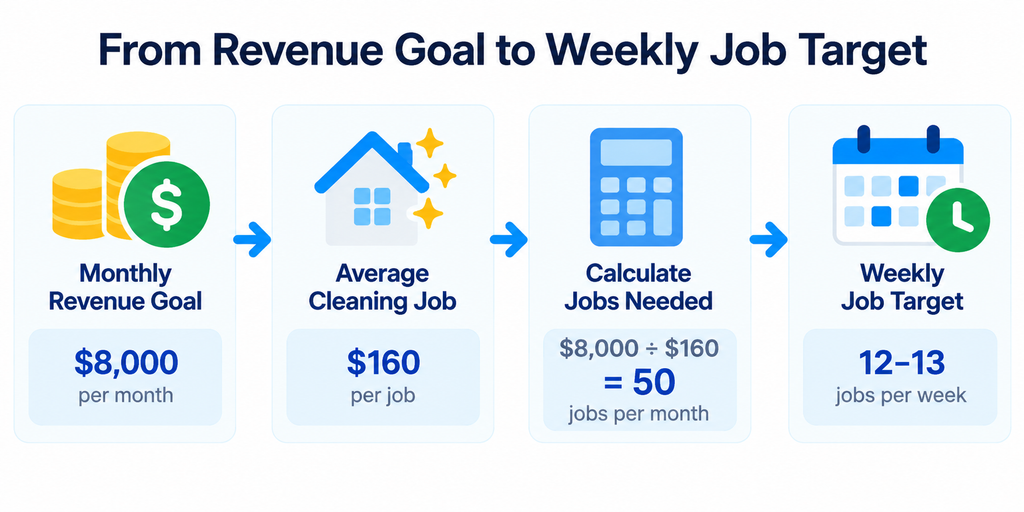
Now the revenue goal becomes operational.
Can you realistically complete that many jobs?
How many customers would you need?
How many of those jobs could be recurring?
This is why pricing and capacity should be planned together.
6. Estimate Your Startup Costs
Before launching, estimate how much money you actually need.
Typical startup expenses may include:
- Business registration
- Licenses or permits
- Insurance
- Cleaning supplies
- Cleaning equipment
- Website
- Branding
- Initial marketing
- Software
- Transportation
- Uniforms
- Cash reserve
Avoid buying everything you might eventually need.
Separate expenses into:
Must have before the first job
Useful after you have customers
Useful only after the business grows
We built a startup cost calculator for this:
Cleaning Business Startup Costs: Complete Breakdown & Calculator (2026)
https://getopsbutler.com/cleaning-business-startup-costs/
7. Create Your Marketing Plan
A cleaning business plan should explain where customers will come from.
Do not write:
“We will use marketing.”
Be specific.
Possible customer acquisition channels include:
- Google Business Profile
- Local SEO
- Referrals
- Neighborhood groups
- Flyers
- Direct outreach
- Partnerships
- Social media
- Local advertising
- Paid search
- Property manager relationships
- Real estate agent relationships
Choose a few channels to test first.
For example:
Example 90-Day Marketing Plan
Month 1
- Create a Google Business Profile
- Build a simple website
- Ask personal contacts for referrals
- Contact local property managers
- Create a basic referral offer
Month 2
- Collect customer reviews
- Improve local service pages
- Test neighborhood outreach
- Track which channels generate inquiries
Month 3
- Increase effort on the best-performing channel
- Stop activities that produce no qualified leads
- Test one additional acquisition channel
The goal is not to be everywhere.
The goal is to discover a repeatable way to generate profitable customers.
For more customer acquisition ideas:
How to Get Clients for a Cleaning Business: 12 Proven Ways (2026)
https://getopsbutler.com/how-to-get-clients-for-a-cleaning-business/
8. Design Your Operating Workflow
Next, document what happens after someone contacts your business.
A simple workflow might be:
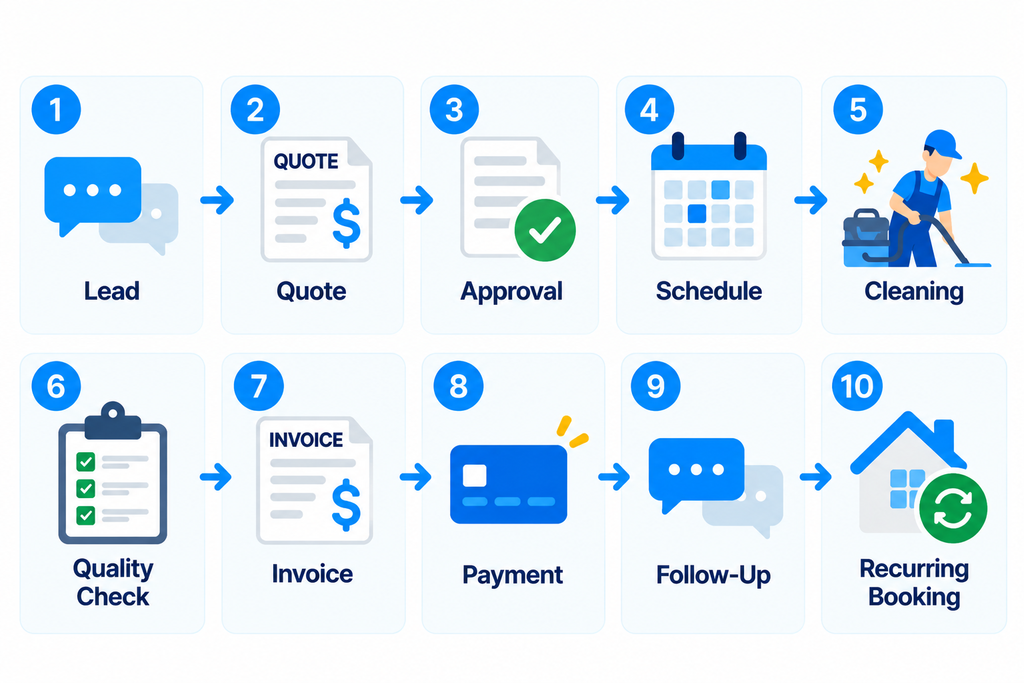
This prevents the business from depending entirely on memory.
Think through:
- How customers request quotes
- How you collect property information
- How prices are approved
- How jobs are scheduled
- How cleaners receive instructions
- How completed work is checked
- How invoices are sent
- How payments are collected
- How complaints are handled
- How recurring jobs are managed
If you need a quoting process, use:
Cleaning Business Estimate Template: How to Create Professional Quotes That Win Jobs
https://getopsbutler.com/cleaning-business-estimate-template/
For invoicing:
Cleaning Business Invoice Template: Free Professional Template & Examples
https://getopsbutler.com/cleaning-business-invoice-template/
9. Plan Your Monthly Expenses
Startup costs tell you what it takes to launch.
Monthly expenses tell you what it takes to survive.
Possible expenses include:
- Labor
- Payroll taxes
- Cleaning supplies
- Fuel
- Vehicle expenses
- Insurance
- Software
- Phone
- Marketing
- Payment processing
- Accounting
- Office expenses
- Equipment replacement
Separate expenses into fixed and variable costs.
Fixed costs may remain relatively stable even when you complete fewer jobs.
Variable costs tend to increase as you complete more work.
Understanding both helps you estimate how much revenue the business needs to generate.
10. Set Profit Goals
Revenue is not the same as profit.
A cleaning company can stay busy and still make very little money.
Your business plan should therefore include a profit target.
For example:
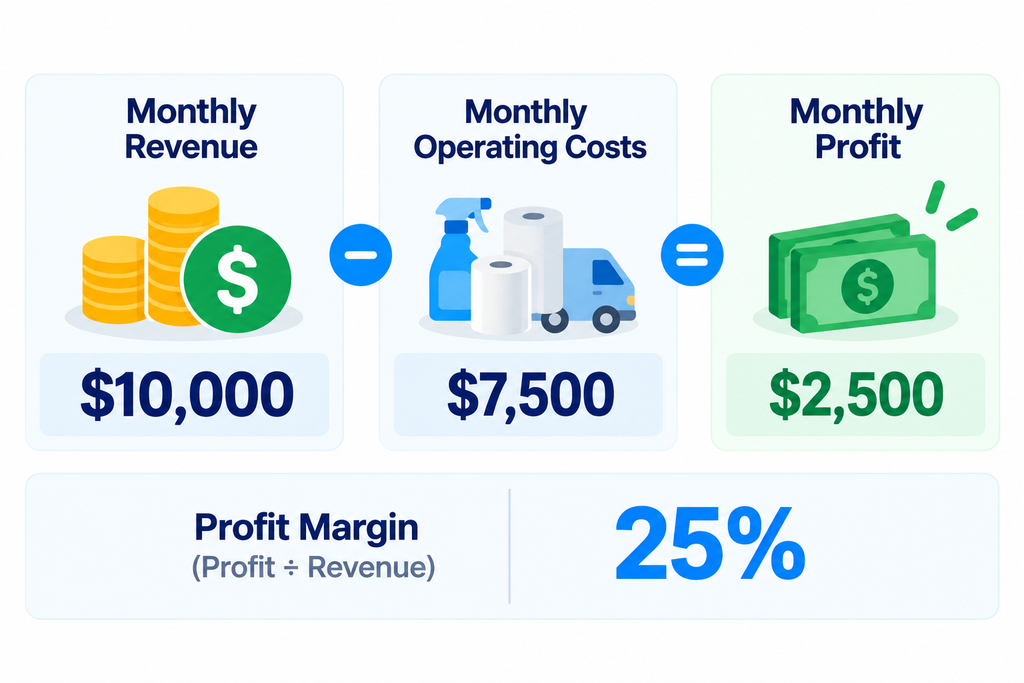
This is only an example.
Your actual numbers will depend on labor, pricing, service mix, overhead, and many other factors.
Use our calculator to test your own numbers:
Cleaning Business Profit Margin Calculator: Know What You Really Make (2026)
https://getopsbutler.com/cleaning-business-profit-margin-calculator/
11. Decide When You Will Hire
If you plan to grow beyond working alone, think about hiring before you desperately need help.
Define a trigger.
For example:
Hire when recurring demand consistently exceeds your available capacity.
Or:
Hire when turning down profitable jobs becomes more expensive than adding labor.
Before hiring, consider:
- Labor cost
- Payroll obligations
- Insurance
- Training
- Scheduling
- Quality control
- Background checks where appropriate
- Equipment
- Transportation
- Communication
- Supervision
Hiring creates capacity.
It also creates management responsibility.
Do not treat headcount itself as the goal.
12. Decide Which Software You Actually Need
A new cleaning business does not need every software tool available.
At first, you may be able to operate with:
- Calendar
- Spreadsheet
- Basic invoicing tool
- Phone
Software becomes more valuable when manual processes start creating problems.
For example:
- Double bookings
- Missed follow-ups
- Lost customer information
- Inconsistent quotes
- Late invoices
- Difficulty coordinating cleaners
- Too much administrative work
If you are comparing platforms, start here:
Best Cleaning Business Software: 7 Tools Compared
https://getopsbutler.com/best-cleaning-business-software/
For scheduling specifically:
Best Scheduling Software for Cleaning Businesses: 7 Tools Compared (2026)
https://getopsbutler.com/best-scheduling-software-for-cleaning-business/
And if you are considering Jobber:
Jobber Review: Is It Worth It for Cleaning Businesses? (2026)
https://getopsbutler.com/jobber-review/
13. Choose the Numbers You Will Track
You do not need dozens of metrics.
Start with numbers that help you make decisions.
Useful cleaning business metrics can include:
- Monthly revenue
- Number of jobs
- Average job value
- Recurring customers
- New leads
- Quote conversion rate
- Customer acquisition cost
- Labor cost
- Gross profit
- Net profit
- Profit margin
- Customer retention
Tracking these over time helps you see whether the business is actually improving.
Free Cleaning Business Plan Template
You can copy the template below into Google Docs, Word, Notion, or another document and customize it for your business.
Cleaning Business Plan Template
1. Business Overview
Business Name:
Owner:
Location:
Service Area:
Business Structure:
Business Type:
Main Goal:
2. Target Customer
Primary Customer:
Customer Location:
Main Customer Problem:
Why They Would Choose Us:
3. Services
Core Services:
Recurring Services:
One-Time Services:
Add-On Services:
Services We Will Not Offer:
4. Pricing
Pricing Method:
Average Target Job Value:
Minimum Job Price:
Recurring Customer Pricing:
Target Monthly Revenue:
5. Marketing
Primary Marketing Channels:
Referral Strategy:
Online Presence:
Monthly Marketing Budget:
90-Day Customer Acquisition Goal:
6. Operations
Quote Process:
Scheduling Process:
Cleaning Checklist:
Quality Control Process:
Invoice Process:
Payment Process:
Customer Follow-Up Process:
7. Startup Costs
Registration and Licenses:
Insurance:
Supplies:
Equipment:
Website and Branding:
Marketing:
Software:
Transportation:
Cash Reserve:
Estimated Total:
8. Monthly Expenses
Labor:
Supplies:
Transportation:
Insurance:
Software:
Marketing:
Payment Processing:
Other:
Estimated Monthly Total:
9. Financial Goals
Monthly Revenue Goal:
Monthly Profit Goal:
Target Profit Margin:
Average Job Value:
Required Jobs per Month:
10. Hiring Plan
Current Team Size:
Hiring Trigger:
First Role to Hire:
Training Process:
Quality Control Process:
11. Software
Scheduling:
Customer Management:
Quotes:
Invoicing:
Payments:
Accounting:
Other:
12. 90-Day Priorities
Priority 1:
Priority 2:
Priority 3:
Target Number of Customers:
Target Monthly Revenue:
Main Problem to Solve:
Do not worry about filling in every field perfectly.
The template is useful because it forces you to turn vague ideas into specific decisions.
Example: Simple Cleaning Business Plan
Here is what a very simple version might look like.
Business:
Residential cleaning company serving customers within a 10-mile area.
Target Customer:
Busy households looking for reliable recurring cleaning.
Services:
Recurring standard cleaning, deep cleaning, and move-out cleaning.
Pricing:
Flat-rate quotes based on property size, condition, frequency, and scope.
Marketing:
Google Business Profile, referrals, local SEO, and property manager relationships.
Operations:
Customer inquiry → Quote → Schedule → Cleaning → Invoice → Payment → Follow-Up.
Financial Goal:
Reach 30 recurring customers while maintaining profitable pricing.
Hiring Trigger:
Add the first cleaner when recurring demand consistently exceeds the owner’s available capacity.
Software:
Start with simple tools and adopt dedicated cleaning business software when scheduling and administration become difficult to manage manually.
That is enough to create direction.
Your plan can become more detailed as the business grows.
Review Your Plan Every 90 Days
A business plan should not become a document that sits untouched for years.
Review it regularly.
Every 90 days, ask:
- Which services are most profitable?
- Which marketing channels produce customers?
- Are prices still high enough?
- Are routes efficient?
- Are recurring customers increasing?
- Which expenses are growing?
- Is the business hitting its profit target?
- What operational problem is consuming the most time?
- Is it time to hire?
- Is it time to change software or processes?
Then update the plan.
The business will change.
The plan should change with it.
Final Take
A cleaning business plan does not need to be complicated.
It needs to help you make better decisions.
Define who you serve.
Define what you sell.
Set prices based on real costs.
Choose how you will get customers.
Build a repeatable operating process.
Track expenses and profit.
And decide what needs to happen before you hire, expand, or add more software.
Start with the free template above and keep the first version simple.
You can improve the plan as you learn what actually works in your market.