
Getting a new cleaning customer is valuable.
Turning that customer into a recurring client can be even more valuable.
Instead of finding a new customer for every open spot on your schedule, recurring cleaning gives you repeat jobs from customers who already know your business.
That can make revenue more predictable, reduce the pressure to constantly generate new leads, and make weekly scheduling easier.
This guide explains how to turn more one-time cleaning customers into weekly, biweekly, and monthly recurring clients.
The Recurring Cleaning Customer Journey
A one-time cleaning does not automatically become recurring business.
You need a process for moving a satisfied customer toward the next booking.
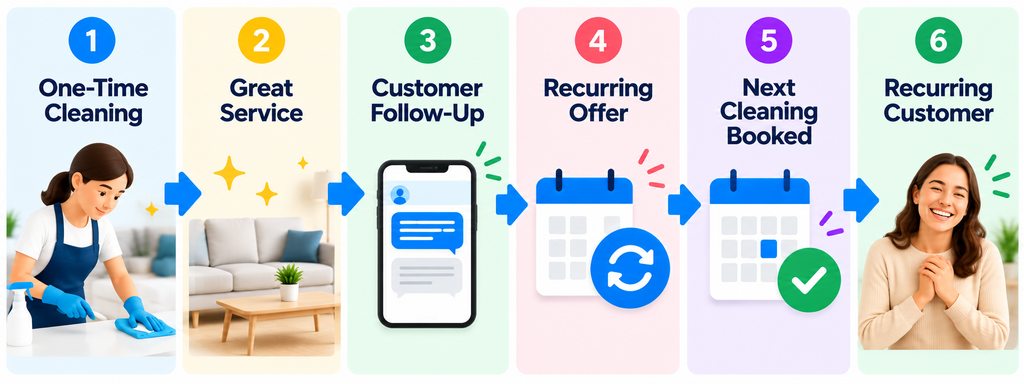
The strongest opportunity often comes after you have already demonstrated the quality of your service.
At that point, the customer does not have to decide whether they trust an unknown cleaning company. They have already experienced your work.
1. Identify Customers Who Are a Good Fit for Recurring Cleaning
Not every one-time customer needs recurring service.
A move-out cleaning customer, for example, may never need another cleaning at that property.
Focus your effort on customers who have a realistic ongoing need.
Good recurring-cleaning prospects may include:
- Busy families
- Working professionals
- Larger households
- Customers who already book cleaning regularly
- Older homeowners who need ongoing help
- Short-term rental operators
- Property managers
- Offices and commercial properties
The goal is not to pressure every customer into a recurring plan.
It is to recognize customers whose cleaning needs naturally repeat and make it easy for them to continue using your business.
2. Deliver a Strong First Cleaning
Recurring business starts with the quality of the first job.
Marketing can generate the lead and a professional quote can win the first booking, but neither will create a long-term customer if the cleaning experience is poor.
Before asking for another booking, make sure the fundamentals are right.
Focus on:
- Arriving when promised
- Following the agreed cleaning scope
- Completing the work consistently
- Communicating professionally
- Respecting the customer’s property
- Handling problems quickly
- Making payment simple
A consistent checklist can help your team deliver the same standard across different cleaners and appointments.
Use our professional house cleaning checklist as a starting point for building a repeatable cleaning process.
3. Follow Up After the First Cleaning
Do not assume a satisfied customer will automatically contact you again.
Follow up after the cleaning.
The message does not need to be complicated.
You can confirm that the customer was satisfied, address any concerns, and remind them that recurring service is available.
Example follow-up:
Hi Sarah,
Thanks for choosing us for your cleaning today.
We hope everything looks great. If there is anything we can improve, please let us know.
If you’d like to keep the home maintained, we also offer weekly, biweekly, and monthly recurring cleaning.
Just reply and we’ll help you choose a schedule.
The purpose is not to send an aggressive sales message immediately after the job.
It is to create a natural next step while the cleaning experience is still fresh.
4. Give Customers Simple Recurring Options
Do not make customers design their own cleaning schedule from scratch.
Offer a small number of understandable choices.
Common recurring cleaning options:
Weekly — cleaning every week
Biweekly — cleaning every two weeks
Monthly — cleaning approximately once per month
You can still customize schedules when necessary, but simple default options make the decision easier.
For many residential cleaning businesses, frequency can also affect the amount of work required during each visit.
A home cleaned every week may require a different amount of time than the same home cleaned only occasionally.
Make sure your recurring pricing reflects the actual labor and costs involved.
Our house cleaning pricing guide and calculator can help you work through your costs and target margin.
5. Explain the Value of Recurring Cleaning
Do not rely only on a discount to sell recurring service.
Customers may value recurring cleaning for several reasons beyond price.
Recurring cleaning can offer customers:
- A consistently cleaner home
- Less time spent arranging each appointment
- A predictable cleaning schedule
- Fewer large cleaning sessions
- Familiarity with the cleaning company
- Easier ongoing home maintenance
Your sales message should focus on the convenience and consistency that matter to the customer.
Price can be part of the offer, but it does not have to be the only reason to continue.
6. Decide Whether to Offer Recurring-Customer Pricing
Some cleaning businesses use different pricing for recurring service.
That can make sense when repeat visits are more predictable or efficient.
But do not create a discount simply because you think every recurring customer expects one.
First understand your costs.
For example, compare:
One-time cleaning
vs.
Weekly cleaning
vs.
Biweekly cleaning
vs.
Monthly cleaning
Consider how labor time, travel, supplies, overhead, and frequency affect each service.
A recurring price still needs to produce an acceptable margin.
Use the cleaning business profit margin calculator to test the economics before setting recurring prices.
7. Make Rebooking Easy
Every extra step between “yes” and the next scheduled cleaning creates unnecessary friction.
Once a customer chooses recurring service, establish the schedule immediately when possible.
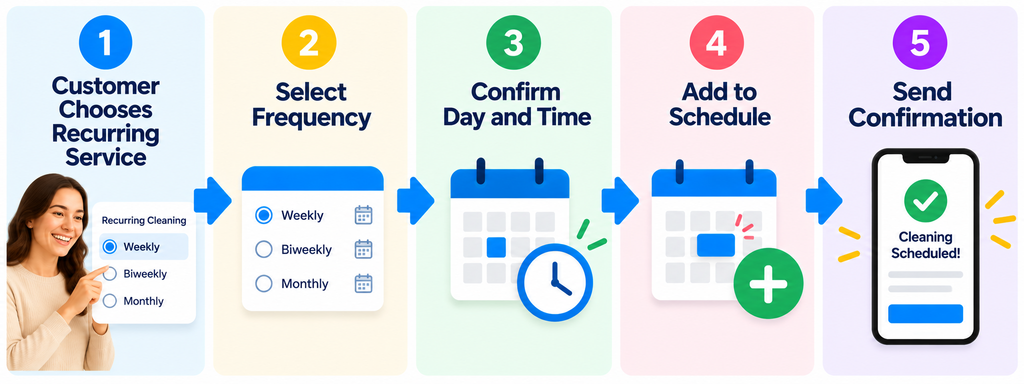
The customer should understand:
- How often you will clean
- The normal service day
- Expected arrival time or window
- What happens if the schedule changes
- How cancellations are handled
- How payment works
As recurring volume grows, managing these appointments manually becomes harder.
Our cleaning business scheduling guide explains how to organize recurring and one-time jobs together.
8. Keep the Schedule Consistent
Consistency matters for recurring customers.
When possible, give customers a predictable service day and arrival window.
For example, a customer may know that their cleaning is scheduled every other Tuesday morning.
That is easier to remember than receiving a different day and time for every appointment.
A stable recurring schedule can also help the business plan cleaner availability and identify remaining capacity for one-time jobs.
This does not mean schedules will never change.
Employees call out, customers reschedule, holidays occur, and unexpected delays happen.
The important part is having a process for communicating those changes clearly.
9. Maintain Service Quality Over Time
Winning a recurring customer is only the beginning.
The business still needs to earn the next booking.
One common risk is allowing service quality to become less consistent after a customer has been with the business for several months.
Create a simple quality-control process.
Quality checks might include:
- Using a consistent cleaning checklist
- Recording customer preferences
- Reviewing customer complaints
- Following up after service problems
- Checking work periodically
- Training cleaners on recurring customer expectations
If a customer has a specific preference, do not make them explain it again at every visit.
Record useful information so the cleaner or crew can see it before the job.
10. Track Why Recurring Customers Cancel
Some cancellations are unavoidable.
Customers move, financial situations change, or they no longer need professional cleaning.
But repeated cancellations for the same reason may reveal a business problem.
Track why recurring service ends.
Possible cancellation reasons:
- Price
- Service quality
- Scheduling problems
- Communication issues
- Customer moved
- Customer no longer needs cleaning
- Switched to another provider
- Unknown
Do not treat every cancellation as proof that your pricing is too high.
Look for patterns over time.
If many customers mention inconsistent service, that points to a different problem than customers leaving because they moved out of your service area.
11. Track Your Recurring Customer Rate
You should know whether your process is actually turning customers into recurring clients.
One simple metric is:
Recurring Customer Conversion Rate
=
New Recurring Customers ÷ Eligible One-Time Customers × 100
Example:
20 eligible one-time customers
8 become recurring customers
8 ÷ 20 × 100 = 40%
This does not need to become a complicated reporting system.
The purpose is to establish a baseline.
If you improve your follow-up process, recurring offer, or scheduling experience, you can then see whether the percentage changes.
12. Measure Customer Retention Too
Conversion into recurring service is only one part of the picture.
You also want customers to stay.
A business that signs many recurring customers but loses them quickly may have a retention problem.
Track indicators such as:
- Active recurring customers
- New recurring customers
- Recurring customers lost
- Average length of customer relationship
- Recurring revenue
- Cancellation reasons
These numbers can help you distinguish between a customer-acquisition problem and a customer-retention problem.
Use Customer Information to Improve Retention
As your customer base grows, it becomes difficult to remember every customer’s preferences, history, follow-ups, and upcoming jobs.
A CRM or cleaning business management platform can help keep this information together.
For example, you may want to track:
- Customer contact information
- Cleaning history
- Quotes
- Recurring schedule
- Property notes
- Customer preferences
- Follow-up status
- Invoices and payments
See our comparison of the best CRM software for cleaning businesses if customer information is becoming difficult to manage manually.
You can also compare the best cleaning business software if you want scheduling, quoting, invoicing, and customer management in the same system.
A Simple Recurring Customer System
You do not need a complicated retention program.
Start with a process your team can actually follow.
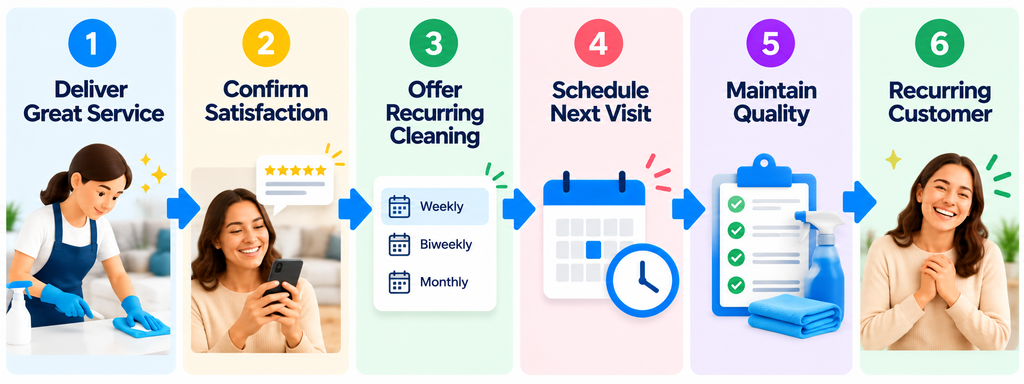
If that process happens consistently, recurring customer growth becomes part of your normal operation rather than something you remember to do occasionally.
Final Take
Recurring cleaning clients can make a cleaning business more predictable.
Instead of starting from zero every week, you have customers already scheduled for future service.
The process starts with a strong first cleaning. Follow up while the experience is fresh, offer simple recurring options, make rebooking easy, keep the schedule consistent, and maintain service quality over time.
Then track what happens.
Measure how many eligible one-time customers become recurring clients and why recurring customers eventually leave.
If you need more customers at the top of the funnel, start with our cleaning business marketing plan.
Then use our cleaning business quote guide and cleaning business scheduling guide to connect those leads to booked and recurring work.