
Running a cleaning business involves more than buying cleaning supplies and paying cleaners.
Your business may also have vehicle costs, insurance, marketing expenses, software subscriptions, payment processing fees, equipment costs, and other overhead.
If you do not track these expenses consistently, it becomes difficult to know whether your prices are actually producing a healthy profit.
This guide breaks down the main cleaning business expenses to track and shows how those costs connect to pricing and profitability.
Why Tracking Cleaning Business Expenses Matters
Revenue tells you how much money comes into the business.
It does not tell you how much you actually keep.
A cleaning company can generate strong sales while still producing weak profits if labor, travel, supplies, or overhead are too high.
Tracking expenses helps you:
- Understand the real cost of completing cleaning jobs
- Set prices based on actual business costs
- Identify expenses that are increasing
- Compare revenue with operating costs
- Estimate profit margins more accurately
- Make better decisions about hiring and growth
Your goal is not necessarily to minimize every expense.
Some expenses help you deliver better service, save time, or grow the business.
The important part is knowing what you are spending and why.
The Main Types of Cleaning Business Expenses
Cleaning business expenses can generally be organized into several categories.
A practical expense structure might include:
- Labor
- Cleaning supplies
- Equipment
- Vehicles and transportation
- Insurance
- Marketing
- Software
- Payment processing
- Office and administrative costs
- Professional services
- Training and hiring
- Other overhead
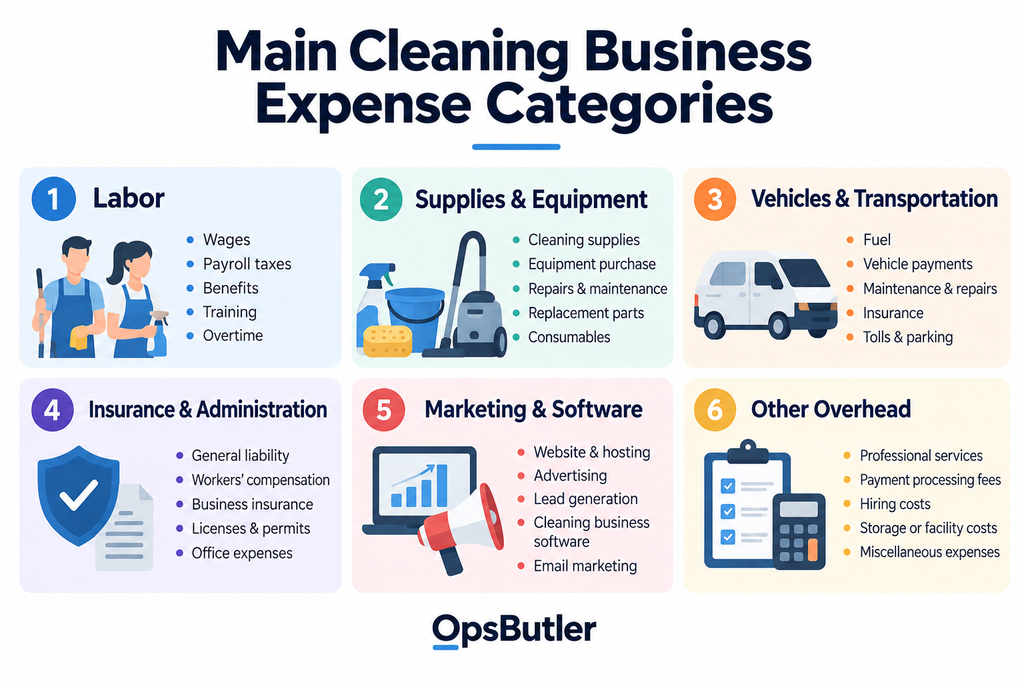
The exact mix will depend on your business model.
A solo residential cleaner may have a relatively simple cost structure, while a cleaning company with multiple crews, vehicles, and commercial accounts may have significantly more expenses to manage.
1. Labor Costs
For many cleaning businesses, labor is one of the largest expenses.
Labor costs can include more than the hourly wage paid to cleaners.
Depending on how your business operates and the requirements in your location, costs may include:
- Employee wages
- Overtime
- Payroll taxes
- Employer contributions
- Workers’ compensation
- Paid time off
- Bonuses or incentives
- Payroll processing fees
- Employee benefits
- Training time
You should also consider non-billable labor time.
For example, cleaners may spend time:
- Driving between jobs
- Loading supplies
- Attending meetings
- Completing training
- Handling administrative tasks
If you only compare customer revenue with the hours physically spent cleaning, you may underestimate your true labor cost.
2. Cleaning Supplies
Cleaning supplies are usually a recurring operating expense.
Common examples include:
- All-purpose cleaner
- Disinfectants
- Glass cleaner
- Bathroom cleaner
- Degreasers
- Floor-cleaning products
- Microfiber cloths
- Sponges
- Scrub pads
- Trash bags
- Gloves
- Paper products
Track how much you spend over time rather than guessing at a fixed amount per job.
If supply costs increase, your pricing may eventually need to change too.
You may also want to separate supplies used directly on customer jobs from general business supplies.
3. Cleaning Equipment
Equipment is different from disposable supplies because it may be used across many jobs.
Examples include:
- Vacuum cleaners
- Carpet-cleaning machines
- Mops and buckets
- Steam cleaners
- Floor machines
- Extension poles
- Carts
- Ladders
- Storage containers
Do not think only about the initial purchase price.
Equipment may also create ongoing expenses for:
- Repairs
- Replacement parts
- Filters
- Batteries
- Maintenance
- Replacement equipment
A $500 machine that lasts several years affects your business differently from $500 of disposable supplies used quickly.
Keeping equipment purchases separate can make your expense records easier to understand.
4. Vehicle and Transportation Costs
Cleaning businesses often travel directly to customer locations, which can make transportation a meaningful expense.
Possible costs include:
- Fuel
- Vehicle payments
- Vehicle leases
- Maintenance
- Repairs
- Tires
- Registration
- Parking
- Tolls
- Vehicle insurance
- Mileage reimbursements
Travel time also matters operationally.
Two jobs that generate the same revenue may not be equally profitable if one requires significantly more driving.
As your service area grows, monitor whether travel is increasing the cost of completing jobs.
5. Insurance
Insurance costs depend on your business, services, employees, vehicles, and location.
Possible insurance expenses may include:
- General liability insurance
- Workers’ compensation insurance
- Commercial auto insurance
- Property or equipment coverage
- Business owner’s policies
- Other coverage required for your operations
Do not treat insurance as an optional afterthought when calculating overhead.
Even when the cost is paid annually rather than monthly, it is still part of operating the business.
You can divide annual expenses into monthly amounts when estimating your normal overhead.
6. Marketing and Customer Acquisition
Finding new customers also costs money.
Marketing expenses may include:
- Website hosting
- Domain registration
- Website development
- Search advertising
- Social media advertising
- Local advertising
- Flyers
- Direct mail
- Business cards
- Referral incentives
- Lead-generation services
- SEO tools
- Email marketing software
The important question is not simply how much you spend on marketing.
You should also understand what that spending produces.
For example:
Customer Acquisition Cost = Marketing and Sales Spend ÷ New Customers Acquired
If you spend $1,000 and acquire 20 new customers:
$1,000 ÷ 20 = $50 per new customer
That number becomes more useful when you compare it with the revenue and profit those customers eventually generate.
For more ways to generate demand, see our Cleaning Business Marketing Plan and How to Get Clients for a Cleaning Business.
7. Cleaning Business Software
Software can become another recurring operating expense as the business grows.
Cleaning businesses may use software for:
- Scheduling
- Customer management
- Quotes and estimates
- Invoicing
- Payments
- Recurring jobs
- Team communication
- Time tracking
- Accounting
- Payroll
- Marketing
Do not subscribe to software simply because another cleaning business uses it.
The software should solve a real operational problem or save enough time to justify its cost.
If you are evaluating platforms, compare our Best Cleaning Business Software and Best Scheduling Software for Cleaning Businesses.
If Jobber is one of the platforms you are considering, our Jobber Review explains its features and where it may fit within a cleaning business.
8. Payment Processing Fees
Accepting card or online payments may create transaction fees.
Depending on your payment system, costs may include:
- Percentage-based processing fees
- Per-transaction fees
- Monthly account fees
- Chargeback fees
- Instant-transfer fees
- Hardware costs
These fees can appear small on an individual transaction but become meaningful as revenue grows.
For example, if your payment processing costs average 3% and you process $20,000 in customer payments:
$20,000 × 3% = $600
That is a real operating expense and should be included when reviewing profitability.
9. Office and Administrative Expenses
Even a home-based cleaning business may have administrative costs.
Examples include:
- Phone service
- Internet
- Printer supplies
- Postage
- Office supplies
- Business banking fees
- Storage
- Business licenses
- Permits
- Memberships
- Administrative software
Some expenses may be small individually.
Together, they can become a meaningful part of monthly overhead.
10. Professional Services
You may occasionally pay outside professionals to support the business.
Examples include:
- Accounting
- Bookkeeping
- Tax preparation
- Legal services
- Payroll services
- Business consulting
- Website development
- IT support
These costs may not occur every month, but they should still be tracked.
If you know an annual accounting or legal expense is likely, including it in your financial planning can prevent it from becoming an unexpected hit to cash flow.
11. Hiring and Training Costs
Adding cleaners creates costs before the new employee becomes fully productive.
Hiring expenses may include:
- Job board fees
- Recruiting advertising
- Background checks where legally permitted
- Onboarding materials
- Training time
- Uniforms
- Equipment
- Payroll setup
- Supervisor time
Employee turnover can make these expenses repeat more often.
A structured hiring and onboarding process can help you understand where recruiting money is being spent and whether new cleaners are staying.
See How to Hire Cleaners for Your Cleaning Business for the full process.
12. Other Cleaning Business Overhead
Every business has costs that do not fit neatly into one category.
Depending on your operation, other expenses may include:
- Storage units
- Warehouse space
- Office rent
- Uniforms
- Laundry
- Replacement keys
- Security systems
- Bank fees
- Financing costs
- Subscriptions
- Franchise fees
- Miscellaneous operating purchases
Avoid creating one enormous “miscellaneous” category.
If an expense occurs regularly or becomes significant, give it its own category so you can see where your money is going.
Fixed vs. Variable Cleaning Business Expenses
Another useful way to organize expenses is by whether they change with the amount of work you perform.
Fixed Expenses
Fixed expenses generally remain relatively stable even when job volume changes.
Examples may include:
- Software subscriptions
- Office rent
- Website hosting
- Certain insurance premiums
- Accounting subscriptions
Variable Expenses
Variable expenses tend to increase as you complete more jobs.
Examples may include:
- Cleaning supplies
- Some labor costs
- Fuel
- Payment processing fees
- Laundry
- Job-specific materials
Some expenses can contain both fixed and variable components.
The purpose of separating them is not to create perfect accounting categories. It is to understand what happens to your costs as your cleaning volume increases.
Direct Costs vs. Overhead
You can also separate expenses based on whether they are directly connected to completing a cleaning job.
Direct Costs
These are costs closely associated with delivering the service.
Examples include:
- Cleaner labor
- Cleaning supplies
- Job-specific materials
- Certain travel costs
Overhead
Overhead supports the overall business rather than one specific cleaning.
Examples include:
- Insurance
- Software
- Accounting
- Website costs
- Office expenses
- Administrative costs
Both matter when setting prices.
A price that covers labor and supplies but ignores overhead can still produce disappointing profits.
How to Calculate Your Monthly Cleaning Business Expenses
Start with a simple monthly expense list.
| Expense | Monthly Cost |
|---|---|
| Labor | $8,000 |
| Cleaning supplies | $700 |
| Vehicle and fuel | $900 |
| Insurance | $350 |
| Marketing | $600 |
| Software | $250 |
| Payment fees | $450 |
| Administrative costs | $300 |
| Other expenses | $450 |
| Total | $12,000 |
If the business generates $18,000 in monthly revenue:
$18,000 revenue − $12,000 expenses = $6,000 operating profit
That gives you a starting point for evaluating profitability.
For a more detailed calculation, use our Cleaning Business Profit Margin Calculator.
Do Not Confuse Startup Costs With Operating Expenses
Startup costs are the expenses required to get the business ready to operate.
Operating expenses are the costs that continue as you run the business.
For example:
Buying your first vacuum may be part of your startup budget.
Replacing filters, repairing equipment, buying supplies, paying employees, and maintaining insurance become ongoing operating costs.
If you are still planning your initial budget, see our complete guide to Cleaning Business Startup Costs.
Build a Simple Expense-Tracking System
You do not need an overly complicated financial system to start tracking expenses.
At minimum:
- Keep business and personal spending separate.
- Record expenses consistently.
- Assign each expense to a category.
- Keep receipts and supporting records.
- Review totals every month.
- Compare expenses with revenue.
- Watch for categories that are increasing.
- Revisit your pricing when costs materially change.
Accounting and tax requirements vary by location and business structure.
Use appropriate accounting or tax guidance for decisions about deductions, reporting, and recordkeeping.
Which Cleaning Business Expenses Should You Watch Most Closely?
Every expense deserves accurate tracking, but some categories can have a larger effect on profitability.
Pay particular attention to:
- Labor
- Travel
- Cleaning supplies
- Customer acquisition
- Payment processing
- Software subscriptions
- Insurance
- Recurring overhead
Small percentage changes in large expense categories can have a bigger financial impact than eliminating several tiny expenses.
The objective is not simply to cut costs.
It is to understand whether each major expense supports profitable operations.
Final Take
A cleaning business needs more than revenue to be financially healthy.
You need to understand what it costs to deliver each job and operate the company around those jobs.
Track labor, supplies, equipment, vehicles, insurance, marketing, software, payment fees, administrative costs, hiring expenses, and other overhead consistently.
Then compare those costs with your revenue and pricing.
Once you have reliable expense numbers, use our Cleaning Business Profit Margin Calculator to see what you are actually keeping.
You can also use our House Cleaning Pricing Guide and Calculator to check whether your prices support the margin you want.