
Many cleaning business owners know what they pay their cleaners per hour.
But an employee’s hourly wage is not necessarily the same as the employee’s true hourly cost to the business.
Payroll-related costs, workers’ compensation, benefits, paid time off, and other employee expenses can increase the amount you actually spend for every hour of labor.
That difference matters when you price jobs, calculate profit margins, and decide how many cleaners your business can afford to hire.
This guide explains how cleaning labor costs work and includes a free calculator to estimate your true hourly labor cost and labor cost per job.
What Is the True Labor Cost of a Cleaning Employee?
Suppose you pay a cleaner $20 per hour.
It may be tempting to calculate the labor cost of a four-hour job like this:
$20 hourly wage × 4 hours = $80 labor cost
But that calculation only includes the employee’s direct wage.
Depending on your business and location, you may also have employer-paid costs associated with that employee.
These can include:
- Employer payroll taxes
- Workers’ compensation insurance
- Benefits
- Paid time off
- Bonuses or incentives
- Other employee-related costs
The true labor cost is the total amount the business spends to employ that worker—not just the wage shown on the employee’s paycheck.
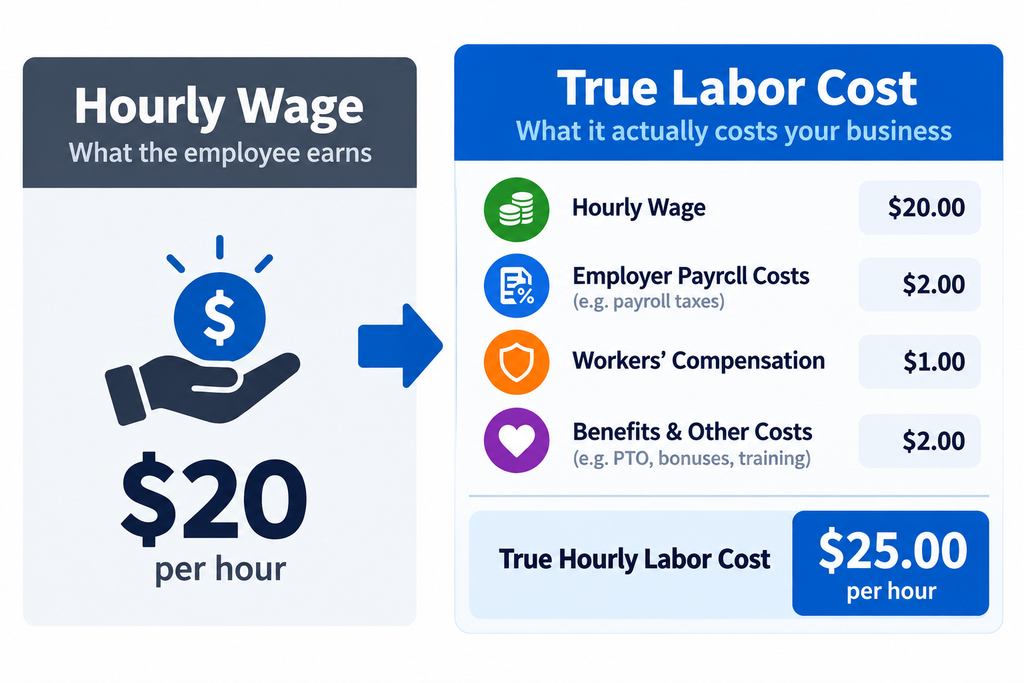
FIGURE 1 — HOURLY WAGE VS. TRUE LABOR COST
Why Labor Cost Matters in a Cleaning Business
Labor is often one of the most important costs to understand when running a cleaning company.
If you underestimate it, a job can look profitable when the actual margin is much smaller.
Accurate labor-cost estimates can help with:
- Pricing cleaning jobs
- Estimating job profitability
- Building labor budgets
- Comparing employees with subcontractors
- Planning hiring
- Setting revenue targets
- Calculating your break-even point
Labor should therefore be treated as part of your overall cost structure rather than viewed only as an hourly wage.
For a broader look at operating costs, see our Cleaning Business Expenses guide.
Free Cleaning Business Labor Cost Calculator
Use the calculator below to estimate the true hourly cost of a cleaner.
Enter:
- Hourly wage
- Employer payroll cost percentage
- Workers’ compensation percentage
- Benefits and other labor costs per hour
- Labor hours required for the job
The calculator will estimate:
- Base hourly wage
- Payroll-related cost per hour
- Workers’ compensation cost per hour
- Benefits and other costs per hour
- True hourly labor cost
- Labor cost per job
Cleaning Business Labor Cost Calculator
Calculate your true hourly labor cost and estimated labor cost per job.
This calculator is for planning purposes only. Actual employment costs vary by location, insurance, benefits, tax obligations, and other factors.
What this calculator is designed to answer:
“If I pay a cleaner a certain hourly wage, approximately how much does that employee actually cost my business per hour—and per job?”
The calculator is a planning tool. Actual employment costs vary based on your location, business structure, insurance, benefits, tax obligations, and other factors.
How to Calculate True Hourly Labor Cost
A simple way to estimate true labor cost is:
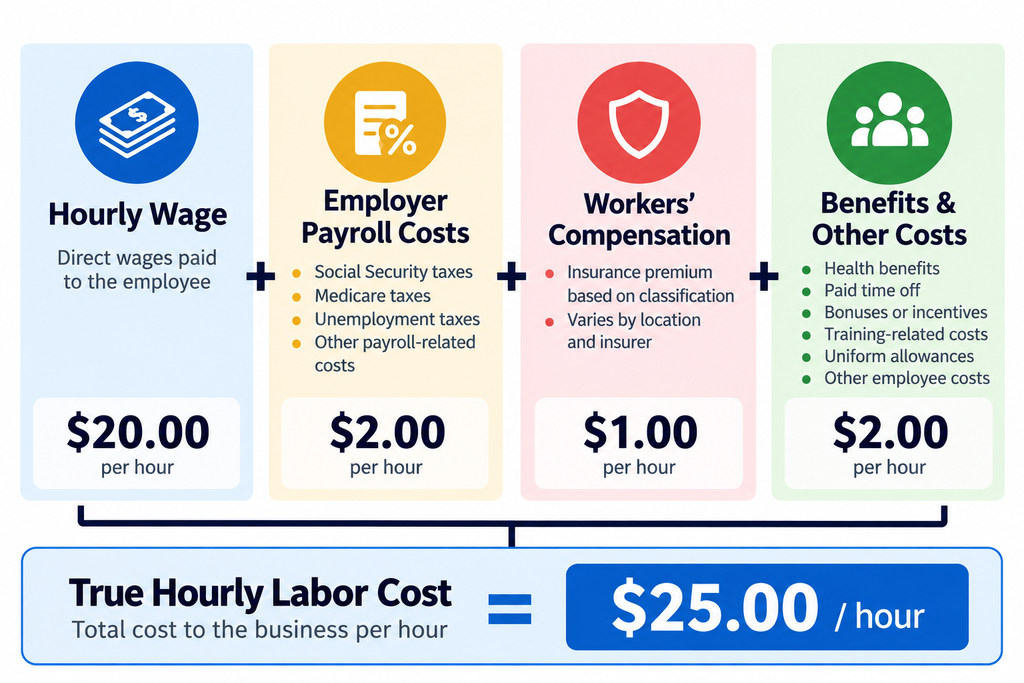
True Hourly Labor Cost = Hourly Wage + Payroll Costs + Workers’ Comp + Benefits and Other Hourly Labor Costs
If payroll costs and workers’ compensation are entered as percentages of wages, those amounts can first be converted into hourly costs.
For example:
Hourly wage = $20
Employer payroll costs = 10%
Workers’ compensation = 5%
Benefits and other labor costs = $2 per hour
First calculate payroll costs:
$20 × 10% = $2.00
Then workers’ compensation:
$20 × 5% = $1.00
Then add the hourly costs:
$20 + $2 + $1 + $2 = $25
The estimated true hourly labor cost is:
$25 per hour
That is $5 more than the employee’s $20 hourly wage.
Hourly Wage Is Only the Starting Point
The wage rate is the easiest labor cost to see.
If an employee earns $20 per hour, the direct wage cost for one paid hour is $20.
But business owners should avoid using the wage rate alone when estimating the cost of delivering a cleaning service.
The additional employment costs may be smaller or larger depending on the company.
That is why two cleaning businesses paying the same wage can still have different true labor costs.
FIGURE 2 — WHAT CAN MAKE UP TRUE LABOR COST
Employer Payroll Costs
Employers may have payroll-related obligations in addition to the employee’s wage.
The exact costs depend on where the business operates and the worker’s employment situation.
For planning purposes, the calculator lets you enter employer payroll costs as a percentage of wages.
For example, if the hourly wage is $20 and the employer payroll cost assumption is 10%:
$20 × 10% = $2 per hour
The wage plus that payroll-cost assumption would therefore be:
$22 per hour
before adding other labor expenses.
Do not treat a generic percentage as a universal tax rate.
Use the actual costs that apply to your business when they are available.
Workers’ Compensation
Workers’ compensation can also contribute to the cost of employing cleaners.
Cleaning work may involve:
- Wet floors
- Lifting
- Repetitive movement
- Chemical exposure
- Equipment use
- Driving or travel between jobs
Your actual workers’ compensation cost can vary based on factors such as location, classification, payroll, insurer, and claims experience.
For calculator purposes, enter the percentage or cost that best reflects your business rather than assuming that every cleaning company pays the same rate.
Benefits and Other Labor Costs
Not every labor cost needs to be entered as a percentage.
Some costs can be easier to estimate as an additional hourly amount.
Depending on your company, these may include:
- Health or other employee benefits
- Paid time off
- Bonuses
- Training-related labor expense
- Uniform allowances
- Employee incentives
- Other employer-paid labor costs
If those costs average approximately $2 for every paid labor hour, you can add $2 to the hourly calculation.
The goal is not to make the estimate unnecessarily complicated.
The goal is to avoid pretending that the hourly wage represents every dollar spent on labor.
How to Calculate Labor Cost Per Cleaning Job
Once you know your estimated true hourly labor cost, you can calculate the labor cost of a job.
The basic formula is:
Labor Cost per Job = True Hourly Labor Cost × Total Labor Hours
Suppose your true hourly labor cost is $25.
A job requires four total labor hours.
$25 × 4 = $100
Estimated labor cost:
$100
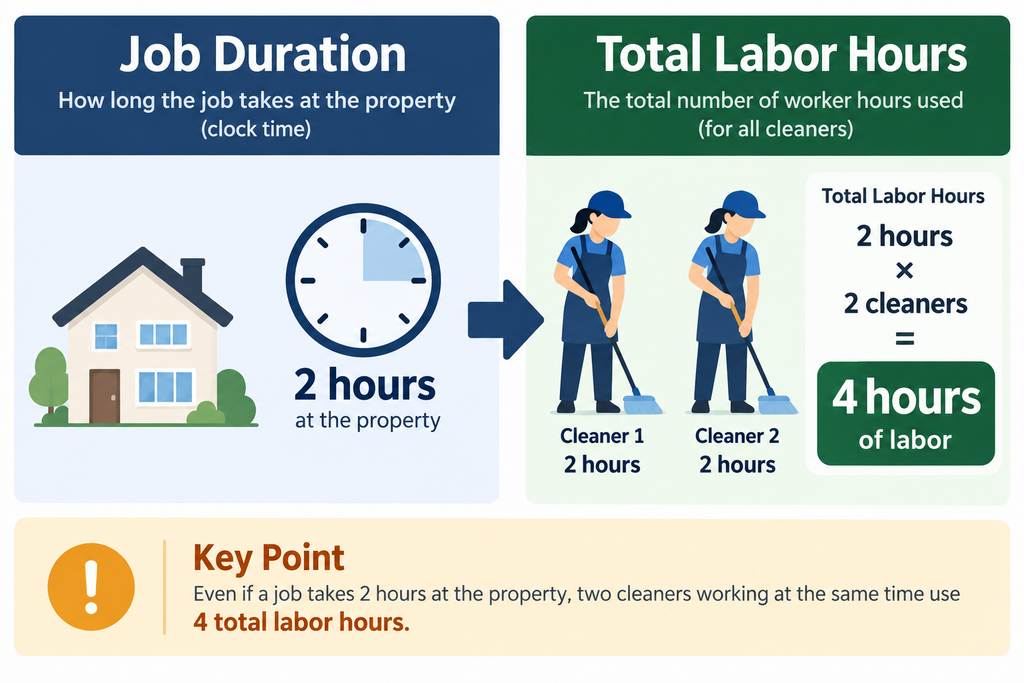
The important phrase here is total labor hours.
If two cleaners each work two hours on the same property, the job uses:
2 cleaners × 2 hours = 4 labor hours
The labor cost is still:
$25 × 4 = $100
This prevents a common mistake where businesses count the job duration but forget to account for multiple employees.
FIGURE 3 — JOB DURATION VS. TOTAL LABOR HOURS
Labor Cost Example: Two-Cleaner Team
Consider a residential cleaning job with these assumptions:
- Hourly wage: $20
- Employer payroll costs: 10%
- Workers’ compensation: 5%
- Benefits and other costs: $2 per hour
- Two cleaners
- Two hours at the property
From the earlier calculation:
True hourly labor cost = $25
Total labor hours:
2 cleaners × 2 hours = 4 labor hours
Labor cost for the job:
$25 × 4 = $100
Now suppose the customer pays $200.
Labor alone represents:
$100 ÷ $200 = 50%
of the job revenue.
But that does not mean the business made a 50% profit margin.
The company may still need to pay for supplies, software, insurance, marketing, transportation, payment processing, and other operating expenses.
That is why labor cost should be analyzed together with the rest of your expenses.
Labor Cost Percentage
Another useful metric is labor cost as a percentage of revenue.
The formula is:
Labor Cost Percentage = Labor Cost ÷ Revenue × 100
Using the previous example:
Labor cost = $100
Job revenue = $200
$100 ÷ $200 × 100 = 50%
Labor cost percentage:
50%
Tracking this percentage over time can help you see whether labor is consuming more or less of your revenue.
However, there is no single labor-cost percentage that is automatically correct for every cleaning company.
Your pricing, service type, efficiency, overhead, market, and business model all affect the number.
Labor Cost vs. Profit Margin
Labor cost percentage and profit margin are not the same thing.
A job can have a 50% labor cost and still have a much lower profit margin after other expenses are included.
For example:
Revenue = $200
Labor = $100
Other job and operating costs = $60
Remaining amount = $40
The simplified margin would be:
$40 ÷ $200 × 100 = 20%
This is why understanding labor is important—but labor should not be analyzed in isolation.
Use our Cleaning Business Profit Margin Calculator to estimate profit after accounting for broader costs.
How Labor Cost Affects Your Break-Even Point
Labor cost also affects the amount of revenue your cleaning business needs before it begins generating profit.
If labor costs rise while prices remain unchanged, your contribution margin can shrink.
That can increase the revenue needed to cover the rest of your operating costs.
For example, increasing wages may be necessary to attract or retain cleaners.
But the business should then understand whether pricing, productivity, or another part of the operation also needs to change.
Use our Cleaning Business Break-Even Calculator to estimate the revenue needed to cover your costs.
How Labor Cost Affects Cleaning Prices
Your prices need to support more than the cleaner’s hourly wage.
Suppose a job takes four labor hours.
If you price the job using only a $20 wage assumption, you might think labor costs $80.
But if the true labor cost is closer to $25 per hour:
$25 × 4 = $100
True labor cost: $100
Wage-only estimate: $80
Underestimated labor cost: $20
That $20 difference comes out of the money available to cover overhead and profit.
As the number of jobs grows, small pricing errors can become much larger.
For residential pricing, see How Much to Charge for House Cleaning.
For commercial work, see How to Price Commercial Cleaning Jobs.
Paid Hours vs. Billable Cleaning Hours
Another issue to consider is that not every paid hour necessarily produces customer revenue.
Employees may spend paid time on activities such as:
- Travel between jobs
- Loading supplies
- Team meetings
- Training
- Rework
- Administrative tasks
- Waiting between assignments
If a cleaner is paid for eight hours but only six hours are directly associated with billable cleaning work, pricing based only on those six hours may understate the cost of maintaining the employee.
This does not mean every non-cleaning minute should be billed directly to one customer.
It means the business needs enough revenue overall to support both productive and necessary non-billable labor.
Key distinction:
Paid hours = hours the business pays the employee.
Billable cleaning hours = labor hours directly associated with revenue-producing cleaning jobs.
Understanding the difference can make labor planning more accurate.
How to Reduce Labor Cost Without Simply Cutting Wages
Managing labor cost does not automatically mean paying cleaners less.
A cleaning business can also improve labor efficiency.
Examples include:
- Better scheduling
- More efficient routing
- Clear cleaning procedures
- Standardized checklists
- Better employee training
- Preparing supplies before jobs
- Reducing rework
- Matching staffing levels to job requirements
- Tracking estimated vs. actual job time
The training system you use can directly affect productivity.
See our Cleaning Business Training Checklist for a structured approach to onboarding and training new cleaners.
Better scheduling can also reduce wasted labor time between jobs.
See our Cleaning Business Scheduling guide for more.
Common Cleaning Labor Cost Mistakes
1. Using Hourly Wage as Total Labor Cost
A $20 wage does not necessarily mean the employee costs the business exactly $20 per hour.
Include the additional employer-paid costs that apply to your company.
2. Forgetting Total Team Hours
Two cleaners working two hours represent four labor hours—not two.
3. Ignoring Non-Billable Paid Time
Travel, training, meetings, and other paid activities can affect overall labor economics.
4. Using Generic Payroll Percentages Forever
Estimates are useful for planning, but replace assumptions with your actual business numbers when possible.
5. Looking at Labor Without Other Expenses
Labor may be a major cost, but it is not the only cost.
Supplies, insurance, software, marketing, vehicles, payment processing, and overhead still matter.
6. Failing to Update Labor Costs
Wages, insurance, benefits, and other employment expenses can change.
An old labor-cost assumption can lead to inaccurate pricing.
How Often Should You Review Labor Costs?
Review labor costs whenever a meaningful cost changes.
That may include:
- Wage increases
- Insurance changes
- New benefits
- Payroll-cost changes
- New hiring
- Major pricing changes
- Changes in average job duration
It is also useful to compare estimated labor hours with actual labor hours.
If a job is consistently estimated at three labor hours but regularly requires four, the issue may be pricing, training, job scope, scheduling, or productivity.
The important thing is to identify the gap rather than allowing the estimate to remain wrong.
Build Labor Cost Into Your Pricing System
Labor cost should not live in a separate spreadsheet that never affects your prices.
A stronger process is:
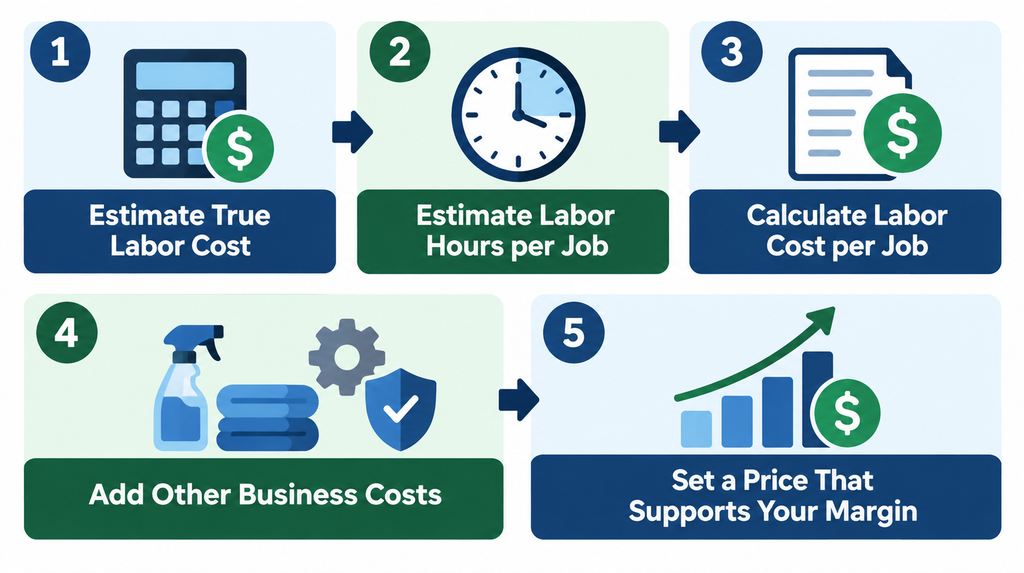
This connects employee costs directly to pricing and profitability.
Your labor assumptions can then be updated whenever wages or other employment costs change.
Final Take
The hourly wage you pay a cleaner is only the starting point for understanding labor cost.
Employer payroll costs, workers’ compensation, benefits, and other expenses can increase the true cost of every labor hour.
Start by estimating your true hourly labor cost.
Then multiply that amount by the total labor hours required for each job.
Compare the result with job revenue, other operating costs, and your target profit margin.
The better you understand what each labor hour actually costs, the easier it becomes to price jobs, plan hiring, and protect the profitability of your cleaning business.